

Yes, stannous fluoride can cause extrinsic tooth stains, but they sit on the tooth surface and usually come off with cleaning or polishing. This is nothing like dental fluorosis, which is permanent and forms inside the tooth. Modern stabilized formulas cut staining risk dramatically compared to older products, so check the label before assuming your toothpaste will discolor your smile.
TL;DR:
- Most extrinsic stains caused by stabilized stannous fluoride appear on the surface and can often be removed with regular cleaning or polishing.
- The staining risk is primarily a formulation issue, with stabilizers like STP, SHMP, and anhydrous bases significantly reducing discoloration.
- Well-formulated products with stabilized stannous fluoride show minimal staining within the first few weeks, especially when using proper brushing techniques.
- Adult use of stabilized stannous fluoride toothpaste cannot cause dental fluorosis, which only occurs during childhood tooth development.
- A nitrogen-enhanced whitening pen provides a quick, safe at-home option to remove surface stains caused by stannous fluoride or other extrinsic sources.
Table of Contents
- Does Stannous Fluoride Stain Teeth? What the Evidence Says
- How Toothpaste Formulation Changes Staining Risk
- How to Prevent and Remove Stannous Fluoride Stains
- Stannous Staining vs. Dental Fluorosis: How to Tell the Difference
- What to Look for on Toothpaste Labels
- What I’d Tell a Patient Weighing the Trade-Off
- Got a Surface Stain? Here’s the At-Home Fix
- Sources
Does Stannous Fluoride Stain Teeth? What the Evidence Says
Stannous fluoride (SnF2) has carried a stain reputation since the 1970s, and it’s not entirely undeserved. But the picture has changed. A systematic review of stabilized SnF2 dentifrice found it consistently reduces plaque, calculus, gingivitis, and halitosis, with a genuine tendency toward stain control in well-formulated products. The catch: the stain studies included in that review carried a high risk of bias, meaning the data is encouraging but not airtight.
Here’s why the staining happens at all. Tin is chemically reactive. Once it’s in your mouth, stannous ions oxidize and bind to the pellicle, the thin protein film that coats every tooth, and to sulfhydryl groups in that film. That reaction produces a discolored surface deposit, usually within the first few weeks of regular use.
- Stains typically appear on the tooth surface, not inside the enamel
- Onset is often noticeable within 2 to 4 weeks of daily use
- Severity depends heavily on formulation, not just tin concentration
- The deposits are removable with mechanical cleaning in nearly every documented case
A clinical proof-of-concept trial testing SnF2 paired with sodium tripolyphosphate found low stain build-up over a four-week period when the formula was properly stabilized. That single data point tells you the staining problem is largely a formulation problem, not an inherent property of tin fluoride chemistry.
How Toothpaste Formulation Changes Staining Risk
The stain risk in any stannous fluoride toothpaste comes down to how the tin is stabilized, not whether tin is present at all. Manufacturers have known this for years, and the fix involves a handful of specific ingredients you can actually spot on a label.
- Sodium hexametaphosphate (SHMP) and sodium tripolyphosphate (STP) bind free tin ions before they can oxidize and discolor the pellicle
- Zinc phosphate compounds serve a similar stabilizing role in some newer formulas
- Anhydrous formulations (no water in the base) slow the oxidation reaction that produces the golden-brown deposit in the first place
- RDA (Relative Dentin Abrasivity) levels affect how much daily brushing mechanically removes any stain that does form, though higher abrasivity trades off against enamel wear over time
Mechanistic reviews of SnF2 chemistry confirm that tin speciation, meaning how the tin ion behaves once it’s dissolved, is the real driver of discoloration. Stabilizers interrupt that process before it reaches the tooth surface. That’s also why some stabilized products still carry a stain warning on the box: it’s often a legacy disclosure held over from older, unstabilized SnF2 formulas, not a reflection of what the current formula actually does.
Pro Tip: Look for “stabilized stannous fluoride” plus a named anti-stain agent like STP on the ingredient list. If the label lists tin fluoride with no stabilizer named at all, treat it like an older-generation formula and watch for staining early.
How to Prevent and Remove Stannous Fluoride Stains
Prevention is mostly about mechanics, not switching products every time you see a hint of discoloration.
- Brush thoroughly, twice daily, using a soft or electric toothbrush that reaches the gumline, where deposits tend to concentrate first.
- Rinse and spit fully after brushing rather than letting paste residue sit on enamel longer than needed.
- If staining appears within a few weeks, try a different stabilized SnF2 formula before assuming you need to abandon stannous fluoride altogether.
- Book a professional cleaning if brushing alone doesn’t clear it. Prophylaxis and polishing remove extrinsic deposits in the overwhelming majority of cases, since the stain sits on the surface rather than inside the enamel structure.
- Consider at-home or in-clinic whitening once the surface is clean, if you want to go beyond your natural shade.
- Stop and call your dentist if you notice pitting, white flecks, or discoloration that doesn’t respond to cleaning. That pattern points away from a toothpaste issue entirely.
A randomized trial on stain control found that chemical anti-stain agents, not overall brushing abrasivity, were the dominant factor in keeping stain scores low. That’s useful to know before you assume a “whitening” or high-abrasion toothpaste will solve a stannous stain on its own. If you’d rather skip the trial-and-error, our guide on treating surface stains at home walks through the safest sequence.
Stannous Staining vs. Dental Fluorosis: How to Tell the Difference
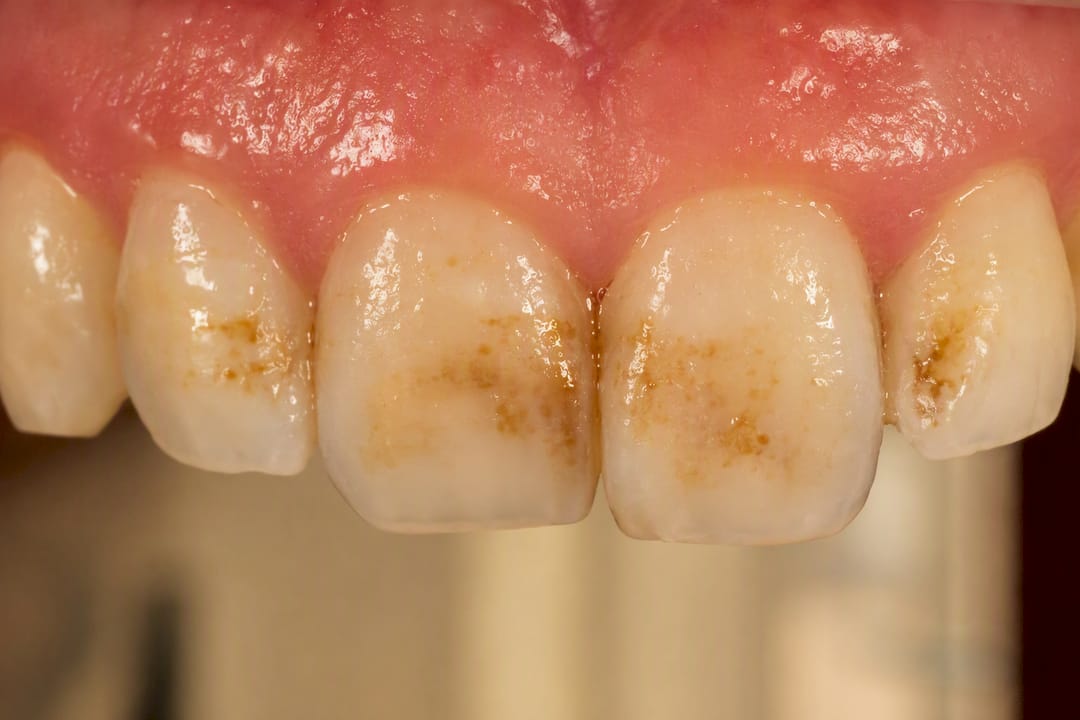
These two get confused constantly, and the confusion leads people to blame the wrong culprit. Extrinsic stannous stains show up as yellow, golden, or light brown deposits sitting on the enamel surface, and they can appear at any age, in anyone using the toothpaste.
Dental fluorosis looks different: white flecks or streaks, sometimes progressing to darker, pitted brown enamel. Critically, fluorosis only forms during tooth development, from birth through around age 8, when excess fluoride is ingested while adult teeth are still forming under the gums. An adult brushing with stannous fluoride toothpaste cannot develop fluorosis from that use.
- Extrinsic stain: removable with cleaning or polishing, appears at any age
- Fluorosis: permanent, intrinsic, tied to childhood fluoride exposure
- Fluorosis treatment often requires microabrasion or bleaching, sometimes restorative work for deeper pitting
- When in doubt, get a professional diagnosis before trying any at-home fix
What to Look for on Toothpaste Labels
A quick label check tells you most of what you need to know before you buy.
- “Stabilized stannous fluoride” on the front or ingredients panel
- STP or SHMP named specifically in the ingredient list
- “Anhydrous” formulation noted for pastes or gels marketed toward sensitivity
- RDA value disclosed, especially useful if you already have sensitive dentin or thinning enamel
- A stain warning alone isn’t disqualifying. Check whether the formula also names a stabilizer before writing it off
Pro Tip: If two products both contain stannous fluoride but only one lists a named anti-stain agent, that’s the one clinical trial data actually supports for lower staining risk.
What I’d Tell a Patient Weighing the Trade-Off
The old fear around stannous fluoride staining outlived the chemistry that caused it. Formulation work over the past two decades, particularly stabilizers like STP and anhydrous bases, has narrowed the gap between SnF2’s clinical benefits and its cosmetic downside to the point where most well-formulated products barely register a visible stain during normal use.
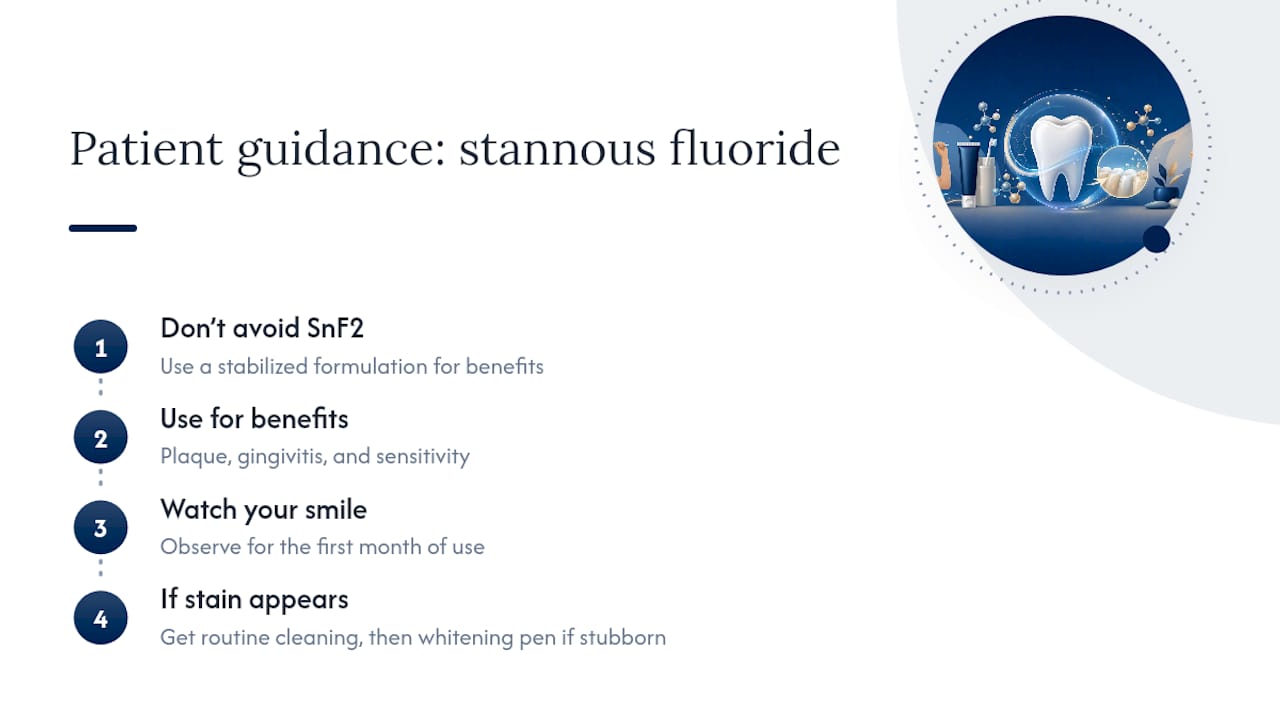
My take: don’t avoid stannous fluoride because of a reputation from decades-old formulas. Use a stabilized version for the plaque, gingivitis, and sensitivity benefits, watch your smile for the first month, and get a routine cleaning if anything shows up. If you’re left with a stubborn surface stain after that, an at-home whitening pen can handle the cosmetic side without touching the oral-health argument for sticking with stannous fluoride in the first place.
— Lenney
Got a Surface Stain? Here’s the At-Home Fix
If a stannous fluoride stain, coffee, wine, or just years of buildup has dulled your smile, you don’t need a $500 in-office visit to fix it. Getsmilefam’s Snow Serum™ Whitening Pen targets exactly this kind of surface discoloration, using an enamel-safe, hydrogen-peroxide-free formula built for sensitive gums, with visible results from a single session instead of weeks of gradual whitening trays.
It’s designed as a cosmetic fix, not a substitute for a dental exam, so if you’re unsure whether what you’re seeing is a removable surface stain or something else, check with your dentist first. Once you’ve confirmed it’s extrinsic staining, the pen is a fast, low-cost way to handle it yourself between cleanings. Order the Snow Serum™ Whitening Pen and use it right after your next brushing session to see the contrast for yourself.
Sources
- Dental fluorosis - StatPearls
- Effects of stabilized stannous fluoride dentifrice on dental calculus, dental plaque, gingivitis, halitosis and stain: A systematic review - PMC
- Stain control with two modified stannous fluoride/sodium tripolyphosphate toothpastes: A randomised controlled proof of concept study
- Stannous fluoride in toothpastes: review of clinical effects and mechanisms - MDPI