

Whitening with gum recession is often possible, but it isn’t automatic. Mild, stable recession usually allows whitening with the right precautions; active gum disease or inflamed tissue means you wait. The deciding factor is a clinical assessment, not a home test. The main risks to manage are heightened sensitivity, gum irritation from gel contact, and uneven shading near the gum line where root surfaces are exposed.
TL;DR:
- Whitening is generally possible with mild, stable gum recession when proper precautions like protective barriers are used during treatment.
- Exposed root surfaces absorb whitening gels faster, increasing sensitivity and uneven shading, especially if gels pool or contact the gums directly.
- In-clinic whitening with dentist supervision offers the most control, including real-time adjustments and protective barriers to minimize irritation.
- Pre-treatment steps such as stabilizing gum health and using desensitizing agents significantly improve comfort and safety during whitening.
- People with active gum disease, significant recession, or persistent pain should delay whitening until their gum condition improves.
Table of Contents
- Understanding Gum Recession and Why It Changes the Risk Equation
- How Whitening Agents Behave Differently on Roots vs. Enamel
- Which Whitening Methods Actually Work With Recession
- Preparing Your Gums Before You Whiten
- When You Should Not Whiten Yet
- What Results Really Look Like With Exposed Roots
- What Getsmilefam Recommends for Gum-Conscious Whitening
- Your Quick-Reference Checklist
- Why the “Just Skip Whitening” Advice Misses the Point
- A Gentler Path Forward With Getsmilefam
- Sources
Understanding Gum Recession and Why It Changes the Risk Equation
Gum recession happens when the gum tissue pulls back and exposes the root surface below the enamel line. That root surface is covered by cementum, a thin, softer layer sitting over dentin, and neither has the dense mineral structure that makes enamel so resistant to chemical exposure. Enamel is your protective shell. Once it’s gone, you’re dealing with different biology entirely.
Dentin is riddled with microscopic tubules that run straight to the nerve. When those tubules are exposed, hot, cold, and whitening agents all reach the nerve faster and trigger a sharper, quicker sensitivity response than intact enamel ever would. That’s the physical reason whitening feels different, sometimes painfully so, once recession sets in.
You don’t need a dental degree to spot early signs. Watch for:
- Teeth that look longer than they used to, especially near the gum line
- A visible notch or indentation where tooth meets gum
- Roots that appear a slightly darker or yellower shade than the crown
- New sensitivity to cold drinks or sweet foods that wasn’t there before
Recession is common enough that most adults will notice some degree of it by middle age, often from a mix of brushing habits, gum disease history, and grinding. That doesn’t mean whitening is off the table. It means the plan has to account for exposed dentin instead of ignoring it.
How Whitening Agents Behave Differently on Roots vs. Enamel
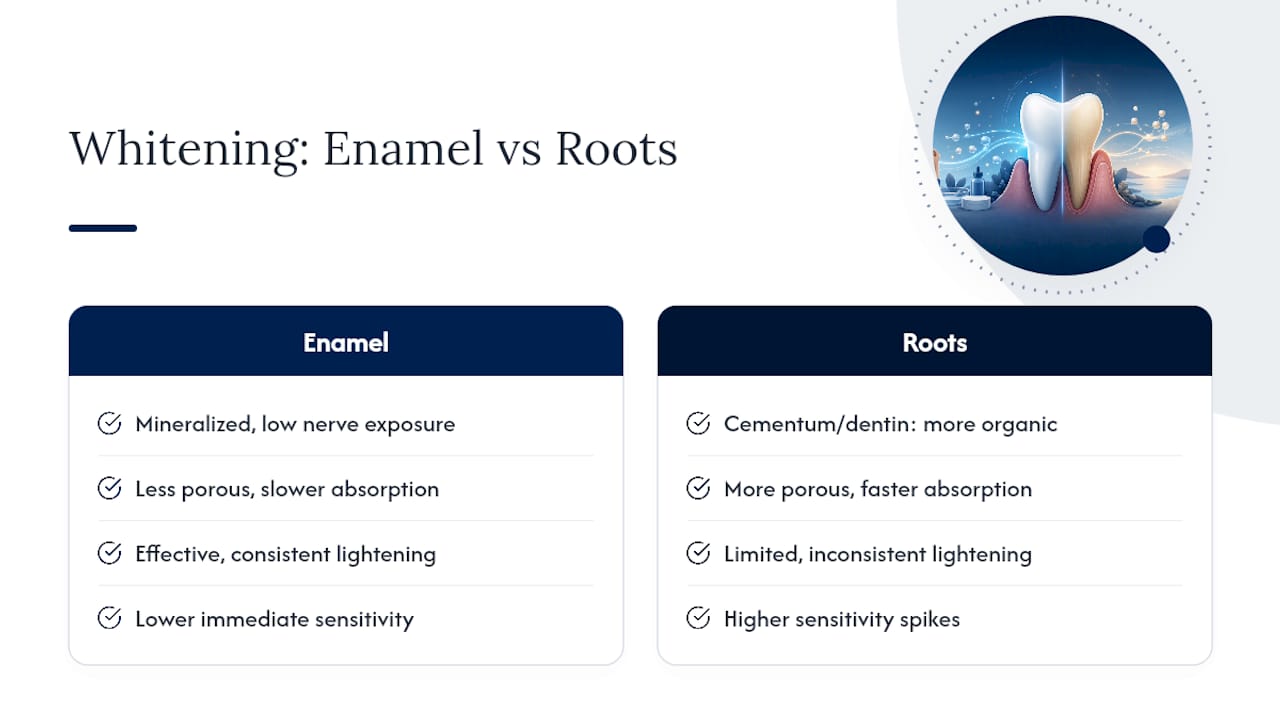
Whitening agents work by breaking down stain molecules trapped inside enamel’s porous structure, whether that’s a peroxide compound or a carboxamide-based formula. Enamel is built to handle that process. It’s mineralized, relatively low in nerve exposure, and designed to be the outer barrier.
Cementum and dentin don’t respond the same way. They’re softer, more organic in composition, and the whitening effect on them is limited and inconsistent, which is a major reason exposed roots often don’t lighten evenly with the crown above them.
The trade-off in plain terms: exposed root surfaces are more porous than enamel, so they absorb whatever gel touches them faster, and that faster absorption is exactly why sensitivity spikes so quickly for people with recession. Sources like NIDCR note that sensitivity and soft-tissue irritation are common, generally temporary side effects of whitening, but “temporary” still means uncomfortable in the moment, particularly on exposed dentin.
This is also why concentration matters so much. Clinic-strength gels work faster because they use higher percentages of active ingredient, but that speed comes with more direct chemical contact. Take-home formulas use lower concentrations over longer sessions, which spreads out the exposure and tends to be gentler on compromised gum tissue. Neither is automatically better. It depends on how much exposed root you’re dealing with and how your dentist wants to manage that trade-off.
Which Whitening Methods Actually Work With Recession
Not every whitening route carries the same risk, and the differences matter more once roots are exposed.
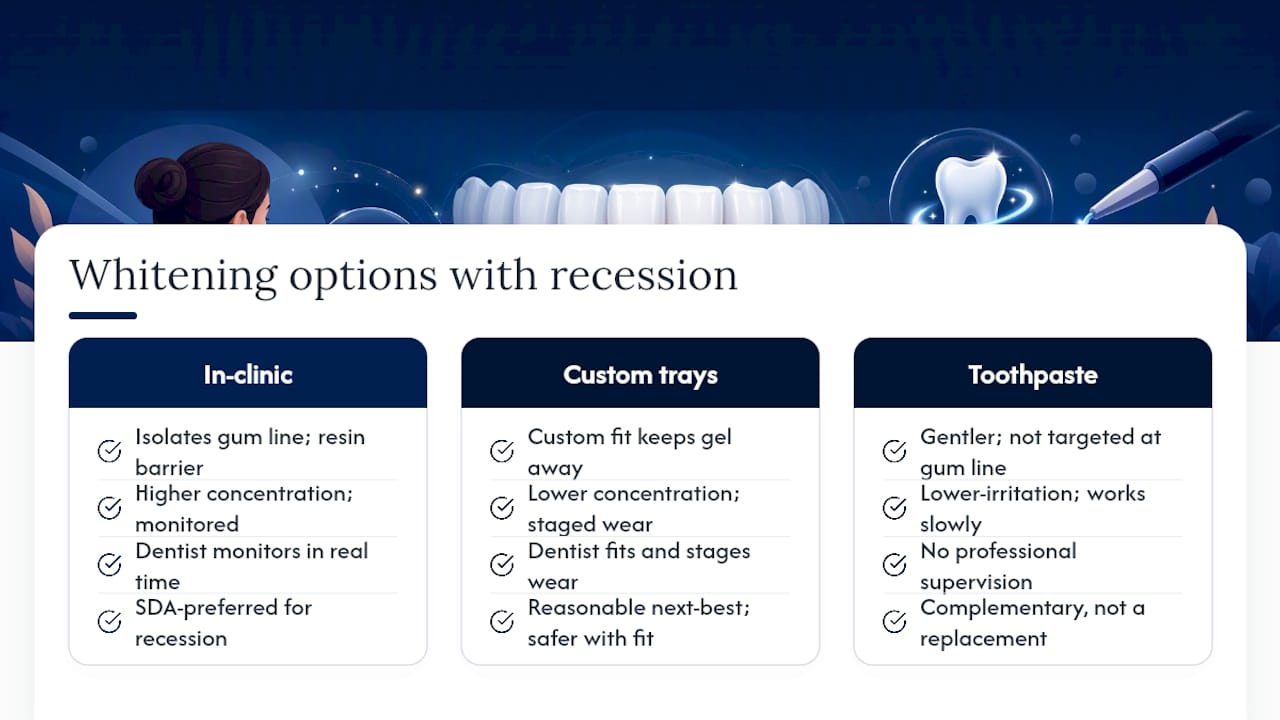
In-clinic whitening gives you the most control. Your dentist isolates the gum line, sometimes with a resin or protective barrier over exposed root surfaces, and monitors your reaction in real time. If sensitivity spikes, treatment adjusts on the spot. This is the Singapore Dental Association’s preferred setting for anyone with recession, precisely because it allows that kind of oversight.
Custom take-home trays come next. A dentist fits trays specifically to your mouth, which keeps the gel where it belongs instead of spreading toward the gum line. Concentrations are typically lower than in-office treatments, and wear time gets staged gradually so you’re not shocking exposed dentin all at once.
Lower-irritation at-home options, like enamel-safe whitening toothpaste, offer a gentler maintenance path, though they work slowly and won’t dramatically shift shade on their own. They’re a reasonable complement to a supervised protocol, not a replacement for one.
Generic strips and pens deserve real caution here. Without a custom fit, gel can pool right against the gum line and sit on already-exposed root surfaces longer than intended, which raises the odds of localized irritation. That doesn’t mean every pen or strip is dangerous, but if you have noticeable recession, precise placement stops being optional.
Pro Tip: Ask your dentist to check tray fit specifically at the gum margin, not just overall comfort. A tray that feels fine but gaps slightly at the gum line is often where irritation starts.
Preparing Your Gums Before You Whiten
Whitening safely with recession is less about the whitening step itself and more about what happens before it.
- Start with a clinical exam. Your dentist checks for active gum disease first. If there’s inflammation, bleeding, or periodontal pockets, that gets treated, sometimes with scaling or root planing, before whitening is even discussed.
- Begin a desensitizing regimen one to two weeks out. Sensodyne’s guidance points to potassium nitrate toothpaste or professional fluoride varnish as a way to partially block dentin tubules before treatment starts, which meaningfully improves how well you tolerate the process.
- Use protective barriers during treatment. This means resin or gel isolation over exposed roots, a well-fitted custom tray, and shorter wear sessions if sensitivity shows up early.
- Follow up afterward. Keep using desensitizing toothpaste for a few days post-treatment. If sensitivity lingers past a week or worsens instead of fading, that’s your cue to call your dentist rather than wait it out.
Pro Tip: If you know you’re sensitive, tell your dentist before the first session, not after. Pre-treatment adjustments are far easier than managing pain mid-protocol.
When You Should Not Whiten Yet
Some situations mean the answer is “not yet,” not “no.”
- Active periodontal disease. Bleeding gums, visible pockets, or tooth mobility mean whitening waits. Cleveland Clinic is clear that inflamed gum tissue reacts poorly to whitening chemicals, and treating the disease has to come first.
- Severe or actively progressing recession. If root exposure is extensive enough that barriers can’t reliably protect it, that’s a sign to address the recession itself before cosmetic treatment.
- Sharp, persistent pain after minimal exposure. Stop immediately and contact your dentist rather than pushing through.
Your dentist will typically check pocket depths, tooth mobility, and the condition of any existing fillings or crowns near the treatment area before clearing you to proceed.
What Results Really Look Like With Exposed Roots
Expect some unevenness. Because cementum and dentin don’t lighten the way enamel does, it’s common to see a temporary banding effect where the crown brightens noticeably but the area right at the gum line lags behind. This usually settles somewhat over time but rarely disappears completely on its own.
When recession is significant enough that whitening alone won’t deliver a satisfying result, other options exist:
- Composite bonding to even out shade and shape in specific spots
- Veneers for more comprehensive coverage when several teeth are affected
- Gum grafting when the recession itself is the primary cosmetic concern
Often the most practical path blends approaches: a desensitizing routine, a conservative whitening protocol, and small restorative touch-ups where root exposure won’t fully match the rest of the smile.
What Getsmilefam Recommends for Gum-Conscious Whitening
Getsmilefam builds its at-home products around the reality that a lot of people whitening their teeth are also managing sensitive or receding gums. The proprietary BLU Whitening Technology and the enamel-safe formula behind the Snow Serum™ Whitening Pen were developed to avoid harsh chemical loads like high-concentration hydrogen peroxide, which matters directly for anyone worried about gel sitting near exposed root surfaces.
That said, a product claim isn’t a substitute for a dental exam. If you have visible recession, tell your dentist before you start any at-home routine, and be honest about symptoms like sensitivity or bleeding.
A few resources worth reading first:
- LED whitening device safety for gums, for anyone considering LED-assisted treatment
- Gum-safe whitening explained, for the product-design reasoning behind lower-irritation formulas
- Sensitive gum whitening options, for a broader look at gentler routes
Your Quick-Reference Checklist
Before you start any whitening plan with recession, work through this:
- Get a clinical assessment before buying or trying anything
- Stabilize gum health and start a desensitizing routine first
- Choose custom trays or supervised protocols over generic strips or pens if roots are exposed
- Talk to your dentist about restorative alternatives if recession is significant
Why the “Just Skip Whitening” Advice Misses the Point
A lot of generic dental advice treats gum recession like a hard stop sign for whitening. That’s lazy, and it’s not what the evidence actually supports. Recession sits on a spectrum, and plenty of people with mild, stable recession whiten just fine once a dentist adjusts concentration, wear time, and protective barriers.
Where conventional advice really falls short is in treating sensitivity as an afterthought instead of the main event. Most people jump straight to picking a whitening product and only think about sensitivity if it shows up mid-treatment. That’s backwards. The pre-desensitizing window, one to two weeks with potassium nitrate or fluoride before you touch a whitening gel, does more to determine your comfort level than the brand of gel you choose.
If you take one thing from this: prioritize the clinical exam and the prep work over the product search. Get your gums assessed, get ahead of sensitivity, and only then decide between in-office care and a gentler at-home routine. Skipping straight to product comparisons is how people end up with irritation they could have avoided entirely.
— Lenney
A Gentler Path Forward With Getsmilefam
If your gums are receding or sensitive, you don’t need to choose between whitening and comfort. Getsmilefam built its at-home lineup, including the BLU Whitening Technology behind the Snow Serum™ Whitening Pen, specifically around enamel-safe, low-irritation formulas instead of the harsh peroxide concentrations that make exposed roots flare up.

That matters most for readers who’ve already been told by a dentist that their recession is mild and stable, since it means you can pursue visible results at home without gambling on a generic strip pooling gel against your gum line. Getsmilefam’s approach is also built for people managing broader sensitivity, which is why the gentle, sensitivity-aware product positioning for older or more sensitive users reflects the same philosophy across the product line.
Before you buy, disclose any gum recession or sensitivity history to your dentist, then take that information into a Getsmilefam product page to find the option built around avoiding harsh chemical exposure at the gum line.
This article is general information, not a substitute for advice from a qualified doctor. Consult a qualified healthcare professional about your own circumstances before acting on anything here.
Sources
- Singapore Dental Association: Tooth whitening / bleaching
- Sensodyne Singapore: How to help sensitive teeth after whitening
- Cleveland Clinic: Gum (periodontal) disease