

Gum-safe whitening is defined as any teeth whitening method that actively protects gum tissue from chemical irritation while still lightening tooth discoloration. The dental industry refers to this more broadly as “tissue-protective whitening,” and the two terms are used interchangeably throughout this article. Most people with stained or yellowish teeth want a brighter smile without the burning, redness, or sensitivity that poorly applied whitening products cause. The difference between a comfortable result and a painful one almost always comes down to formulation, concentration, and application technique. Getsmilefam builds its entire product line around this principle: effective whitening that does not compromise gum health.
What is gum-safe whitening and why does it matter?
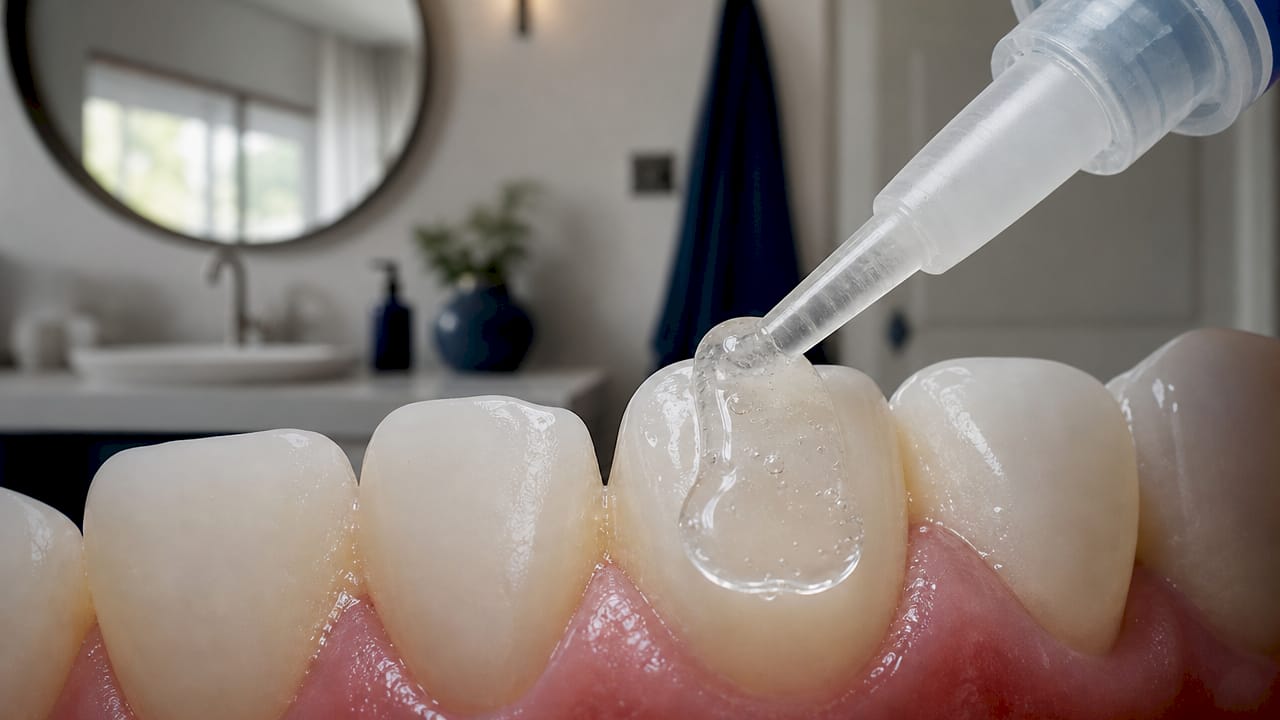
Gum-safe whitening matters because gum tissue is far more vulnerable to bleaching agents than tooth enamel. When whitening gel contacts soft tissue, it causes a chemical reaction that can produce redness, burning, or white patches on the gums. Gum irritation is a common side effect when whitening gel leaks onto gums, but proper technique prevents it entirely. That distinction is the foundation of every gum-friendly whitening approach.
The core goal of tissue-protective whitening is to keep the active bleaching ingredient on the tooth surface and away from the gumline. This requires three things working together: a safe ingredient concentration, a gel formula that stays where it is applied, and a delivery method that limits contact with soft tissue. When all three are present, whitening is both effective and gentle.
How does whitening gel irritate gums?
Traditional whitening products rely on hydrogen peroxide or carbamide peroxide to break apart stain molecules inside tooth enamel. Both agents are effective, but both also cause chemical burns on soft tissue when they reach the gums. Hydrogen peroxide concentrations above 15% in at-home products increase the risk of gum injury significantly. Higher concentrations amplify results on teeth but also amplify damage if the gel migrates.
Gel migration is the main mechanical problem. It happens in three ways:
- Leakage from ill-fitting trays. Generic trays do not conform to individual tooth shapes, leaving gaps where gel flows freely toward the gumline.
- Excessive gel volume. Applying more gel than the tray holds causes overflow onto soft tissue, which many people mistakenly believe produces faster results.
- Salivary dilution. Excessive salivary flow can cause whitening gels to pool on gums, spreading active ingredients to areas they should never reach.
People with pre-existing gum inflammation face a compounded risk. Micro-inflammation of gums dramatically increases sensitivity and chemical irritation during whitening, which is why gingival health must be confirmed before starting any treatment.
Pro Tip: Before your first whitening session, run your tongue along your gumline. If any area feels tender or bleeds easily when you brush, pause and see a dentist before applying any whitening product.
What ingredients make a whitening product gum-friendly?
The safest whitening products share a specific set of formulation characteristics. Knowing what to look for helps you choose products that protect your gums without sacrificing results.
Controlled bleaching agent concentration
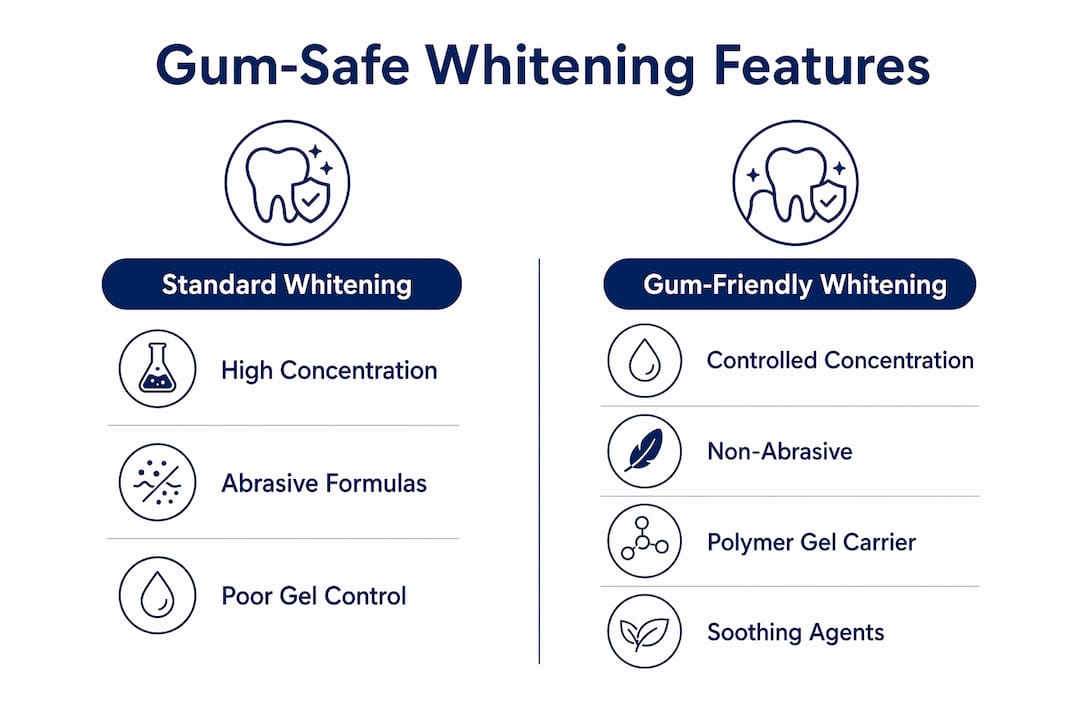
Safe whitening uses lower concentrations of active bleaching agents combined with controlled exposure time. At-home products that stay below the 15% hydrogen peroxide threshold reduce the chemical load on soft tissue without eliminating whitening effectiveness.
Non-abrasive, enamel-safe formulas
Many whitening products with abrasive agents damage enamel and irritate gums. Non-abrasive formulations lift surface stains through chemical action rather than physical scrubbing, which protects both enamel and the gum margin where enamel thins out. This is a core principle behind safe vs. harsh whitening product selection.
Polymer gel carriers
Polymer-based carriers like Carbopol control gel viscosity to prevent diffusion beyond the tooth surface to the gums. This is one of the most significant formulation advances in modern whitening. A thicker, more stable gel stays where it is placed rather than flowing toward soft tissue.
Nano-hydroxyapatite and natural soothing agents
Nano-hydroxyapatite strengthens enamel and reduces irritation by repairing micro-imperfections while gently lifting stains. Natural extracts like xylitol also soothe gum tissue during the whitening process. These ingredients are increasingly common in whitening toothpastes for gums and in remineralizing formulas designed for daily use.
Here is a quick comparison of formulation approaches by protection level:
| Feature | Standard whitening | Gum-friendly whitening |
|---|---|---|
| Bleaching agent concentration | Often above 15% | Controlled, at or below safe threshold |
| Gel viscosity | Low, prone to migration | High, polymer-stabilized |
| Abrasive content | Frequently present | Non-abrasive formula |
| Enamel repair ingredients | Rarely included | Nano-hydroxyapatite or fluoride |
| Gum soothing agents | Not standard | Xylitol, natural extracts |
How to whiten teeth safely while protecting your gums
Safe whitening for gums is not complicated, but it does require following a specific sequence. Skipping steps is where most people run into trouble.
-
Get a dental check-up first. Confirm that your gums are healthy before applying any whitening product. Pre-existing gum inflammation exacerbates whitening irritation, and treating active gum disease before whitening is non-negotiable.
-
Choose a custom or well-fitted tray. Custom trays with reservoirs minimize gel leakage by holding gel precisely over the tooth surface. Generic trays increase the chance of gel reaching the gumline.
-
Use the recommended amount of gel. More gel does not produce faster or better results. Overfilling a tray is the single most common cause of preventable gum irritation at home.
-
Control moisture during treatment. Dentists use cotton rolls or wicks to manage saliva during in-office sessions. At home, blotting excess saliva before inserting your tray reduces the risk of gel migration.
-
Stick to the recommended wear time. Leaving a whitening tray in longer than directed does not whiten faster. It increases the total chemical exposure to your gums and enamel.
-
Apply aftercare. After each session, rinse with water and consider a desensitizing product. Potassium nitrate helps manage discomfort after whitening and is found in many sensitivity-relief toothpastes. For more guidance on avoiding sensitivity during whitening, Getsmilefam covers this in detail.
Pro Tip: If you notice white spots on your gums immediately after removing a tray, that is blanching caused by gel contact. Rinse immediately with water. Blanching that fades within an hour is temporary. Blanching that persists or causes pain means your tray fit or gel volume needs adjustment.
Professional in-office whitening adds an extra layer of protection. Professional treatments use 35–40% hydrogen peroxide with rubber dams or painted resin to isolate gum tissue completely. The high concentration is safe precisely because the gums are shielded throughout the 60–90 minute procedure.
Common myths about gum-safe whitening
Several widespread beliefs lead people to damage their gums or waste money on ineffective products. Clearing these up protects both your gums and your results.
-
Myth: More gel means faster whitening. The active ingredient needs contact time with the tooth surface, not volume. Excess gel overflows onto gums and causes irritation without improving results.
-
Myth: Natural or DIY methods are always safer. Lemon juice, baking soda, and activated charcoal are frequently promoted as gentle alternatives. Lemon juice is acidic enough to erode enamel. Activated charcoal is abrasive and can scratch both enamel and gum tissue. “Natural” does not automatically mean safe for gums.
-
Myth: Whitening and stain removal are the same thing. Whitening changes the actual color of tooth enamel through a chemical process. Stain removal cleans surface deposits without altering enamel color. Many whitening toothpastes for gums primarily remove surface stains rather than bleach enamel, which is why managing expectations matters.
-
Myth: Sensitivity means permanent damage. Temporary sensitivity and minor gum blanching are normal responses linked to fluid movement in the tooth or mild irritation. Persistent discomfort that lasts beyond 48 hours warrants pausing treatment and switching to a gentler formula, but short-term sensitivity does not indicate lasting harm.
Key Takeaways
Gum-safe whitening works because it combines controlled bleaching agent concentrations, polymer-stabilized gel formulas, and precise application methods to protect soft tissue while effectively brightening teeth.
| Point | Details |
|---|---|
| Gel migration is the core risk | Ill-fitting trays, excess gel, and saliva all carry bleaching agents onto gum tissue. |
| Concentration matters | At-home products above 15% hydrogen peroxide significantly increase gum injury risk. |
| Polymer carriers improve safety | Carbopol and similar carriers stabilize gel viscosity and prevent diffusion to soft tissue. |
| Healthy gums are a prerequisite | Active gum inflammation must be treated before starting any whitening regimen. |
| Sensitivity is usually temporary | Blanching and mild discomfort fade within hours; persistent pain signals a need to stop. |
Why gum health is the part most people skip
People come to me focused entirely on shade. They want to know how many shades lighter they will get and how fast. Almost nobody asks about their gum health first, and that is the mistake that turns a straightforward whitening experience into a painful one.
I have seen people apply high-concentration gels with generic trays and then wonder why their gums are raw and sore for days. The product was not the problem. The application was. The same ingredient at the same concentration, delivered with a well-fitted tray and the correct gel volume, would have been fine.
The other thing I keep coming back to is the DIY trend. Activated charcoal and oil pulling get promoted as the gentle, natural path to whiter teeth. Charcoal is physically abrasive. It does not distinguish between stain deposits and enamel. Over time, it thins enamel and exposes the gum margin to more damage, not less. If you want whitening methods for sensitive teeth that actually hold up to scrutiny, look for products built on non-abrasive chemistry and polymer-controlled delivery.
The bottom line is this: a brighter smile is sustainable only when your gums are healthy enough to support it. Whitening and gum care are not competing priorities. They are the same priority.
— Lenney
Getsmilefam’s approach to whitening that works gently
Getsmilefam designs its whitening products around the same principles covered in this article: controlled formulations, non-abrasive ingredients, and gum-protective delivery. The BLU Teeth Whitening Kit uses BLU Whitening Technology developed in Singapore, with lab-approved ingredients and no harsh hydrogen peroxide, making it suitable for people with sensitive gums.
For daily maintenance, the BLU Whitening Toothpaste keeps surface stains from rebuilding between sessions without abrasive agents that wear down enamel or irritate the gumline. Both products are built for people who want real results without trading their gum health to get them. For additional guidance on cosmetic safety and post-whitening care, cosmetic safety tips for women 40+ offers practical strategies for managing sensitivity after whitening sessions.
FAQ
What is gum-safe whitening in simple terms?
Gum-safe whitening is a teeth whitening approach that uses controlled ingredient concentrations, stable gel formulas, and precise application to brighten teeth without irritating or burning gum tissue.
Is gum-safe whitening as effective as regular whitening?
Yes. Gum-friendly whitening achieves comparable results by using the correct concentration of bleaching agent with a polymer-stabilized gel that stays on the tooth surface rather than migrating to soft tissue.
Can I whiten my teeth if I have sensitive gums?
You can whiten with sensitive gums, but a dental check-up first is required. Pre-existing gum inflammation significantly increases the risk of chemical burns, so gingival health must be confirmed before starting any whitening regimen.
How do I know if a whitening product is safe for my gums?
Look for non-abrasive formulas, bleaching agent concentrations at or below 15% for at-home use, polymer gel carriers for viscosity control, and added enamel-repair ingredients like nano-hydroxyapatite or fluoride.
What should I do if my gums hurt after whitening?
Rinse immediately with water, stop the treatment session, and apply a desensitizing product containing potassium nitrate. If discomfort persists beyond 48 hours, pause the regimen and consult a dentist before continuing.