

A safe whitening formula is a peroxide-based product formulated at controlled concentrations to whiten teeth effectively without causing enamel erosion, tooth sensitivity, or gum irritation. The term “safe whitening formula” is the consumer-facing phrase for what dental science calls a regulated low-concentration bleaching agent, typically hydrogen peroxide or carbamide peroxide within clinically validated thresholds. Understanding the difference between a formula that whitens safely and one that simply claims to is the most practical thing you can do before buying any whitening product. Brands like Getsmilefam, Crest, and regulatory bodies including the FDA and ADA have each established benchmarks that define where safety begins and ends.
What active ingredients define a safe whitening formula?
The two primary whitening agents in any evidence-backed formula are hydrogen peroxide and carbamide peroxide. Safe at-home formulas typically contain 3% hydrogen peroxide or 10% carbamide peroxide, concentrations the FDA and ADA support for unsupervised consumer use without significantly increasing enamel erosion risk. These numbers are not arbitrary. They represent the threshold at which whitening efficacy and biological safety intersect.
Carbamide peroxide works differently from hydrogen peroxide in one important way. It breaks down into hydrogen peroxide and urea, releasing the active bleaching agent gradually over time. This sustained release makes carbamide peroxide particularly well suited for overnight tray use, where extended wear time is part of the design rather than a risk factor.
Non-peroxide alternatives have grown popular in recent years, but the science behind them is less settled. Products containing activated charcoal, for example, carry a documented risk. A scientific review found that activated charcoal causes enamel abrasion and surface changes that can weaken teeth over time. PAP (phthalimidoperoxycaproic acid) is a newer non-peroxide agent with a more favorable early safety profile, though long-term clinical data remains limited compared to peroxide research spanning decades.
Here is how the main whitening agents compare at a glance:
| Agent | Typical concentration | Mechanism | Key safety consideration |
|---|---|---|---|
| Hydrogen peroxide | 3% (OTC) | Direct oxidation of stain molecules | Fast-acting; higher sensitivity risk at elevated doses |
| Carbamide peroxide | 10% (OTC) | Breaks down to H2O2 + urea | Slower release; gentler for overnight use |
| PAP | Varies | Oxidation without free radicals | Promising early data; limited long-term studies |
| Activated charcoal | Varies | Mechanical abrasion | Enamel abrasion risk; not recommended by ADA |
The core reason why safe whitening ingredients are chosen at low concentrations is straightforward. Higher peroxide concentration and longer contact times increase whitening speed but also increase sensitivity and soft tissue irritation. The goal of a well-designed formula is to deliver meaningful whitening at the lowest effective dose.
How do delivery methods affect the safety of whitening products?
The formula itself is only part of the equation. How a product delivers peroxide to your teeth determines how much of that peroxide reaches enamel versus gum tissue, and for how long. This is why two products with identical peroxide concentrations can produce very different safety outcomes.
Whitening strips, custom trays, gels, and pens each have distinct contact profiles. Strips conform closely to tooth surfaces and limit gum exposure when applied correctly. Custom trays, fitted by a dentist, offer the most precise control over peroxide placement. Over-the-counter trays tend to be less precise, which increases the chance of gel overflow onto soft tissue. Whitening pens apply a thin layer of gel directly to teeth, making them convenient but dependent on the user’s application technique.
Formulation technology plays an equally important role. Polymer-based carriers like PVP and Carbopol stabilize peroxide, improve adhesion to tooth surfaces, and provide controlled release. This means the active ingredient works where it should, for the right amount of time, rather than dissipating quickly or pooling near the gumline.
Several additives in the ingredients in whitening products list also directly reduce adverse reactions:
- Potassium nitrate works by neural desensitization. Clinical evidence shows it lowers tooth sensitivity without substantially blocking whitening effects, making it a standard inclusion in sensitivity-conscious formulas.
- Fluoride strengthens enamel and helps counteract any mineral loss that occurs during the bleaching process.
- Adjusted pH levels reduce the acidity of the formula, which lowers the risk of enamel softening during contact.
A 2026 randomized controlled trial confirmed that 3% hydrogen peroxide strips effectively whiten extrinsic stains with adverse events statistically similar to placebo. That finding matters because it validates the low-concentration strip format as both effective and genuinely safe, not just marketed as safe.
Pro Tip: If you experience sensitivity after whitening, do not increase the product strength to compensate. Sensitivity-prone users benefit from a stepped-down wear time protocol rather than escalating concentration after adverse reactions begin.
What are the risks of unsafe whitening formulas?
Unsafe whitening formulas share a predictable set of problems: concentrations too high for unsupervised use, abrasive ingredients that physically wear enamel, and labeling that obscures what is actually in the product. Overuse or ignoring product instructions directly increases adverse events including enamel erosion, tooth sensitivity, and gum irritation. These are not rare edge cases. They are the documented result of misuse.
The risks fall into two categories. The first is chemical damage from excessive peroxide exposure. The second is mechanical damage from abrasive agents, which is particularly relevant when evaluating non-peroxide products marketed as “natural.” Activated charcoal sits in this second category. Its abrasiveness can remove surface stains, but it does so by physically wearing down enamel rather than oxidizing stain molecules.
To verify safe whitening ingredients before purchasing, look for these specific markers:
- A Drug Facts panel on the packaging. This is the FDA’s required format for over-the-counter drug products and confirms the product has been reviewed under regulatory standards.
- The active ingredient concentration listed clearly. For hydrogen peroxide, 3% or below is the standard OTC threshold. For carbamide peroxide, 10% is the accepted benchmark.
- The ADA Seal of Acceptance, which indicates the product has met the American Dental Association’s criteria for safety and efficacy through independent review.
- Clear directions for use with specific wear times and frequency limits. Absence of this information is a red flag.
- A manufacturer contact or customer service channel. Legitimate products stand behind their formulas.
“Consumers should verify safety by checking for Drug Facts panels, ingredient concentrations, and trusted seals like the ADA Acceptance Mark.” — FDA guidance on OTC whitening products
Red flags that signal an unsafe product include unsupported claims like “whiter in 24 hours with no sensitivity ever,” no listed active ingredient concentration, and ingredients flagged by regulatory bodies. If a product cannot tell you what is in it and at what dose, that is your answer.
How to choose and use a safe whitening formula
Choosing the right product starts with matching the formula to your specific situation. Not every whitening product is appropriate for every person, and starting with the gentlest effective option reduces the chance of adverse reactions.
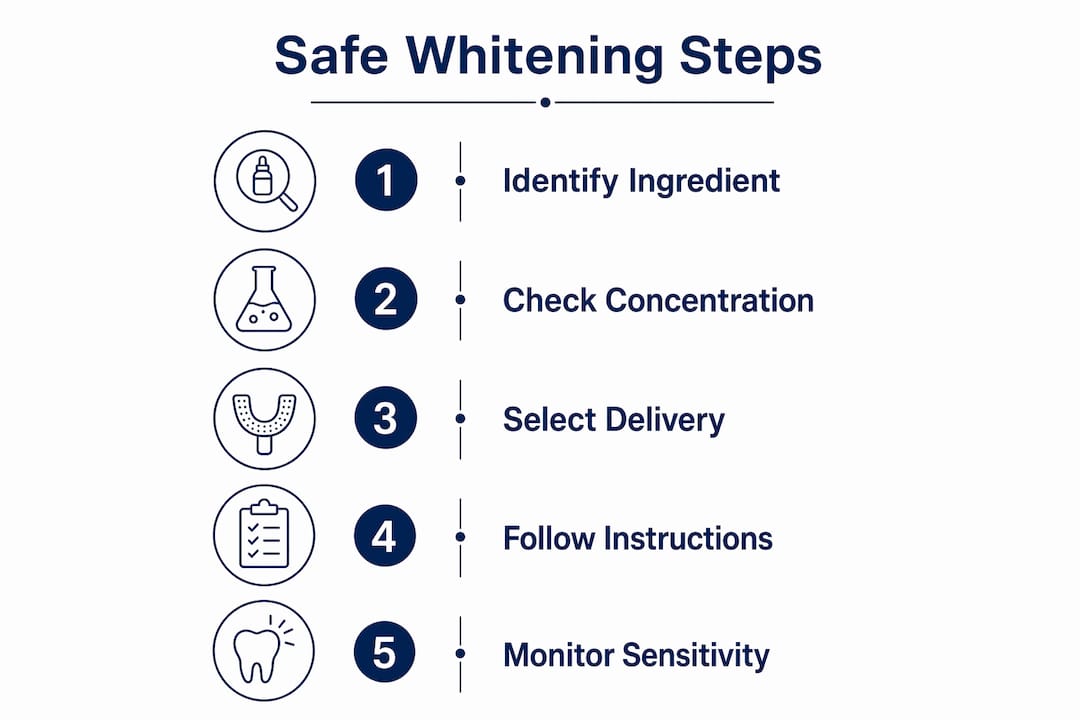
Follow this sequence when selecting and using a whitening formula:
- Start with a low-concentration product. For most people with extrinsic staining from coffee, tea, or wine, low-dose strips targeting extrinsic stains are a clinically supported first step with a strong safety record.
- Follow the usage schedule exactly. Do not extend contact times beyond what the instructions specify. More is not better with peroxide. The dose-time relationship is real, and exceeding recommended wear time increases sensitivity risk without proportionally improving results.
- Add a desensitizing product if needed. Toothpastes containing potassium nitrate, used in the days before and during a whitening course, reduce baseline sensitivity and improve tolerability.
- Avoid DIY mixtures. Lemon juice, baking soda pastes, and oil pulling have no clinical support for whitening and carry real risks. Lemon juice is acidic enough to soften enamel. Baking soda is mildly abrasive and should not be used as a primary whitening agent.
- Consult a dentist before whitening if you have dental restorations such as crowns or veneers, active gum disease, or a history of significant sensitivity. Peroxide does not whiten restorations, and whitening around them can create visible color mismatches.
- Stop use immediately if you develop sharp, lingering sensitivity or visible gum irritation. These are signals to pause, not push through.
Pro Tip: Check the whitening ingredients science behind any product you consider. Understanding what each ingredient does helps you read labels critically rather than relying on marketing copy.
Safe whitening for sensitive teeth requires an additional layer of care. If your teeth are already reactive to temperature or pressure, a formula with potassium nitrate and a shorter initial wear time is the right starting point.
Key takeaways
A safe whitening formula is defined by its peroxide concentration, delivery design, and the presence of desensitizing agents. These three factors together determine whether a product whitens effectively or causes harm.
| Point | Details |
|---|---|
| Peroxide concentration matters | 3% hydrogen peroxide or 10% carbamide peroxide are the FDA and ADA-supported thresholds for safe OTC use. |
| Delivery method shapes safety | Strips and polymer-based gels control peroxide contact and reduce gum exposure better than generic trays. |
| Desensitizers reduce risk | Potassium nitrate and fluoride in the formula lower sensitivity without blocking whitening effectiveness. |
| Verify before you buy | Look for a Drug Facts panel, listed ingredient concentrations, and the ADA Seal of Acceptance. |
| Misuse causes most harm | Extending wear time or overusing products is the primary driver of enamel erosion and sensitivity complaints. |
What I’ve learned about whitening formulas that most brands won’t tell you
After spending years reading the clinical literature and watching how consumers actually use whitening products, one pattern stands out clearly. Most whitening failures are not formula failures. They are user behavior failures. People extend wear times because they want faster results. They skip the sensitivity precautions because they feel fine the first day. Then they wonder why their teeth ache by day three.
The science on this is not ambiguous. Safe consumer whitening depends on choosing evidence-backed peroxide products and strict adherence to directions. That sentence sounds obvious, but the majority of adverse event reports trace back to one of those two failures.
What I find genuinely underappreciated is the role of polymer-based delivery systems. Most consumers focus entirely on the active ingredient percentage and ignore the carrier. But a 3% hydrogen peroxide product in a well-engineered polymer matrix will outperform a 6% product in a thin, poorly adhesive gel. The carrier controls how long the peroxide stays in contact with enamel, how evenly it distributes, and how much reaches the gumline. That is not a minor detail.
The other thing worth saying plainly: the safe versus harsh whitening distinction is not just about ingredient choice. It is about the full formulation. A product can use a safe ingredient at an unsafe concentration, or a safe concentration with an unsafe delivery method. Consumers who understand this are far harder to mislead by marketing language.
— Lenney
Getsmilefam’s approach to safe, effective whitening
Getsmilefam builds its whitening products around the principle that safety and effectiveness are not a trade-off. The BLU Teeth Whitening Kit uses a controlled-concentration formula with BLU Whitening Technology developed in Singapore, designed to deliver visible results in a single session without harsh peroxide levels that trigger sensitivity. For daily maintenance, the BLU Whitening Toothpaste provides enamel-safe whitening with lab-approved ingredients suited for sensitive gums. Both products reflect what the clinical evidence actually supports: low-concentration, well-formulated whitening that works because of its design, not despite it. If you are ready to move from reading about safe whitening to experiencing it, Getsmilefam is a logical next step.
FAQ
What is a safe whitening formula made of?
A safe whitening formula contains hydrogen peroxide or carbamide peroxide at controlled concentrations, typically 3% and 10% respectively, along with desensitizing agents like potassium nitrate and fluoride to reduce sensitivity during use.
How do I verify safe whitening ingredients in a product?
Check the packaging for a Drug Facts panel, a clearly listed active ingredient concentration, and the ADA Seal of Acceptance. Products missing any of these markers have not met standard regulatory or professional safety criteria.
Is carbamide peroxide safer than hydrogen peroxide?
Carbamide peroxide releases hydrogen peroxide more slowly through a breakdown process, making it gentler for extended wear applications like overnight trays. Neither is inherently safer at equivalent active peroxide levels. The delivery method and concentration determine the actual risk.
Can non-peroxide whitening products damage teeth?
Yes. Activated charcoal, one of the most common non-peroxide whitening agents, carries documented enamel abrasion risk. The ADA does not recommend it, and scientific reviews have identified surface changes associated with its use.
How often should I use a whitening formula safely?
Follow the manufacturer’s instructions exactly. Most OTC whitening strips and gels are designed for one to two week courses, not continuous daily use. Overuse is the leading cause of sensitivity and enamel erosion complaints in at-home whitening.