

Whitening fails when the stain sits inside the tooth instead of on top of it. Peroxide gel bleaches surface pigment on enamel, but it can’t reliably reach discoloration buried in dentin or trapped inside a filling. The first move if your teeth aren’t responding is simple: figure out which category your stains fall into, then get a dentist to confirm it.
- Usually responds well: coffee, tea, tobacco, and plaque buildup (extrinsic, surface-level)
- Responds partially or unevenly: aging-related yellowing, mild fluorosis
- Usually resistant: tetracycline banding, trauma-related gray teeth, fillings, and crowns
The Singapore Dental Association notes that whitening resistance almost always comes down to a mismatch between where the treatment works and where the stain actually lives.
Key Takeaways
Whitening resistance almost always comes down to stain location, and the fix depends on identifying whether the discoloration sits on enamel or inside the tooth.
| Point | Details |
|---|---|
| Location determines outcome | Surface stains from coffee, tea, and tobacco respond well; internal stains usually don’t. |
| Get diagnosed first | A dental exam with X-rays and shade matching prevents wasted, repeated bleaching. |
| Alternatives exist for resistant cases | Internal bleaching, bonding, veneers, and crowns handle stains bleach can’t reach. |
| Restorations never bleach | Existing crowns, veneers, or fillings need replacement, not more whitening gel. |
| Getsmilefam fits maintenance, not intrinsic stains | The Snow Serum™ Whitening Pen uses non-peroxide BLU technology suited for surface stains and touch-ups. |
Table of Contents
- Types of Tooth Stains and Which Ones Bleaching Can Fix
- How Peroxide-Based Whitening Works and Where It Stops
- Common Causes Behind Stains That Won’t Lighten
- Why Whitening Seems to “Fail” and the Risks of Overdoing It
- Dental Solutions When Bleaching Won’t Reach the Stain
- What Happens During a Dental Assessment for Resistant Stains
- Keeping New Stains From Forming After Treatment
- Frequently Asked Questions
- Sources
Types of Tooth Stains and Which Ones Bleaching Can Fix
Extrinsic stains sit on the enamel surface. Coffee, tea, red wine, tobacco, and hardened plaque are the usual suspects, and peroxide-based whitening paired with a professional cleaning handles these well in most cases.
Intrinsic stains form inside the tooth, below the enamel, and that’s a different problem entirely. Discoloration that originates within the tooth structure typically resists conventional bleaching because peroxide gel can’t penetrate deep enough to reach it. Common subtypes include tetracycline banding from childhood antibiotic exposure, fluorosis (white or brown mottling from excess fluoride during tooth development), trauma-related internal bleeding that leaves a tooth gray or dark, and simple age related thinning that lets yellow dentin show through worn enamel.
| Stain Type | Visual Clue | Typical Bleach Response |
|---|---|---|
| Coffee, tea, tobacco surface film | Yellow-brown surface layer, often near gumline | Responds well |
| Fluorosis (mild) | White flecks or streaks | Partial |
| Tetracycline banding | Gray or blue-gray horizontal bands | Usually resistant |
| Trauma-related discoloration | Single dark or gray tooth | Usually resistant |
| Fillings, crowns, veneers | Uniform tone that doesn’t match neighboring teeth | Does not bleach |
Mixed cases complicate things further. A person with coffee stains layered over mild fluorosis might see partial lightening followed by a plateau. If you already have restorations that don’t respond the way your natural teeth do, that’s expected, not a product failure. Learning the difference between stain types before starting treatment saves both time and money.
How Peroxide-Based Whitening Works and Where It Stops
Whitening gel oxidizes and breaks apart pigmented molecules sitting in the outer enamel. It doesn’t remove stains so much as bleach them chemically, and that reaction has a hard physical limit: it can’t reliably travel past the enamel into dentin, and it definitely can’t penetrate composite, porcelain, or metal restorations.
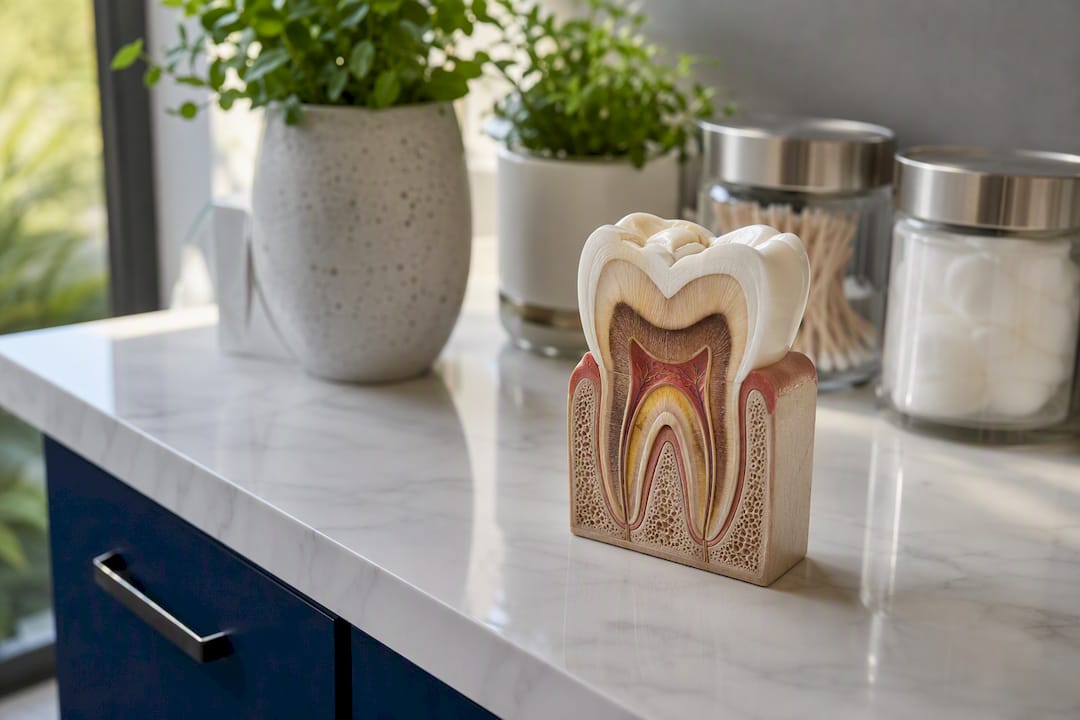
Picture the tooth in three layers. Enamel sits on the outside, translucent and porous. Dentin sits underneath, denser and naturally more yellow. The pulp, with the nerve and blood supply, sits at the core. Peroxide gel works its way through enamel’s microscopic pores, but by the time it reaches dentin its concentration has usually dropped too far to make a visible difference.
- Penetration depth drops sharply once gel moves past the enamel layer
- Enamel porosity varies person to person, which is why two people with identical stains see different results
- Metal-containing pigments (from tetracycline or old amalgam) resist the oxidation reaction that peroxide relies on
- Restoration materials like composite and porcelain are chemically inert to peroxide
Hydrogen peroxide and carbamide peroxide are the two active agents in almost every whitening product on the market, and concentration plus contact time determine how much lightening actually happens. A Newport Beach Dental Solutions review of underwhelming whitening outcomes points to the same conclusion: material type and penetration depth cap what any peroxide formula can achieve, no matter how long you leave it on.
Common Causes Behind Stains That Won’t Lighten
- Tetracycline or other antibiotic exposure during tooth development gets incorporated directly into the mineral structure of dentin, so bleaching has nothing on the surface to react with.
- Fluorosis changes how enamel mineralizes as teeth form, creating opacity that sits below the surface rather than staining it.
- Dental trauma or internal bleeding stains a tooth from the inside out, often turning it gray or dark, and the pigment sits in dentin, not enamel.
- Age-related enamel thinning lets naturally yellow dentin show through, which isn’t a stain at all. There’s nothing to bleach away.
- Large or deep restorations are made of materials that don’t respond to peroxide chemistry, period.
- Developmental enamel defects create uneven mineralization that whitens unevenly or not at all.
- Plaque and tartar trapped under restoration edges keeps discoloring the margin no matter how many whitening sessions you do, because the buildup itself needs a cleaning, not a bleach.
Certain causes like medication exposure, fluorosis, and trauma consistently show up as the reasons whitening plateaus early or doesn’t move the shade at all.
Why Whitening Seems to “Fail” and the Risks of Overdoing It
Most perceived failures aren’t failures of the product. They’re a mismatch between the method and where the stain actually sits, or an untreated restoration nobody accounted for going in.
- Intrinsic stains simply sit out of peroxide’s reach
- Existing crowns, veneers, or fillings won’t change shade no matter how many rounds you do, since repeated bleaching without a diagnosis produces uneven results and won’t touch restoration color
- Mixed staining lightens unevenly, leaving patchy results
- Aggressive at-home habits can wear enamel thin enough to expose more yellow dentin, making things look worse
- Old staining habits (coffee, smoking) reverse gains within weeks if nothing changes
Pro Tip: Skip another round of high-concentration bleach before you know what you’re dealing with. Repeated treatment without a diagnosis raises sensitivity risk and can damage enamel without fixing the actual stain.
Dental Solutions When Bleaching Won’t Reach the Stain
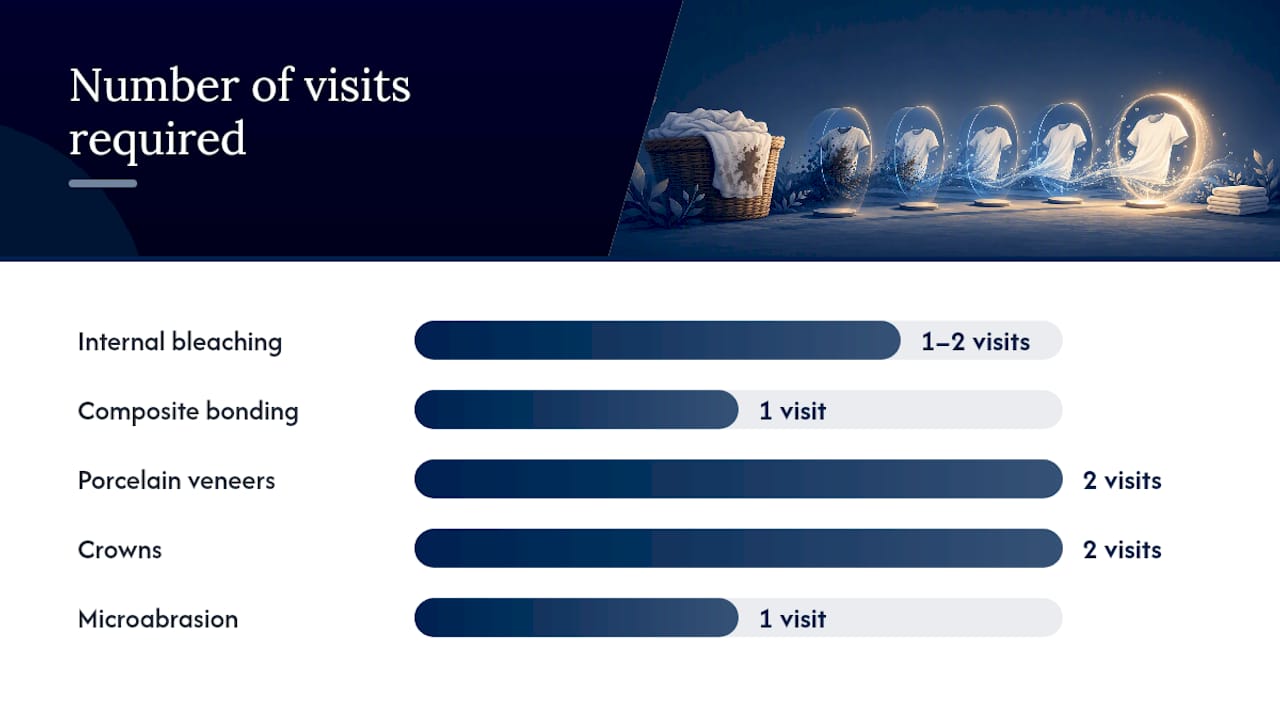
If peroxide can’t get to the pigment, a dentist has other tools. Internal bleaching treats a single dark, non-vital tooth (usually after root canal treatment) by placing bleaching agent inside the tooth chamber itself. Composite bonding covers discoloration with tooth-colored resin in one visit. Porcelain veneers mask more extensive intrinsic staining with thin ceramic shells. Crowns fully cap a tooth when the structure is compromised, not just discolored. Microabrasion polishes away very shallow enamel defects like mild fluorosis spots.
- Internal bleaching: moderate invasiveness, low to medium cost, one to two visits, results can be long-lasting
- Composite bonding: low invasiveness, low to medium cost, single visit, typically needs touch-ups every few years
- Porcelain veneers: higher invasiveness (enamel removal), high cost, two visits, often lasts about a decade or longer
- Crowns: highest invasiveness, high cost, two visits, often last many years
- Microabrasion: minimal invasiveness, low cost, single short visit, permanent for the treated defect
| Option | Invasiveness | Cost Range | Time | Longevity |
|---|---|---|---|---|
| Internal bleaching | Moderate | Low to medium | 1 to 2 visits | Several years |
| Composite bonding | Low | Low to medium | 1 visit | about a decade or longer |
| Porcelain veneers | High | High | 2 visits | can last many years |
| Crowns | High | High | 2 visits | can last many years |
| Microabrasion | Minimal | Low | 1 visit | Permanent (for treated area) |
Pro Tip: A single dark tooth after trauma is usually a job for internal bleaching, not veneers. Generalized banding from tetracycline usually needs veneers or bonding across several teeth to look even.
If you’re already wearing crowns or veneers, whitening gel won’t touch them at all. Matching new restorations to a whitened smile usually means replacing the old ones rather than trying to bleach around them.
What Happens During a Dental Assessment for Resistant Stains
A dental exam identifies the stain type, how deep it sits, and whether any restorations are complicating the picture. A clinical exam paired with shade matching and imaging is the reliable starting point before anyone commits to a treatment plan.
- Clinical exam and shade matching against a standard guide
- X-rays if trauma or internal staining is suspected
- Pulp testing to check whether a discolored tooth is still vital
- Review of existing restorations that might need replacing
Ask your dentist: how much lightening is realistically possible, what alternatives exist if whitening won’t work, what the sensitivity risk looks like, what it costs, and whether internal bleaching or restoration replacement fits your specific case better than another round of gel.
Keeping New Stains From Forming After Treatment
Prevention comes down to three things working together: hygiene habits, diet choices, and periodic professional maintenance. None of it works in isolation.
- Cut back on or quit smoking, since tobacco redeposits surface stain fast
- Limit high-chroma drinks like coffee, tea, and red wine, or rinse with water right after
- Use a whitening-friendly toothpaste and a soft brush rather than anything gritty
- Book routine cleanings to clear tartar before it darkens
- Skip abrasive home scrubs and baking soda pastes that wear enamel down over time
Pro Tip: Time your touch-ups around your habits, not a calendar. If you drink coffee daily, plan a maintenance session sooner than someone who mostly drinks water, and reach for a desensitizing formula if you notice tenderness.
Small changes to diet and routine protect results far more effectively than any single whitening session, no matter how strong the formula.
A Realistic Take on What Whitening Can and Can’t Do
Most people who think whitening “didn’t work” never had a stain whitening could fix in the first place. A dental exam settles that question in one visit, and it saves you from repeating a treatment that was never going to change your specific stain. Getsmilefam builds its BLU Whitening Technology for the surface stains that actually do respond, not as a substitute for that diagnosis.
At-Home Whitening for the Stains That Do Respond
Getsmilefam’s at-home kits are built specifically for extrinsic, surface-level staining, the kind that comes from coffee, tea, and everyday enamel dulling, not the kind buried in dentin. The BLU Whitening Technology behind the Snow Serum™ Whitening Pen uses lab-approved, enamel-safe ingredients with no hydrogen peroxide, which makes it a reasonable option even for people with sensitive gums.
That formula fits three specific situations well: touching up your shade between professional visits, maintaining results after a dentist-led whitening treatment, and handling day-to-day surface buildup without booking another appointment. It won’t lighten a tetracycline-banded tooth or a crown, and it isn’t meant to. For readers who want a gentler, gum-safe option for ongoing maintenance, the SmileFam for Seniors line applies the same non-peroxide approach. Grab a travel-sized pen and keep it in reach for the stains that actually respond to it.
Frequently Asked Questions
Can whitening ever lighten a gray tooth from an old injury? Rarely with surface gel alone. A gray, trauma-related tooth usually needs internal bleaching or a restoration, since the discoloration sits inside the dentin where peroxide can’t reach effectively.
Why did my teeth whiten unevenly? Uneven results usually mean you’re dealing with mixed staining, some extrinsic and some intrinsic, or a restoration that isn’t reacting to the gel the way your natural enamel is.
Is fluorosis staining permanent? Mild fluorosis often improves somewhat with whitening or responds well to microabrasion, but more pronounced banding typically needs bonding or veneers to even out.
Will whitening damage my enamel if I keep repeating it? Repeated high-concentration bleaching without a break can raise sensitivity and, over time, thin enamel enough to expose more of the naturally yellow dentin underneath.
Do at-home pens work as well as professional treatments? For surface stains and touch-ups, yes, they can produce visible results. For intrinsic staining, no at-home product reaches deep enough, which is why a dental assessment matters before you invest in either option.
This article is general information, not a substitute for advice from a qualified doctor. Consult a qualified healthcare professional about your own circumstances before acting on anything here.
Sources
- Why Some Stains Do Not Respond to Teeth Whitening | Teeth Whitening London
- Teeth Whitening Not Working? Stain Types - Dentistry Of Kingwood
- Why Some Tooth Stains Don’t Respond to Whitening
- The ultimate stain removal guide | Consumer Reports