

A whitening pen or short tray session can visibly refresh your smile in minutes to a few days when used correctly. That’s the short answer. The longer one involves picking the right method, respecting wear times, and knowing when a quick fix is the right call versus when you actually need a dentist.
Here’s what you need to know upfront:
- Recommended approach: An enamel-safe brush-on whitening pen or a short-wear tray session for surface brightening. Visible improvement from peroxide-based gels typically takes a few days of consistent use.
- Speed of results: Whitening pens can reduce surface dullness within a single session; peroxide-based strips or trays show measurable shade change over several days.
- Safety floor: Don’t exceed labeled wear times, don’t apply daily for extended periods, and stop immediately if you feel sharp sensitivity. The American Dental Association notes that OTC products use lower peroxide concentrations than professional systems and that an ADA Seal identifies products meeting safety and effectiveness standards.
- Dentist check first: If you have crowns, veneers, bonding, or chronic sensitivity, consult a dentist before starting any touch-up routine.
Key Takeaways
Quick, consistent touch-ups using an enamel-safe pen or short-wear strips are the most effective way to maintain whitening results between full treatments without causing sensitivity or enamel damage.
| Point | Details |
|---|---|
| Best quick method | A brush-on whitening pen or short-wear strips refresh surface staining in minutes to days. |
| Safe frequency | Whitening pens every 2–7 days; strips every 1–3 months; full tray sessions every 3–6 months. |
| 48-hour rule | Avoid dark-pigmented foods and drinks for 48 hours after any touch-up to prevent immediate shade relapse. |
| When to see a dentist | Persistent sensitivity, restorations, intrinsic staining, or rapid relapse all require professional guidance. |
| Getsmilefam option | The Snow Serum™ Whitening Pen uses BLU Whitening Technology for enamel-safe, peroxide-free quick touch-ups. |
Table of Contents
- What does a whitening touch-up actually do?
- How to use the main quick touch-up methods safely
- How often should you do a touch-up?
- Signs it’s time for a touch-up
- Daily habits that make touch-ups less frequent
- When should you choose a professional touch-up?
- Why the SmileFam Snow Serum™ Whitening Pen fits a quick touch-up routine
- The case for treating touch-ups as a routine, not a rescue
- The Snow Serum™ Whitening Pen is built for exactly this
- Sources
What does a whitening touch-up actually do?
A “quick touch-up” in whitening refers to a short-duration, low-to-moderate concentration treatment used to refresh color between full whitening cycles. It is not a restart. It is maintenance.
Understanding that distinction saves you from overusing products and expecting results they cannot deliver.
Extrinsic vs. intrinsic stains matter here. Extrinsic stains sit on the outer enamel surface and come from coffee, tea, red wine, and tobacco. Quick touch-ups work on these. Intrinsic stains live inside the tooth structure, often from medications, trauma, or fluorosis, and they resist most OTC methods entirely. If your discoloration is deep and unresponsive to surface treatments, a touch-up pen is not the answer.
Realistic expectations by method:
- Whitening pens: Brighten surface dullness; best for minor fading after an event or a few weeks of staining habits.
- Short-wear strips or trays: Can lift extrinsic staining by one to two shades over several days of consistent use.
- Whitening toothpaste: Polishes away surface film; does not chemically bleach enamel.
- Full re-whitening: Required when the shade has shifted significantly from baseline, not just dulled slightly.
According to a cosmetic dentist’s guidance, touch-ups refresh results rather than restart whitening, and a 6–12 month refresh schedule works for many adults depending on lifestyle and sensitivity. The ADA also notes that there is often a time trade-off between OTC and professional options, and that safety and measurable claims matter more than marketing speed promises.
How to use the main quick touch-up methods safely
Whitening pens (brush-on gel)
This is the fastest, most portable option for a quick dental touch up. You twist the base to dispense gel, brush a thin layer onto dry teeth, hold your lips away from your teeth for 30–60 seconds, then let the gel dry. Do not eat or drink for at least 30 minutes after application.
Wear time: 30–60 seconds of active application; gel continues working for up to 30 minutes on the tooth surface. Expected refresh: Surface brightening within one to three uses. Pros: Portable, precise, no trays, no mess. Cons: Lower peroxide concentration than trays; results are subtle rather than dramatic. Sensitivity tip: If you feel tingling, reduce application to every other day and switch to a sensitivity-formula toothpaste in the days leading up to use.
Pro Tip: Dry your teeth with a clean cloth or tissue before applying pen gel. Saliva dilutes the formula and cuts effectiveness significantly.
Whitening strips (short maintenance cycles)
Apply strips to upper and lower teeth, press firmly to remove air pockets, and wear for the time stated on the label (typically 15–30 minutes). Remove, rinse, and avoid staining drinks for at least an hour.
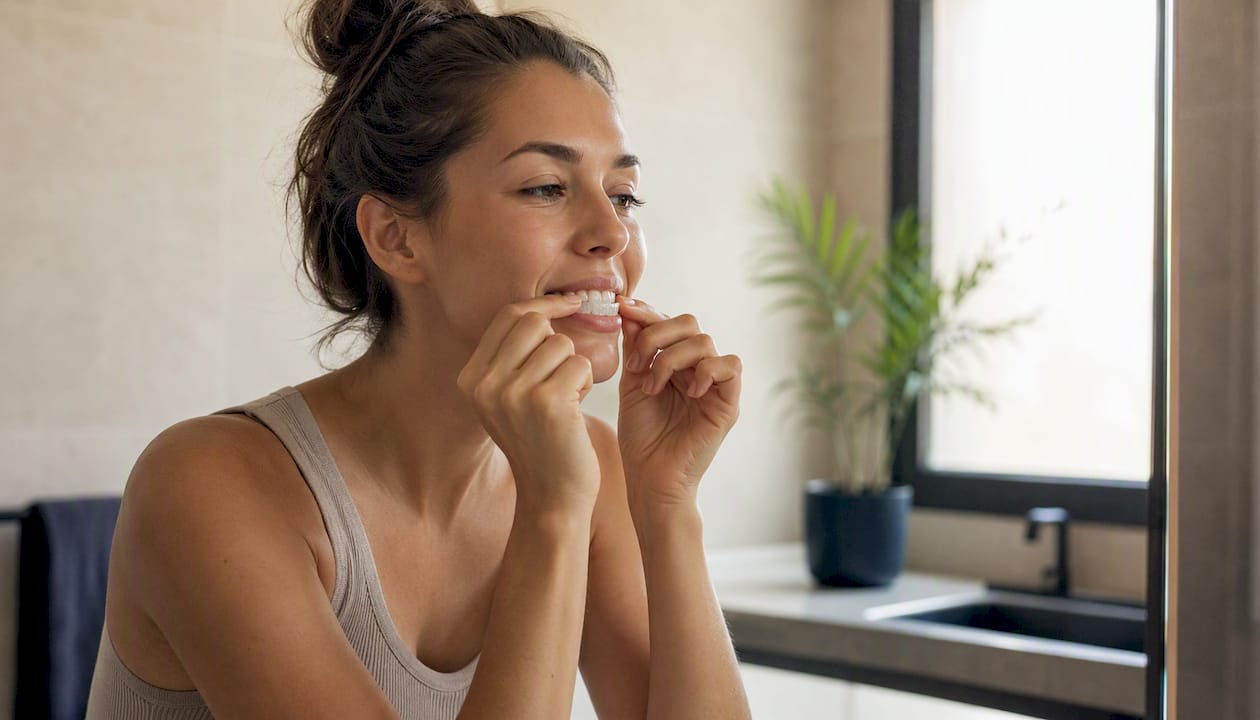
Wear time: 15–30 minutes per session. Expected refresh: Noticeable shade improvement over 3–5 days of use. Pros: Widely available, ADA Seal options exist, easy to use. Cons: Can slip on irregular tooth shapes; some users experience gum irritation from gel contact. Sensitivity tip: Use every other day rather than daily if sensitivity appears. Look for strips carrying the ADA Seal of Acceptance for verified safety and effectiveness.
Short-wear trays (touch-up syringes)
Fill a custom or boil-and-bite tray with a small amount of gel, seat it over teeth, and wear for the time specified on the product label.
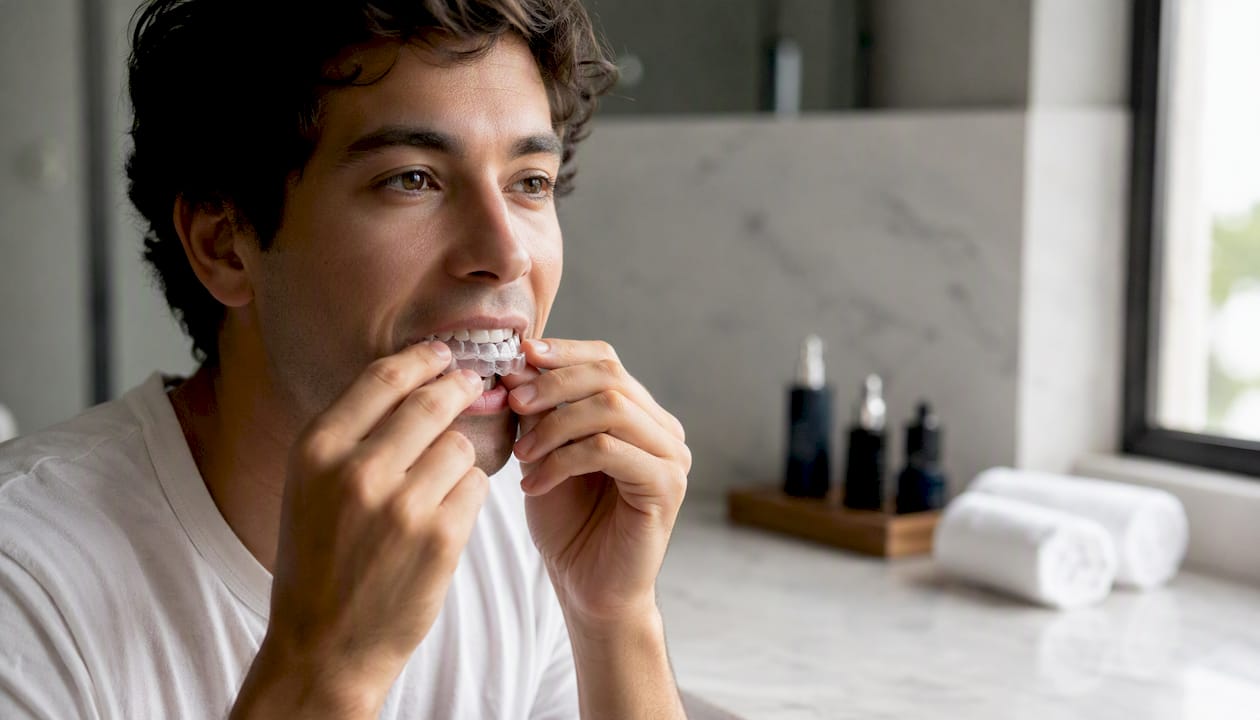
Per dentist-sourced instructions, the recommended approach is 15 minutes once or twice daily, not exceeding the total labeled daily wear. After removing the tray, wipe away any excess gel from the gumline immediately. Avoid staining foods and beverages for about 48 hours after treatment, as enamel is more porous during that window.
Sensitivity tip: Store gel in a cool, dark place. Warm or humid storage degrades potency and can cause uneven results.
Whitening toothpaste and rinses
These are surface-maintenance tools, not bleaching agents. Use a whitening toothpaste twice daily to polish away surface film and slow stain buildup. A whitening rinse used after meals adds a mild oxidizing layer between brush sessions.
Pros: Zero additional time investment; safe for daily use. Cons: No chemical bleaching; cannot lift set staining.
For readers managing sensitivity alongside whitening, pairing a sensitivity toothpaste with a whitening rinse is a practical middle ground between doing nothing and running a full strip cycle.
How often should you do a touch-up?
Frequency depends on the method, your diet, and how quickly your shade fades. Coffee drinkers and smokers will need more frequent maintenance than someone who avoids dark beverages. Sensitivity history matters too: if you’ve had reactions before, longer gaps between sessions protect enamel and gum tissue.
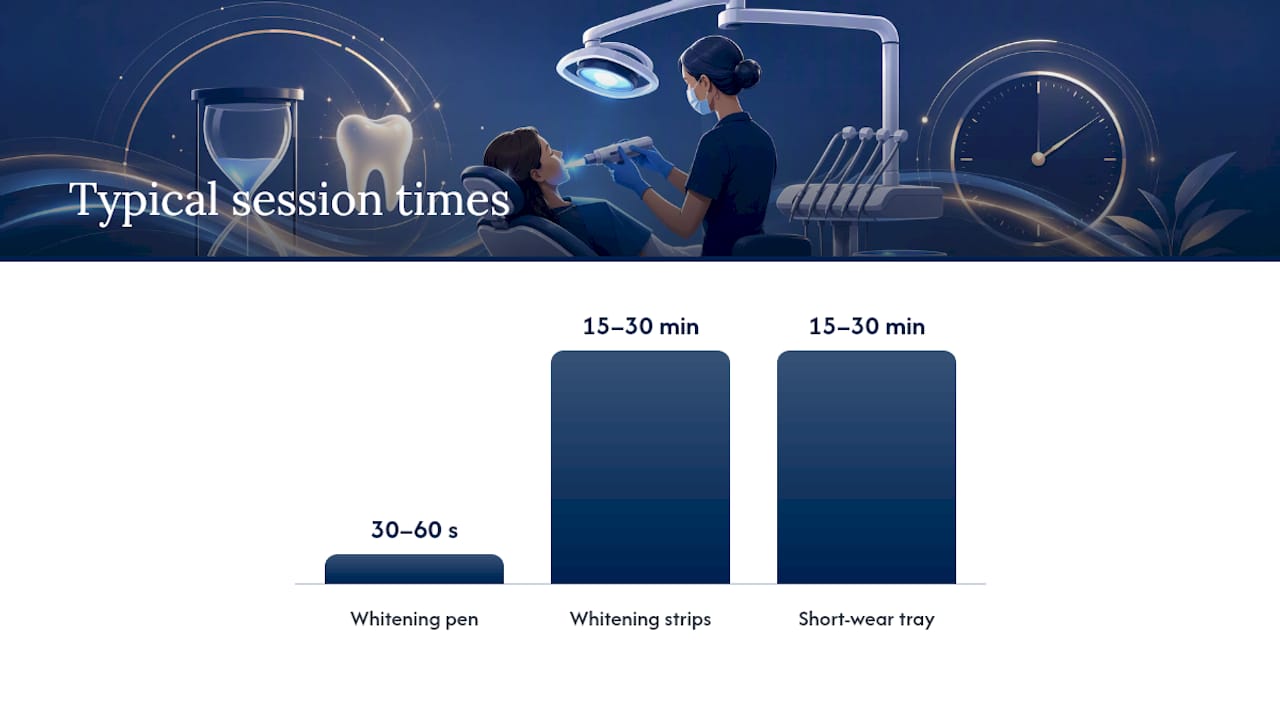
| Method | Suggested maintenance interval | Typical session time |
|---|---|---|
| Whitening pen | Every few days for active maintenance | 30–60 seconds |
| Whitening strips | Every few weeks to months for a short boost cycle | 15–30 minutes |
| Short-wear tray session | Occasionally or per dentist guidance | 15–30 minutes |
A cosmetic dentist’s guidance puts the most common refresh window at 6–12 months for full touch-up cycles, with lifestyle habits driving the actual timing. Daily heavy re-application of any peroxide product is not safe. If you find yourself needing touch-ups more than once a month, that’s a signal to see a dentist rather than increase product use.
Factors that accelerate fading and shorten your maintenance window:
- Daily coffee, tea, or red wine consumption
- Tobacco use (smoking or chewing)
- Certain medications that cause intrinsic staining
- Acidic diet that softens enamel and increases stain uptake
- Skipping regular dental cleanings
For a practical guide to maintaining whitening results between sessions, small daily habits compound faster than you’d expect.
Signs it’s time for a touch-up
Most people wait too long or act too soon. Here’s how to read the actual signals:
Go ahead with a touch-up when you notice:
- A visible color shift compared to a photo taken right after your last whitening treatment
- New staining after a high-exposure period (a vacation, a stretch of heavy coffee drinking)
- Uneven shade across teeth, particularly on the front six
- Surface dullness that doesn’t clear up after two days of brushing with a whitening toothpaste
Stop and see a dentist instead when you have:
- Sharp or lingering sensitivity that wasn’t there before
- Gum redness, swelling, or irritation at the gumline
- Exposed dentin (the yellowish layer visible near the gumline when enamel thins)
- Recent dental work including crowns, veneers, or bonding — whitening agents don’t affect restoration materials, so uneven results are likely
- Sudden focal discoloration on a single tooth, which can signal a cavity or nerve issue
Pro Tip: Take a photo of your smile under the same lighting every time you finish a whitening treatment. Natural daylight near a window works well. That reference shot is far more reliable than memory when you’re trying to judge whether a touch-up is actually needed.
Daily habits that make touch-ups less frequent
The best whitening touch-up technique is the one you need less often. These habits do the most work between sessions:
- Brush twice daily with a whitening or sensitivity toothpaste. The mechanical action removes surface film before it sets.
- Rinse immediately after staining drinks. You don’t need to brush every time, but a water rinse within a few minutes cuts pigment absorption significantly.
- Use a straw for dark beverages. It sounds minor, but it routes coffee and iced tea past the front teeth entirely.
- Schedule regular dental cleanings. Professional cleaning removes calculus and surface staining that no OTC product can touch. Most adults benefit from cleanings every six months.
- Avoid staining foods for 48 hours after any touch-up. Enamel is temporarily more porous post-treatment, and dark pigments absorb faster during that window.
For a week after a touch-up, a simple micro-routine helps lock in the shade: brush with a whitening toothpaste in the morning, use a whitening rinse after lunch, and avoid red wine and coffee after 6 PM. Two weeks before a planned touch-up, swap to a sensitivity-formula toothpaste to reduce the chance of post-treatment discomfort.
The lifestyle changes guide from Getsmilefam covers the full set of behavioral adjustments that compound over time.
When should you choose a professional touch-up?
At-home methods cover most maintenance needs, but there are clear situations where a dentist-led touch-up is the faster, safer, or only viable option.
According to WebMD, in-office bleaching provides the quickest visible results, often after a single 30–60 minute treatment, while OTC products take longer to reach similar levels of whitening. That speed gap matters when you have a deadline, a wedding, or a job interview in 48 hours.
Two main professional paths:
- In-office power whitening: High-concentration peroxide applied by a dentist, often with light or heat activation. One session produces a noticeable shade change. Fastest option available.
- Dentist-prescribed take-home trays: Custom-fitted trays with professional-strength gel used over several days at home. A practicing dentist notes that dentist supervision helps match peroxide strength and schedule to individual sensitivity, which OTC products cannot do.
Reasons to choose professional over OTC:
- Persistent sensitivity that worsens with OTC products
- Crowns, veneers, or bonding that need shade-matching guidance
- Intrinsic staining from tetracycline, fluorosis, or trauma
- Rapid relapse despite consistent maintenance habits
- Need for a significant shade change, not just a surface refresh
For certain intrinsic defects that don’t respond to any bleaching, dental bonding is an alternative. The Cleveland Clinic notes bonding material typically needs touchups or replacement every 3–10 years, which is worth factoring into long-term planning when whitening alone won’t solve the problem.
For a direct comparison of at-home versus dentist-supervised options, the tradeoffs between cost, speed, and control are worth reading before you book an appointment.
You can also explore professional-grade whitening at home through systems like Lumi & KoR™ that sit between standard OTC products and full in-office treatment.
Why the SmileFam Snow Serum™ Whitening Pen fits a quick touch-up routine
Brush-on whitening pens are the most practical format for a fast at-home touch-up, and the Snow Serum™ Whitening Pen from Getsmilefam is built specifically for that use case.
The pen uses Getsmilefam’s proprietary BLU Whitening Technology, developed to deliver visible results without relying on harsh hydrogen peroxide. The formulation is enamel-safe and designed for sensitive gums, which matters when you’re applying a product repeatedly as part of a maintenance routine rather than a one-time treatment.
How to use it:
- Twist the base until gel appears at the brush tip.
- Dry your teeth with a tissue or cloth first.
- Apply a thin, even layer across the front surface of each tooth.
- Hold lips away from teeth for 30–60 seconds to let the gel set.
- Avoid eating or drinking for 30 minutes after application.
- Wipe away any excess gel near the gumline immediately.
- Store the pen in a cool, dark place to preserve gel potency.
Safety profile:
- No harsh hydrogen peroxide in the formula.
- Enamel-safe ingredients aligned with the safety priorities the ADA outlines for OTC whitening products.
- Suitable for sensitive gums when used as directed.
For readers who want to understand the ingredient-level reasoning behind enamel-safe formulations, the guide to enamel-safe whitening ingredients from Getsmilefam covers the key distinctions.
The case for treating touch-ups as a routine, not a rescue
Most adults approach whitening backwards. They let their shade fade for months, then reach for a product in a panic before an event and apply it aggressively, often causing sensitivity and uneven results. Then they wait another six months and repeat the cycle.
Brief, regular maintenance beats that pattern every time. A whitening pen used every few days after a heavy coffee week does far less damage to enamel than a five-day strip cycle run in desperation. The shade stays more consistent, sensitivity stays lower, and you spend less overall.
Keep a simple photo log and a calendar note for your last touch-up. Check in with a dentist once a year to assess enamel health and get a professional cleaning that resets your baseline. And if sensitivity or gum irritation appears at any point, stop the product immediately and get a professional opinion before continuing.
Touch-ups are maintenance, not medicine. Treat them that way.
The Snow Serum™ Whitening Pen is built for exactly this
When you need a fast, enamel-safe option that fits into a real daily routine, the Snow Serum™ Whitening Pen from Getsmilefam delivers visible brightening without the sensitivity risk that comes with harsh peroxide formulas. It’s compact enough to keep in a bag, precise enough to apply in under a minute, and formulated with BLU Whitening Technology for results you can see without the enamel trade-off.
Getsmilefam backs the pen with a satisfaction guarantee and a formulation designed for repeated maintenance use, not just one-time treatments. For travelers or anyone who wants a complete kit, the Premium Travel Kit bundles the essentials for on-the-go touch-ups. Pick up the Snow Serum™ Whitening Pen and build the consistent routine your results actually need.
Sources
- Whitening | American Dental Association
- Teeth Whitening Touch-Ups: How Often is Enough?
- Top 5 Teeth Whitening Methods Explained by Dr. Sandi Hamm, DDS: Your Expert Guide to a Brighter Smile in Mansfield, Texas
- Teeth Whitening Touch up Syringe Instructions - Dr. Sajan
- Teeth Whitening Strips, Gels, Toothpaste, Bleaching, and More
- Dental bonding
This article is for general informational purposes only and is not a substitute for professional dental advice. Confirm any whitening routine with a licensed dentist, particularly if you have restorations, sensitivity, or underlying dental conditions.