

You pour your morning coffee, sip your evening glass of red wine, and repeat the cycle every single day. Over time, those small pleasures leave behind a visible record on your teeth. Many people try whitening toothpastes, strips, or trendy charcoal products, only to feel underwhelmed or, worse, end up with painful sensitivity. For lifestyle-driven stains, whitening pens can produce measurable color change when used correctly, though results depend heavily on technique and consistency. This guide walks you through everything: what causes stains, what tools you actually need, and a precise step-by-step method to get real results safely at home.
Table of Contents
- What causes tooth stains and how whitening pens help
- What you need: Tools, ingredients, and safety tips
- Step-by-step guide: How to clean stained teeth with a whitening pen
- What to expect, common problems, and solutions
- The surprising truth about at-home whitening pens: What really works
- Smile confidently: Next steps for brighter teeth
- Frequently asked questions
Key Takeaways
| Point | Details |
|---|---|
| Whitening pens target surface stains | Pens are most effective on stains from coffee, wine, and smoking but less so on deep or restoration-related discoloration. |
| Safety requires care | Follow all instructions to prevent sensitivity or gum irritation caused by overuse. |
| Realistic results | Most users see about three shades of whitening in 1-2 weeks with proper use. |
| Sensitivities are manageable | If you notice sensitivity, use less often and consider a desensitizing toothpaste. |
| Ongoing care matters | Combine whitening with good oral hygiene for lasting results and smile confidence. |
What causes tooth stains and how whitening pens help
You are not imagining it. Teeth do stain faster than most people expect, and the culprits are hiding in everyday habits.
Understanding why stains form
Tooth discoloration falls into two main categories: extrinsic (surface) stains and intrinsic (deep) stains. Extrinsic stains sit on the outer layer of enamel and are caused by pigment-rich foods and drinks, tobacco, and even some mouthwashes. Coffee, black tea, red wine, and cigarette smoke are the most common offenders because they contain tannins and chromogens, which are compounds that bind tightly to enamel. Intrinsic stains, on the other hand, develop inside the tooth structure itself, often from aging, certain antibiotics taken during childhood, or trauma to the tooth. These are far harder to treat with any at-home product.
The good news is that most lifestyle-driven stains are extrinsic, which means they sit right where a whitening pen can reach them.
How whitening pens differ from other methods
Whitening pens apply a concentrated gel directly to the tooth surface, allowing the active ingredient to sit and work without being diluted by saliva the way toothpaste is. Research confirms that bleaching pens removed coffee stains from both teeth and resin composites more effectively than toothbrushing alone. That is a meaningful difference in real-world use.
However, it is important to be honest about limitations. Whitening pens work best on surface stains. They are not effective on intrinsic discoloration, and they will not change the shade of crowns, veneers, or composite fillings. Knowing this upfront saves frustration later.
Comparison: Whitening pen vs. other at-home methods
| Method | Best for | Limitations | Sensitivity risk |
|---|---|---|---|
| Whitening pen | Targeted surface stains | Less effective on intrinsic stains | Low to moderate |
| Whitening strips | General surface whitening | Uneven coverage, gum contact | Moderate |
| Whitening toothpaste | Maintenance, mild stains | Minimal active whitening | Low |
| Charcoal toothpaste | Surface polish | Limited whitening evidence | Low to moderate |
| Professional in-office | All stain types | High cost, requires appointment | Moderate to high |
The Snow Serum™ Whitening Pen is formulated specifically to target surface stains with precision, and the BLU Teeth Whitening Kit offers a more complete treatment option for those wanting broader coverage. Both are worth considering depending on your goals.
Key stain causes at a glance:
- Coffee and tea (tannins and chromogens)
- Red wine (tannins and dark pigments)
- Tobacco products (tar and nicotine)
- Dark sauces like soy sauce, tomato sauce, and balsamic vinegar
- Poor brushing habits that allow plaque to trap stain particles
What you need: Tools, ingredients, and safety tips
Understanding the science sets you up for success. Next, get everything ready and review safety so your results are both effective and comfortable.
Your materials checklist
You do not need a complicated setup. Here is what to have on hand before you start:
- A quality whitening pen with clearly labeled active ingredients
- A clean mirror with good lighting
- Tissues or a small towel to blot excess gel
- Desensitizing toothpaste (optional but recommended for sensitive teeth)
- A timer or phone to track application time
Reading the ingredient label
This step matters more than most people realize. Look for the active whitening ingredient and its concentration. Hydrogen peroxide and carbamide peroxide are the two most common options. Hydrogen peroxide-based whitening ingredients are generally safe in commercial products, but risk sensitivity with long-term or high-concentration use. Most over-the-counter pens contain between 3% and 10% hydrogen peroxide, which is considered a safe range for at-home use.
Ingredient comparison at a glance:
| Ingredient | Concentration range | Whitening speed | Sensitivity risk |
|---|---|---|---|
| Hydrogen peroxide | 3%–10% | Fast | Moderate |
| Carbamide peroxide | 10%–22% | Moderate | Low to moderate |
| PAP (phthalimidoperoxycaproic acid) | Varies | Moderate | Very low |
| Sodium bicarbonate | N/A | Slow (polishing) | Very low |
Some newer formulas, including those used in BLU Whitening Technology, are designed to deliver results without relying on hydrogen peroxide at all, which significantly reduces the risk of gum irritation and sensitivity.
Safety precautions before you begin:
- Do not use a whitening pen on broken, cracked, or decayed teeth
- Avoid use if you have active gum disease or open sores in your mouth
- Do not apply gel directly to gum tissue
- If you are pregnant or breastfeeding, consult your dentist first
- Patch test: apply a tiny amount to one tooth and wait 24 hours if you have a history of sensitivity
“If you have a history of sensitivity, starting with a lower-concentration formula and shorter contact times is the smartest move. Whitening should never hurt.”
The Snow Serum™ Whitening Pen uses lab-approved, enamel-safe ingredients designed to minimize the sensitivity issue many people associate with traditional peroxide products.
Pro Tip: Use a desensitizing toothpaste for two days before starting your whitening routine. This pre-loads potassium nitrate into the dentin tubules and significantly reduces the chance of sensitivity during treatment.
Step-by-step guide: How to clean stained teeth with a whitening pen
With materials and safety covered, here is exactly how to put your whitening pen to use, step by step.
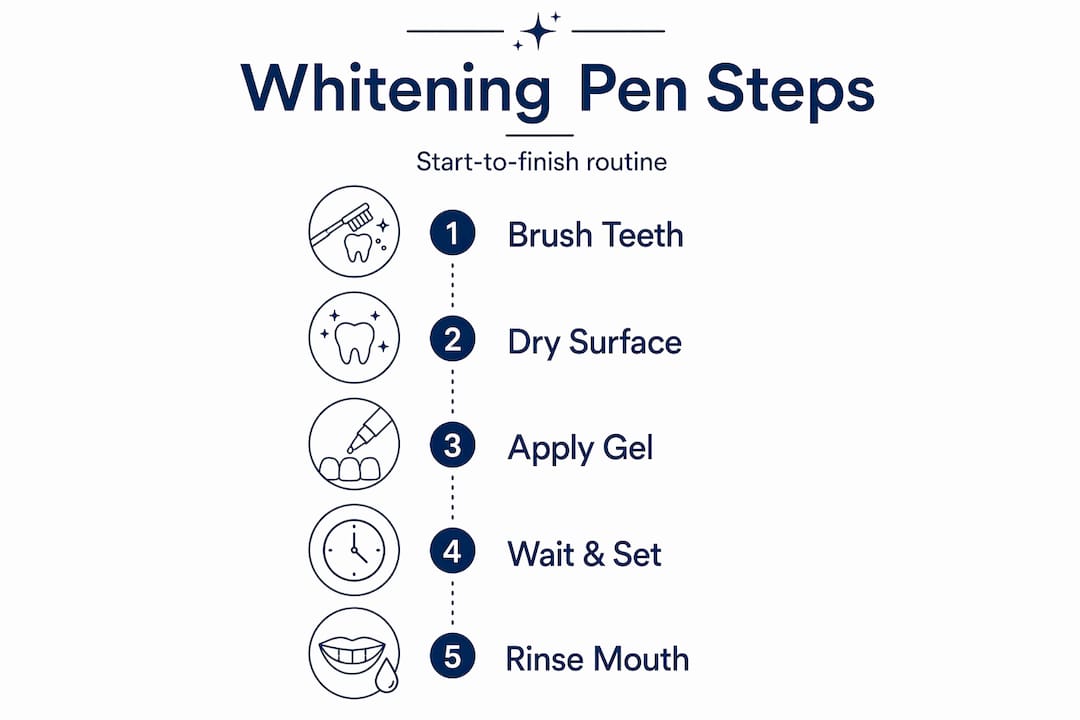
Step 1: Brush and dry your teeth
Brush your teeth thoroughly before applying the pen. This removes food debris and surface plaque, which would otherwise block the whitening gel from making direct contact with the enamel. After brushing, gently dry your teeth with a tissue or simply keep your lips slightly open for 30 seconds. Moisture on the tooth surface dilutes the gel and reduces effectiveness.
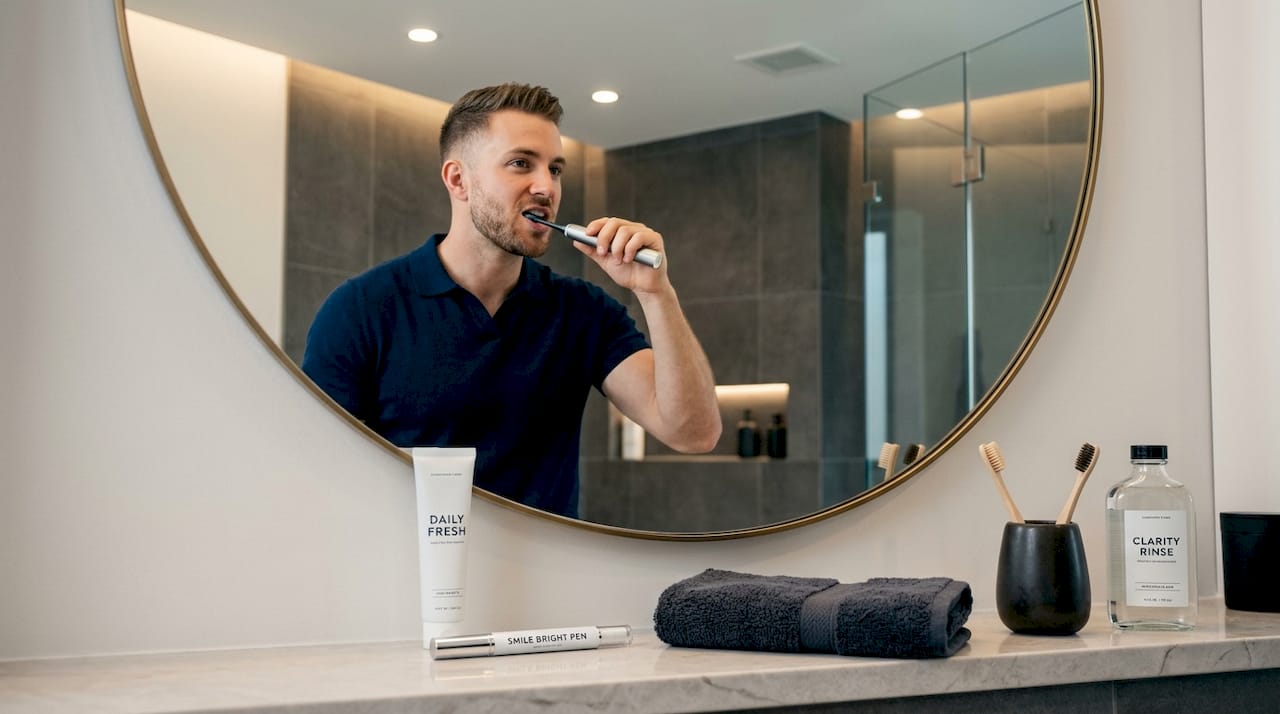
Step 2: Twist or click to dispense gel
Most whitening pens require you to twist the bottom or click a button to push gel to the brush tip. Do this slowly. You want just enough gel to coat the tooth surface without excess dripping onto your gums. One to two clicks is usually sufficient for a full application.
Step 3: Apply with a thin, even layer
Using the brush tip, paint a thin layer of gel across each tooth you want to whiten. Use gentle, sweeping strokes and work from one side to the other. Stay about 1 to 2 millimeters away from the gum line to avoid irritation. Focus on the front-facing surfaces since those are the most visible and most affected by lifestyle stains.
Step 4: Keep your mouth open and let it set
This is the step most people skip, and it makes a real difference. Keep your lips open or slightly apart for 30 to 60 seconds after applying. This allows the gel to begin adhering before saliva can wash it away. Some pens recommend leaving the gel on for up to 30 minutes before rinsing. Always follow the specific instructions for your product.
Step 5: Avoid eating or drinking
After applying, avoid food, drinks, and even water for at least 30 minutes. This gives the active ingredients time to work without interruption. Coffee, tea, and wine are especially important to avoid right after whitening since the enamel is temporarily more porous and more susceptible to restaining.
Step 6: Rinse and assess
After the recommended contact time, rinse your mouth with water. Do not brush immediately after whitening. Give your enamel at least 30 minutes to remineralize before brushing again.
Frequency and realistic results:
Most whitening pens are designed for once or twice daily use over a period of 1 to 2 weeks. Most at-home pens lighten teeth by about three shades, not the eight shades some marketing claims suggest. Setting that expectation early keeps you motivated rather than disappointed.
For consistent whitening pen application tips and product-specific guidance, always check the manufacturer’s instructions since contact times and frequency vary.
Pro Tip: Take a photo of your teeth in natural light before you start your first application. Compare weekly. Progress is often gradual enough that you might not notice it day to day, but photos make the difference obvious.
What to expect, common problems, and solutions
Once you have completed a few cycles, you will want to know what is normal, what issues to watch for, and when to consider other options.
Typical results timeline
Most users begin to notice a subtle difference after 3 to 5 days of consistent use. By the end of two weeks, the average improvement is around two to three shades lighter. Touch-ups are less dramatic than professional whitening and results vary significantly based on your baseline discoloration type. Yellowish stains from coffee and tea tend to respond the best. Grayish stains, often from aging or old antibiotics, are more resistant.
Sensitivity: Why it happens and what to do
Mild tooth sensitivity can occur even with low-concentration at-home gels. This happens because peroxide temporarily opens microscopic channels in the enamel, allowing temperature and pressure to reach the nerve more easily. It is usually short-lived, lasting a few hours at most.
If you experience sensitivity:
- Reduce application frequency from twice daily to once daily or every other day
- Switch to a desensitizing toothpaste for the duration of your whitening course
- Shorten the contact time per session
- Take a 2 to 3 day break before resuming
- If sensitivity is severe or persistent, stop use and consult your dentist
If you are not seeing results
Check whether you are applying the gel to a dry tooth surface. Wet enamel is one of the most common reasons whitening pens underperform. Also consider whether the stains you are targeting might be intrinsic rather than extrinsic. If your teeth have crowns, veneers, or large composite fillings in the visible areas, those will not respond to any whitening product.
Pairing your pen with a BLU Whitening Toothpaste helps maintain results between sessions and gently polishes away new surface stains before they set. For tracking your shade progress objectively, the AI Whitening App offers a data-driven way to measure improvement over time.
Statistic to know: Studies show that surface stains from coffee and tea are among the most responsive to peroxide-based whitening, with measurable color change achievable within 1 to 2 weeks of consistent at-home use.
Pro Tip: Rinse your mouth with water immediately after consuming coffee, tea, or wine. This simple habit slows down restaining between whitening sessions and extends your results significantly.
The surprising truth about at-home whitening pens: What really works
Here is something most whitening guides will not tell you: the product matters far less than how you use it and what you expect from it.
Social media is full of before-and-after photos showing dramatic eight-shade transformations from whitening pens. The reality is more nuanced. In a 2025 in vitro study comparing activated charcoal toothpaste vs a 6% hydrogen peroxide whitening pen, the peroxide pen produced immediate and substantial whitening results that charcoal toothpaste simply could not match. That is strong evidence that peroxide-based pens genuinely work. But “genuinely works” and “works like a professional treatment” are two different things.
Professional in-office whitening uses concentrations of 25% to 40% hydrogen peroxide, often activated by light, in a controlled clinical setting. At-home pens use 3% to 10%. The gap in concentration explains the gap in results. This is not a failure of the product. It is physics and chemistry.
Where whitening pens genuinely shine is in targeted maintenance and gradual improvement. If you have had a professional whitening treatment and want to preserve the results, a pen used 2 to 3 times per week is one of the most efficient tools available. If you are starting from scratch with moderate coffee or tea staining, a consistent two-week course with a quality pen will deliver real, visible improvement.
Technique is also far more important than most guides acknowledge. Applying gel to a wet tooth, skipping the drying step, or eating too soon after application can cut your results in half. The people who are disappointed with whitening pens are often the ones who applied them quickly and inconsistently.
When should you see a dentist instead? If your staining is gray or brown rather than yellow, if it has been present for many years, or if it appears to come from inside the tooth rather than the surface, a dentist is the right first step. Pens are not a substitute for professional diagnosis or treatment of intrinsic discoloration.
Finally, the Ultimate Whitening Bundle approach, combining a whitening pen with a complementary toothpaste and treatment kit, consistently outperforms using any single product alone. Layering your tools is the strategy that gets you closest to professional-level results at home.
Smile confidently: Next steps for brighter teeth
Ready to get started, or looking to level up your results? Here are next steps with proven SmileFam solutions.
You now have the knowledge to use a whitening pen correctly and safely. The next step is choosing a product that matches that knowledge. The Snow Serum™ Whitening Pen uses BLU Whitening Technology developed in Singapore, with enamel-safe, lab-approved ingredients that deliver visible results without the sensitivity risk of traditional peroxide formulas. For those who want to maximize and maintain results, the Ultimate Whitening Bundle combines the pen with complementary treatments for a complete at-home whitening system. Add the BLU Whitening Toothpaste to your daily routine to protect your progress and keep new stains from setting in between sessions.
Frequently asked questions
Are whitening pens safe for daily use?
Whitening pens are generally safe when used as directed, but daily use over extended periods may increase tooth sensitivity or gum irritation. Always follow the manufacturer’s recommended frequency and duration.
How long does it take to see results with a whitening pen?
Most people notice visible improvement within 1 to 2 weeks of consistent use, with average lightening of about three shades rather than the dramatic claims some products advertise.
Will a whitening pen work on crowns or veneers?
No. Whitening pens cannot lighten crowns, veneers, or composite restorations because their effect is limited to natural tooth enamel. Pens are less effective for intrinsic staining and will not change the shade of any dental restoration.
What should I do if I experience tooth sensitivity during whitening?
Reduce how often you apply the pen, use a desensitizing toothpaste, or pause use for a few days. If sensitivity persists, stop use entirely and consult your dentist before continuing.