

Whiter teeth genuinely improve confidence. That’s not marketing copy; it’s what the research keeps finding. Adults who whiten their teeth report less self-consciousness about their smiles, smile more freely, and feel more at ease in social settings. The confidence benefits of whiter teeth show up across professional life, personal relationships, and basic daily interactions. Here’s what the science actually says, and why it matters for you.
The core benefits at a glance:
- Reduced anxiety about your smile in public and professional situations
- More frequent, uninhibited smiling, which triggers mood-lifting responses
- Stronger first impressions tied to perceived attractiveness and competence
- Measurable improvements in self-esteem, backed by psychosocial research
- Long-term social comfort that persists well beyond the whitening treatment itself
How whiter teeth improve your confidence and self-esteem
The psychosocial case for teeth whitening is well-documented. A 2024 study of 33 Generation Z adults found that whitening positively affected self-confidence, professional life, personal life, social life, and mood, with statistically significant improvements in smile satisfaction scores before and after treatment.
Individuals with higher perfectionism saw the greatest short-term gains in social comfort after treatment, with personality traits significantly influencing social impact improvements post-whitening.
The numbers from clinical measurement tools tell a consistent story. Researchers using the Psychosocial Impact of Dental Aesthetics Questionnaire (PIDAQ) found that whitening reduced psychological distress and aesthetic anxiety while raising dental self-confidence scores within weeks of treatment.
| Psychosocial dimension | Direction of change after whitening | Timeframe observed |
|---|---|---|
| Dental self-confidence | Significant increase | — |
| Psychological impact (distress) | Significant decrease | — |
| Social impact | Positive shift | — |
| Aesthetic concern | Meaningful reduction | Across all assessment points |
| Overall self-esteem (RSES) | Moderate positive correlation (r = 0.500) | Cross-sectional |
A separate cross-sectional study found a moderate positive correlation between dental self-confidence and overall self-esteem, with a correlation coefficient of r = 0.500 (p < 0.05). In plain terms: the more comfortable you feel about your smile, the better you tend to feel about yourself overall.
The science behind why whitening changes how you feel
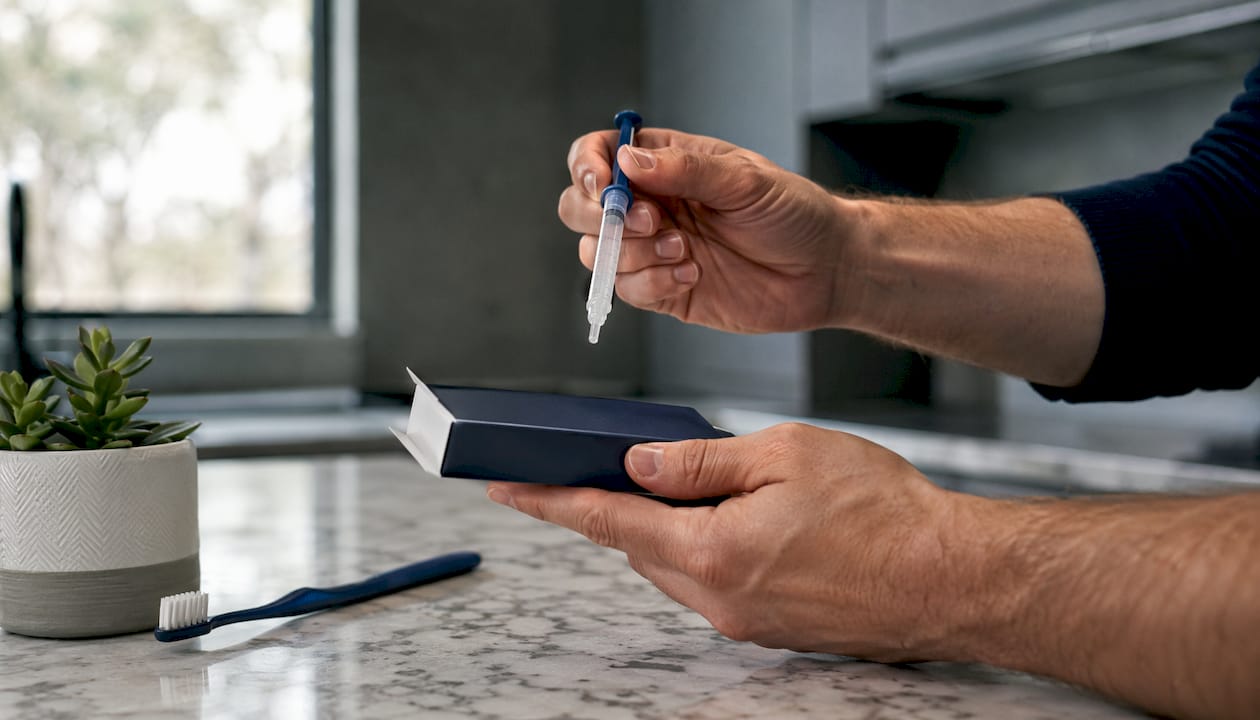
Stained or discolored teeth create a behavioral loop that quietly chips away at confidence. People who feel self-conscious about their teeth smile less, make less eye contact, and pull back from situations where their smile might be noticed. That smile suppression cuts off the mood-lifting effect that comes from smiling freely, reinforcing the original discomfort. Whitening interrupts that cycle at the source.
The biological piece matters here. Smiling freely, without holding back, triggers the release of mood-enhancing neurotransmitters. When discoloration causes people to suppress their smiles, they lose access to that emotional lift repeatedly throughout the day. Restoring confidence in your smile restores access to it.
What the research shows about the mechanism:
- Whitening produces a detectable color change that shifts self-perception almost immediately
- Reduced aesthetic anxiety leads to more natural social behavior, including more eye contact
- Increased smiling creates a positive feedback loop, reinforcing confidence over time
- Personality traits moderate how strongly these effects register for each person
Personality is a real factor. A randomized, double-blind trial found that individuals with lower neuroticism and higher perfectionism experienced the greatest short-term psychological and social benefits after whitening. People high in neuroticism may remain more critical of their appearance even after objective improvement, which is worth knowing before you start.
Pro Tip: Set your expectations around how you feel, not just how white your teeth look. Patients often perceive color relapse over time even when objective whiteness stays above baseline. Tracking your confidence and social ease, not just shade comparisons, gives you a more accurate read on whether the treatment is working for you.
How a brighter smile shapes your social and professional life
First impressions form fast, and tooth color plays a bigger role in them than most people expect. Research published in the American Journal of Orthodontics found that people with visibly white teeth were rated as more successful, more intelligent, and more trustworthy compared to those with discolored teeth. Those aren’t just aesthetic judgments; they translate into real-world outcomes in job interviews, client meetings, and networking.
Faces with whiter teeth are also consistently perceived as younger and more attractive across all age and gender groups, based on studies using digitally modified photographs. Whitened teeth received the highest ratings for youthfulness and attractiveness, with natural teeth scoring in the middle and darkened teeth scoring lowest.
Specific social behaviors that improve with smile confidence:
- More frequent and genuine smiling in conversation
- Increased eye contact, which signals engagement and warmth
- Greater willingness to speak up in group settings or meetings
- Less avoidance of photos, video calls, and public-facing situations
- Stronger rapport in first meetings, where impressions form within seconds
Teeth are also viewed as a form of physical and social capital, linked to perceptions of self-control, health, and status. That connection runs deep in American culture, where white teeth have been associated with professional success and social acceptance for well over a century. The aesthetic benefits of teeth whitening, then, aren’t superficial. They connect directly to how others read you and how you carry yourself.
Personal grooming choices, from nail care to smile aesthetics, consistently show up in research as meaningful contributors to overall self-confidence and how others perceive you.
What 2024–2026 studies reveal about whitening and confidence
The most recent research adds important nuance to the confidence story. A 2025 randomized trial tracked whitening outcomes over one year and found that psychosocial benefits were real in the short term but moderated significantly by personality. Lower neuroticism and higher conscientiousness predicted better long-term psychological outcomes.
Psychosocial benefits of whitening remained observable nine months post-procedure, with sustained improvements in social comfort and self-assurance, according to long-term follow-up research.
Key findings from 2024–2026 studies:
- Generation Z adults showed statistically significant improvements in smile satisfaction and psychosocial status after whitening
- Dental self-confidence correlates moderately with overall self-esteem (r = 0.500, p < 0.05)
- Long-term color relapse is common, and patients often perceive it even when objective whiteness stays above pre-treatment levels
- Conscientiousness predicts sustained long-term psychological benefit better than the degree of color change itself
- Personality-driven moderation effects were equally strong in both active whitening and placebo groups, suggesting mindset matters as much as shade
The long-term picture is encouraging but honest. Benefits are real and measurable, and they persist, but they are not identical for everyone. Knowing your own tendencies around perfectionism and anxiety helps you calibrate what to expect and how to maintain results. Reviewing safe whitening practices before starting a treatment plan protects both your enamel and your satisfaction.
Professional whitening vs. at-home methods: which delivers more confidence?
The confidence gap between professional and at-home whitening is smaller than most people assume, and the research backs that up. Clinical studies using PIDAQ scores show meaningful psychosocial improvements from at-home whitening with carbamide peroxide 10%, including gains in dental self-confidence and reductions in aesthetic anxiety within one month. The key variable isn’t always the method; it’s the degree of color change the person actually perceives.
Professional in-office treatments typically produce faster, more dramatic initial results, which can accelerate the early confidence boost. For people with higher neuroticism or perfectionism, that quicker visible change may matter more psychologically. At-home options, including professional-grade whitening at home, close much of that gap when used consistently and correctly.
What matters most for sustained confidence is expectation management and maintenance. Color relapse affects both treatment types over time, and the person who understands that going in tends to stay more satisfied. Getsmilefam’s BLU Whitening Technology offers an enamel-safe, hydrogen-peroxide-free approach designed for consistent at-home use, making it a practical option for adults who want real results without the cost or scheduling of repeated clinical visits.
Ready to feel the difference a brighter smile makes? The BLU Teeth Whitening Kit from Getsmilefam uses lab-approved, enamel-safe ingredients and delivers results in a single session. For adults who want a gentler option, the SmileFam for Seniors line offers the same confidence-building results with formulas designed for sensitive gums.
Key Takeaways
Whiter teeth produce measurable, research-backed improvements in self-esteem, social comfort, and professional perception, with benefits that can persist for nine months or longer after treatment.
| Point | Details |
|---|---|
| Self-esteem connection | Dental self-confidence and overall self-esteem share a moderate positive correlation of r = 0.500. |
| Long-term benefits | Psychosocial improvements from whitening remain observable nine months post-procedure. |
| Personality matters | Lower neuroticism and higher perfectionism predict the greatest short-term confidence gains after whitening. |
| Social perception | People with whiter teeth are rated as more successful, intelligent, and trustworthy in real-world studies. |
| Color relapse is common | Patients often perceive relapse even when objective whiteness stays above baseline; expectation management is key. |