

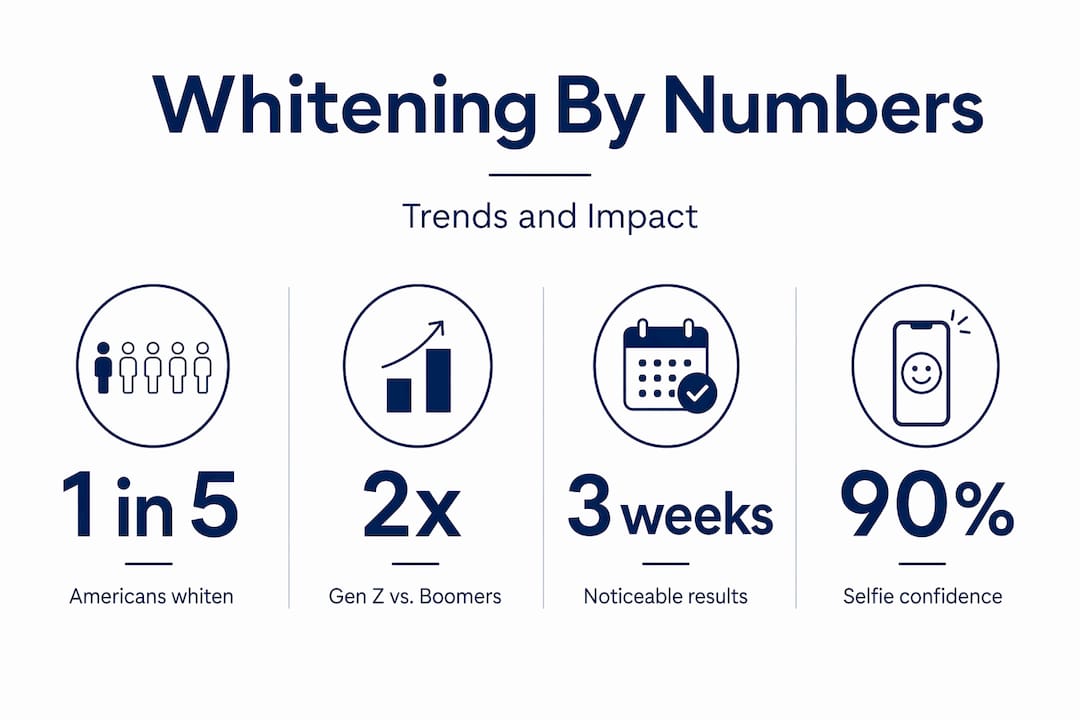
Teeth whitening has quietly become one of the most practiced cosmetic procedures on the planet, and understanding why teeth whitening is popular means looking beyond vanity. Nearly 1 in 5 Americans have had their teeth professionally whitened, and millions more use at-home kits every year. The reasons stretch from deeply social to surprisingly scientific. Smarter formulations, more affordable products, and the relentless pressure of social media have all converged to make a whiter smile feel less like a luxury and more like a standard part of personal care. This article unpacks all of it.
Table of Contents
- Key takeaways
- Why white teeth became a cultural standard
- How the science of whitening actually works
- The market forces and convenience driving adoption
- The psychological payoff no one talks about enough
- My honest take on why whitening is not going away
- Try Getsmilefam’s approach to safer whitening
- FAQ
Key takeaways
| Point | Details |
|---|---|
| Whitening is mainstream, not niche | Nearly 1 in 5 Americans have whitened their teeth, with younger adults leading adoption rates. |
| Social perception drives demand | Whiter teeth signal youth, vitality, and self-care, making them a modern social currency. |
| Modern products are genuinely safer | Low-concentration formulations now deliver real results with minimal sensitivity or adverse effects. |
| Convenience fuels growth | At-home kits and whitening pens have made professional-level results accessible without clinic visits. |
| Confidence is the core reward | Users consistently report improved self-esteem and social confidence as the primary motivation for whitening. |
Why white teeth became a cultural standard
The desire for bright teeth is not new. Across cultures and centuries, a clean white smile has been associated with health and privilege. Ancient Romans used urine for its ammonia content. Elizabethan-era aristocrats used abrasive tooth powders. What changed in the modern era is the scale and speed at which this preference spread.
Television and film normalized a certain aesthetic of radiant smiles during the mid-20th century. Then social media took that aesthetic and made it inescapable. Influencer culture and photo trends fuel interest and normalize whitening in a way no marketing campaign could replicate. The “Instagram smile” became a shorthand for aspirational beauty across generations, and whitening products were the fastest, cheapest route to achieving it.
“Teeth whiteness has become a perceptual cue for youth, health, and personal investment. It functions less like a hygiene signal and more like a social status marker in many modern contexts.”
Research backs this up. Whiter teeth are perceived as younger and healthier, and that perception carries real social weight in both personal and professional settings. In contexts where first impressions matter — job interviews, dates, client meetings — your smile communicates before you say a word.
What makes this trend especially durable is its cross-demographic reach. Consider how whitening popularity has grown:
- Younger adults are twice as likely to whiten as older adults, according to polling data on cosmetic dentistry habits
- Social class signals are embedded in dental aesthetics, with higher-income groups historically more likely to have straighter, whiter teeth
- Global diffusion means this is no longer a Western-centric trend; demand for whitening solutions available in Singapore online, across Southeast Asia, and in Australia has grown sharply alongside local beauty culture
The cultural momentum behind teeth whitening shows no sign of reversing. If anything, it accelerates with each new social platform.
How the science of whitening actually works
Most people know whitening “does something” with bleach, but the mechanism is more specific than that. Teeth develop stains in two distinct ways. Extrinsic stains sit on the outer surface of the enamel, caused by coffee, tea, wine, and tobacco. Intrinsic stains develop inside the tooth structure itself, often from aging, certain medications, or fluorosis. Color change depends on stain type, and most over-the-counter products are formulated specifically for extrinsic discoloration.
Here is what happens chemically: hydrogen peroxide releases oxygen radicals that penetrate the enamel and break apart the molecular chains responsible for staining. The result is a lighter tooth shade without physically removing enamel. The concentration of the active ingredient determines both the speed of results and the potential for sensitivity.
| Product type | Typical concentration | Average result time | Sensitivity risk |
|---|---|---|---|
| Professional in-office | 25–40% HP | 1 session | Moderate to high |
| Professional take-home tray | 10–15% HP | 2–4 weeks | Moderate |
| OTC whitening strips (standard) | 6–10% HP | 2–3 weeks | Low to moderate |
| Low-concentration strips | 3% HP | 3–4 weeks | Minimal |
| Whitening pens | 3–6% HP | Variable | Minimal |
Recent clinical trials confirm that low-concentration whitening strips are effective and well-tolerated, producing meaningful shade improvement with no serious adverse events. This research has been a turning point in consumer confidence. For years, people assumed you had to choose between results and comfort. The data now shows you do not.
Pro Tip: If sensitivity is your main concern when whitening, choose a product with 3% hydrogen peroxide or a peroxide-free formulation. You can also apply a remineralizing gel after each session to rebuild enamel strength and reduce discomfort. Learn more about managing whitening sensitivity before you start.
Sensitivity management determines consumer compliance, and this is exactly why lower-concentration products have grown so rapidly. People actually complete their treatment cycles because they can tolerate them.
The market forces and convenience driving adoption
The teeth whitening industry is not just popular. It is one of the fastest-growing segments in consumer health. The global whitening kits market is projected to reach $14.43 billion by 2034 with a compound annual growth rate of 6.7%. That kind of sustained growth reflects genuine consumer demand, not a passing trend.
Here is what is actually driving that growth, in order of impact:
- At-home accessibility. You no longer need a dental appointment to get results. OTC strips, pens, and LED kits have put clinic-grade whitening within reach for everyday consumers. Approximately 19% of Australian adults use DIY whitening kits, while only a third opt for professional treatments. That ratio holds in most developed markets.
- Price compression. Professional whitening in Singapore can cost several hundred dollars per session. Quality at-home options cost a fraction of that. When affordable whitening products become available, the addressable market expands dramatically.
- Social media visibility. Product innovation and social media trends are key drivers expanding whitening’s appeal. Before-and-after content is among the most shared beauty content online. Every user who posts their results becomes an unpaid ambassador for the category.
- Technology enhancements. LED light accelerators, app-guided treatment schedules, and enamel-safe formula advances have made at-home whitening more precise and user-friendly than it was even five years ago.
The demographic data is equally telling. Millennials and Gen Z are the most engaged whitening consumers globally, which matters because both cohorts treat self-presentation as a serious investment. Whitening fits naturally into routines that already include skincare, fitness, and curated social profiles.
In markets like Singapore, this intersection of aesthetics, technology, and convenience is especially visible. Searches for the best teeth whitening products in Singapore in 2026 have grown alongside broader demand for affordable whitening products that do not require multiple dental visits. The appetite for teeth whitening options in Singapore reflects a global pattern: consumers want real results, safely, on their own schedule.
The psychological payoff no one talks about enough
Here is what the before-and-after photos never fully capture: the internal shift that happens when you feel good about your smile. This is why teeth whitening popular in Singapore and globally is not just a cosmetic trend. It is a confidence story.
Whitening acts as a social cue for self-care, signaling to others that you invest in yourself. But the more significant effect is internal. Users consistently report a measurable boost in social confidence after whitening. They smile more. They speak up more in meetings. They feel less self-conscious in social situations. These are not trivial outcomes.
Consider what this looks like in practice:
- A professional preparing for a job interview whitens their teeth and reports feeling more composed and confident during the conversation.
- Someone returning to dating after a long relationship includes whitening in their self-reinvention routine because it signals a fresh start to themselves, not just to others.
- A student about to give a major presentation whitens as part of their confidence preparation, alongside rehearsing their delivery.
Whitening fits into broader self-care routines precisely because its results are visible and immediate. Unlike skincare that takes months to show progress, or fitness that requires sustained effort before results appear, whitening delivers a noticeable change within days. That fast feedback loop makes it psychologically rewarding in a way few other cosmetic practices can match.
Pro Tip: Pair whitening with a strong daily oral hygiene routine to extend your results. Whitening works best when combined with consistent brushing, flossing, and avoiding heavy staining beverages in the first 48 hours after treatment. Check out these safe daily whitening picks to maintain your results longer.
The psychosocial dimension also explains why whitening has become a routine event-driven behavior. Weddings, graduations, job changes, and reunions consistently spike whitening product sales. People reach for whitening not just as maintenance but as a marker of transition and celebration.
My honest take on why whitening is not going away
I’ve spent years watching cosmetic trends rise and fall, and teeth whitening keeps compounding in popularity for one reason: it delivers on its promise faster than almost anything else in personal care.
What I’ve noticed is that whitening often functions as a gateway. Someone tries a whitening pen, gets results they can see within a week, and suddenly becomes more invested in the full picture of dental aesthetics. That’s when people start exploring veneers, aligners, or professional treatments. The whitening category feeds the broader cosmetic dentistry market in ways that are underappreciated.
What I’ve also learned is that the risks of overuse are real but overstated in casual conversation. Most people who experience sensitivity are using products at too high a concentration, too frequently. The solution is not to avoid whitening. It is to choose well-formulated products and follow the recommended protocols. A step-by-step approach to safe professional whitening is worth understanding even if you ultimately choose to whiten at home.
Social media makes this harder, not easier. The pressure to achieve unrealistically white results in three days leads people toward aggressive products they do not need. My advice: treat whitening as a gradual process and measure success in weeks, not sessions. The results you sustain are worth more than the results you rush.
— Lenney
Try Getsmilefam’s approach to safer whitening
If this article has you thinking seriously about whitening, Getsmilefam is worth exploring. Built around proprietary BLU Whitening Technology developed in Singapore, Getsmilefam formulates products specifically for people who want results without the harshness of high-peroxide formulas.
Their flagship Snow Serum™ Whitening Pen is designed for daily use, works in a single session, and avoids the enamel damage associated with aggressive treatments. For anyone who wants a more thorough at-home setup, the BLU Teeth Whitening Kit pairs LED acceleration with enamel-safe serum for visible results without a dentist visit. Both products align with what the research actually supports: lower concentrations, consistent use, and smart formulation over brute chemical strength.
FAQ
Why is teeth whitening so popular right now?
Teeth whitening has grown popular because of the combination of social media pressure, more affordable at-home products, and genuine improvements in formula safety. Research shows that whiter teeth signal youth and vitality, making them a modern marker of personal investment.
Is at-home whitening actually safe?
Yes, when used correctly. Clinical trials confirm that low-concentration strips cause minimal side effects and no serious adverse events, making them a well-tolerated option for most people. Following the product’s recommended schedule is the key to safe results.
How long does teeth whitening take to show results?
At-home products typically show noticeable results within one to three weeks depending on the concentration and stain type. Whitening pens and low-concentration strips are slower but gentler, making them better suited for people with sensitivity concerns.
Why do younger people whiten their teeth more than older adults?
Adults under 45 are about twice as likely to whiten as older adults, largely because younger consumers are more exposed to social media aesthetics and more likely to integrate whitening into regular beauty routines. The event-driven nature of whitening also maps well to life stages like first jobs, engagements, and graduations.
Does teeth whitening actually boost confidence?
Consistently, yes. Users report measurable improvements in self-esteem and social ease after whitening. The effect is tied to the fact that whitening delivers visible results quickly, reinforcing the psychological reward of investing in personal appearance.