

Teeth whitening return on investment (ROI) measures the financial and aesthetic value you gain relative to what you spend on whitening treatments. Unlike a simple purchase, whitening is a decision with compounding returns: a brighter smile affects how you feel, how others perceive you, and how often you need to repeat the treatment. The real question is not just “how much does it cost?” but “how much value does it deliver over time?” This article breaks down the cost of teeth whitening, compares your options, and shows you exactly how to get the most from every dollar you spend.
What is the teeth whitening return on investment?
Teeth whitening ROI is best understood as cost per shade improvement multiplied by how long those results last. ROI for whitening should be evaluated by cost per shade improvement and durability over time, with professional treatments often offering better long-term value despite higher upfront cost. That framing changes everything. A $45 over-the-counter strip kit sounds affordable until you realize you are buying it three times a year.
The two main categories are professional in-office whitening and over-the-counter (OTC) products. Professional treatments use higher-concentration peroxide gels applied by a licensed dentist. OTC options include whitening strips, trays, and pens available at any pharmacy. Both deliver real results, but the gap in effectiveness and longevity is significant enough to affect your total cost over a two-year period.
Intangible returns matter too. Confidence, first impressions, and professional presence are real outputs of a whiter smile. They are harder to quantify, but consumer research consistently links improved appearance to higher self-reported confidence and better social outcomes. Treating whitening as a pure expense misses half the picture.
Professional vs. OTC whitening: cost, results, and longevity
The numbers here are concrete. Professional in-office whitening costs $300–$800 and produces 6–10 shade improvements in 1–2 hour sessions. OTC strips cost about $45 and deliver 2–5 shade improvements over 14–20 days. That is a meaningful gap in both speed and outcome.
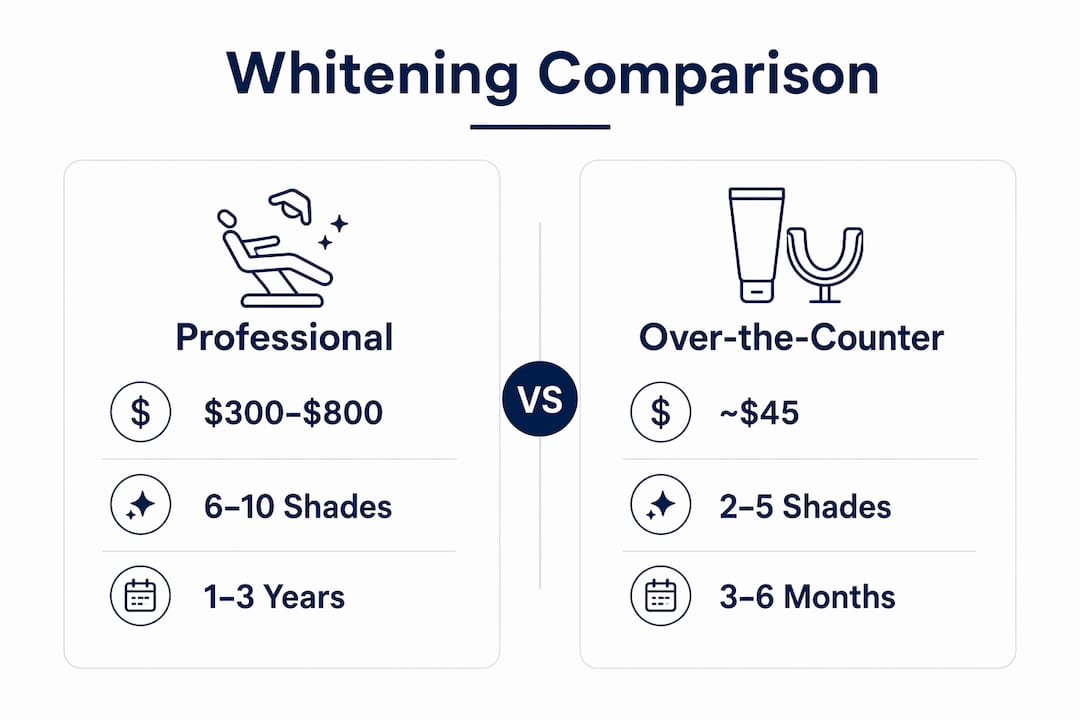
Longevity widens the gap further. Professional whitening results last 1–3 years with proper hygiene, while OTC results typically need touch-ups every 6–12 months. If you use OTC strips twice a year at $45 per kit, you spend $90 annually. Over three years, that is $270 with modest shade improvement and repeated sensitivity cycles.
| Factor | Professional whitening | OTC whitening |
|---|---|---|
| Average cost | $300–$800 per session | ~$45 per kit |
| Shade improvement | 6–10 levels | 2–5 levels |
| Results duration | 1–3 years | 6–12 months |
| Sensitivity risk | Lower with custom protocols | Moderate, varies by product |
| Supervision | Dentist-supervised | Self-administered |
Pro Tip: If you want to compare true cost, divide the total spend by the number of shades improved and the months results last. A $600 professional treatment lasting 30 months at 8 shades improved often beats a $45 kit lasting 8 months at 3 shades improved on every metric.
What factors affect your whitening investment value?
Not every patient gets the same return from the same treatment. Several variables determine whether your whitening investment delivers full value or falls short.
- Lifestyle habits. Coffee, tea, red wine, and tobacco are the primary drivers of tooth discoloration and the fastest way to shorten whitening results. Lifestyle factors like coffee directly affect how long whitening results last. Cutting back or rinsing after staining beverages extends your results without additional cost.
- Initial tooth shade and stain type. Extrinsic stains from food and drink respond well to peroxide-based whitening. Intrinsic stains from tetracycline antibiotics or fluorosis are harder to treat and may require more sessions, raising your total cost.
- Dental restorations. Crowns, veneers, and fillings do not respond to whitening agents. Treating natural teeth alongside restorations can create uneven color, reducing satisfaction and perceived ROI. Completing any dental work before whitening protects your results.
- Sensitivity concerns. Temporary sensitivity during whitening comes from peroxide opening dentinal tubules. It resolves quickly and is manageable with desensitizing toothpaste and lower-concentration protocols. Unmanaged sensitivity leads some people to abandon treatment early, wasting their investment. Reviewing sensitivity management strategies before you start can prevent that outcome.
- Pre-treatment dental health. Dr. Cindy Li of Excel Dental stresses dental exams before whitening to identify gum disease, cavities, or exposed roots that affect both safety and outcomes. Skipping this step is one of the most common ways consumers reduce their own ROI.
How to maximize your teeth whitening ROI
Getting the most from your whitening investment comes down to four decisions made before, during, and after treatment.
- Choose peroxide-based treatments. Charcoal and baking soda DIY methods lack clinical evidence and can cause irreversible enamel damage. Peroxide-based bleaching is the scientifically proven method. Choosing the right chemistry from the start protects your enamel and your money. You can review safe vs. harsh whitening options to understand what to avoid.
- Invest in custom trays. Custom-fitted professional trays allow more affordable professional-grade gel refills at home, saving money over repeated in-office visits or OTC product cycles. The upfront cost is higher, but the per-use cost drops significantly after the first purchase.
- Follow a maintenance protocol. Touch-up treatments every 6–12 months preserve professional results without the full cost of a new session. Pairing touch-ups with a consistent oral hygiene routine, including twice-daily brushing and regular dental cleanings, extends results further.
- Time your treatment correctly. Whitening after completing any dental restorations and after resolving active gum issues gives you the cleanest baseline. Starting with healthy teeth and gums means the whitening agent works on the right surfaces from day one.
Pro Tip: Use desensitizing toothpaste for two weeks before your whitening treatment. It pre-loads potassium nitrate into the dentinal tubules, reducing sensitivity during the process and making it easier to complete the full protocol without interruption.
Long-term financial and intangible benefits of teeth whitening
The teeth whitening investment value extends well beyond the treatment chair. Over a three-year horizon, the financial case for professional whitening over repeated OTC use becomes clear. Three years of biannual OTC strip purchases costs $270 with modest results. A single professional session at $600 with one $50 touch-up kit at the 18-month mark costs $650 total, with significantly better shade improvement and consistency.
The intangible returns are harder to price but no less real. A clinical and consumer evidence review confirms that professional whitening offers better outcomes and less sensitivity than OTC alternatives. Patients who achieve their target shade report higher satisfaction and are less likely to continue spending on additional products.
“A whiter smile is one of the most requested cosmetic improvements because the return is immediate and visible. Patients who invest in professional whitening consistently report higher confidence and satisfaction than those who cycle through OTC products.” — Composite insight from GB Dentistry clinical review
Career and social returns are also documented. Studies in social psychology consistently show that appearance affects first impressions within seconds. A brighter smile signals health and confidence, two attributes that matter in job interviews, client meetings, and social settings. These returns do not appear on a receipt, but they are part of the honest teeth whitening cost analysis every consumer should run.
For readers who want a practical breakdown of money-saving whitening strategies, combining professional treatment with smart at-home maintenance is the approach that consistently delivers the best financial and aesthetic outcome.
Key takeaways
Teeth whitening ROI is highest when you choose peroxide-based treatments, complete dental work first, and maintain results with a consistent oral care protocol.
| Point | Details |
|---|---|
| ROI definition | Measure whitening value as cost per shade improved divided by months results last. |
| Professional vs. OTC cost | Professional whitening costs $300–$800 but lasts 1–3 years; OTC costs $45 but needs repeating every 6–12 months. |
| Restorations affect results | Complete crowns, veneers, or fillings before whitening to avoid uneven color and wasted spend. |
| Peroxide is proven | Charcoal and DIY methods risk enamel damage; peroxide-based bleaching is the only clinically validated option. |
| Intangible returns count | Confidence and professional appearance are real outputs of whitening that belong in any honest cost-benefit analysis. |
My take on evaluating whitening as an investment
I have seen too many people spend $200 on OTC products over 18 months and end up with patchy, underwhelming results. Then they conclude that whitening does not work. The problem was never whitening. The problem was the framework they used to evaluate the purchase.
The biggest misconception I encounter is that a lower sticker price means better value. It almost never does in teeth whitening. A $600 professional session that lasts three years and delivers 8 shades of improvement is a fundamentally different product than a $45 strip kit. Treating them as comparable because they both “whiten teeth” is like comparing a $15 haircut to a $90 one and being surprised the results differ.
The second thing I would push back on is skipping the dental exam. I understand the impulse. It feels like an extra cost. But whitening over an untreated cavity or inflamed gums does not just reduce your ROI. It can cause real harm. The exam is not overhead. It is the foundation that makes the investment work.
My honest recommendation: think of whitening the way you think of any appearance investment with a long shelf life. Calculate the cost per month, not the upfront price. Factor in the confidence return. And choose a method with clinical evidence behind it, not just a compelling before-and-after photo.
— Lenney
How Getsmilefam supports your whitening investment
Getsmilefam builds products for people who want real whitening results without the complexity or cost of repeated dental visits. The Premium Travel Kit is designed to maintain your whitening results on the go, so travel and busy schedules do not undo the investment you have already made. For users with sensitive teeth or gums, Getsmilefam’s enamel-safe formulas use BLU Whitening Technology without harsh hydrogen peroxide, making consistent maintenance comfortable and practical.
Getsmilefam also offers a 1-year warranty on its products, adding confidence to every purchase. Whether you are maintaining professional results or starting your whitening routine at home, Getsmilefam gives you the tools to protect and extend the value of your smile investment.
FAQ
What is the average return on investment for teeth whitening?
Teeth whitening ROI is measured as cost per shade improved over the duration results last. Professional treatments at $300–$800 typically deliver 6–10 shades over 1–3 years, making them more cost-effective per month than OTC kits requiring replacement every 6–12 months.
Is professional teeth whitening worth the higher cost?
For most people, yes. Professional whitening delivers more consistent results, less sensitivity, and longer-lasting outcomes than OTC alternatives, which lowers your total spend over a two-to-three year period.
How long do teeth whitening results last?
Professional whitening results last 1–3 years with proper oral hygiene and lifestyle habits. OTC strip results typically fade within 6–12 months and require more frequent repurchasing to maintain the same shade.
Does teeth whitening work on crowns or veneers?
No. Whitening agents do not affect dental restorations like crowns, veneers, or fillings. Whitening natural teeth alongside restorations can create uneven color, so completing any dental work before treatment is the standard recommendation.
What is the safest and most effective whitening method?
Peroxide-based bleaching is the only clinically validated whitening method. Charcoal and baking soda alternatives lack clinical evidence and risk enamel damage, making them a poor investment for both your teeth and your money.