

To reduce tea stains on teeth, rinse your mouth with plain water immediately after drinking, add milk to your tea, use a straw for cold brews, and wait before brushing, especially after hot tea. Pair those habits with a stain-fighting whitening toothpaste two to three times a week, and most surface discoloration stays manageable without giving up your daily cup.
Quick action checklist:
- Swish and spit plain water right after finishing your tea
- Add milk to black tea before drinking (more on why this works below)
- Use a straw for iced or cold-brew tea to limit contact with enamel
- Wait before brushing, especially after hot tea
- Brush with a whitening toothpaste regularly
Pro Tip: Add milk to your cup before pouring the tea, not after. A laboratory study found that milk proteins (casein) bind tannins more effectively when mixed early, reducing the amount of staining pigment that ever reaches your enamel — a small order change with a measurable payoff.
Key Takeaways
Rinsing with plain water immediately after tea and adding milk before drinking are the two highest-impact, zero-cost habits for preventing surface stains from forming.
| Point | Details |
|---|---|
| Rinse right away | Swish plain water for 20–30 seconds after every cup to remove free tannins before they bond. |
| Add milk early | Casein proteins bind tannins before they reach enamel; add milk before pouring tea for best effect. |
| Wait before brushing | Brush no sooner than 30 minutes after tea to avoid abrading temporarily softened enamel. |
| Use whitening toothpaste | Apply a mild-abrasive or low-peroxide whitening toothpaste two to three times a week for surface stain control. |
| Getsmilefam BLU Toothpaste | An enamel-safe, peroxide-free option for routine tea-stain maintenance, suitable for sensitive gums. |
Table of Contents
- Why does tea stain your teeth in the first place?
- What to do right after drinking tea
- Everyday habits that prevent stain buildup
- Safe at-home stain-reduction methods
- Professional options for removing tea stains
- What results to expect and typical costs in Singapore
- An honest take on tea stains and what actually works
- Getsmilefam’s BLU technology for tea-stain maintenance
- Sources
Why does tea stain your teeth in the first place?
Tea contains two main culprits: tannins and chromogens. Tannins are plant polyphenols that act like a sticky net, making it easier for chromogens (the color-carrying compounds) to grip the surface of your teeth. Once chromogens latch onto enamel, they oxidize and darken over time, producing the yellowish-brown tint that tea drinkers know well.
Enamel is not perfectly smooth at a microscopic level. Its porous surface gives chromogens more places to anchor, and research on staining chemistry confirms that surface roughness directly amplifies how visible the discoloration becomes. Hot tea compounds the problem: heat temporarily opens enamel pores, letting pigments penetrate more deeply.
Acidity matters too. Tea is mildly acidic, and after any acidic drink, enamel softens briefly. That window of softness makes the surface more vulnerable to both staining and abrasion, which is exactly why brushing immediately after tea does more harm than good.
Not all teas stain equally:
- Black tea has the highest tannin concentration and stains the most aggressively
- Oolong tea sits in the middle range
- Green and white teas carry fewer tannins and cause noticeably less discoloration
- Herbal teas vary widely; most are low-risk, though hibiscus and berry blends can still pigment enamel
Adding milk changes the equation. A laboratory study on extracted human teeth found that milk proteins (casein) bind tannins before they interact with enamel, producing a statistically significant reduction in staining. That is not folk wisdom — it is a measurable chemical interaction.
What to do right after drinking tea
Speed matters here. The longer tannins sit against enamel, the more they bond. These steps interrupt that process before it completes.
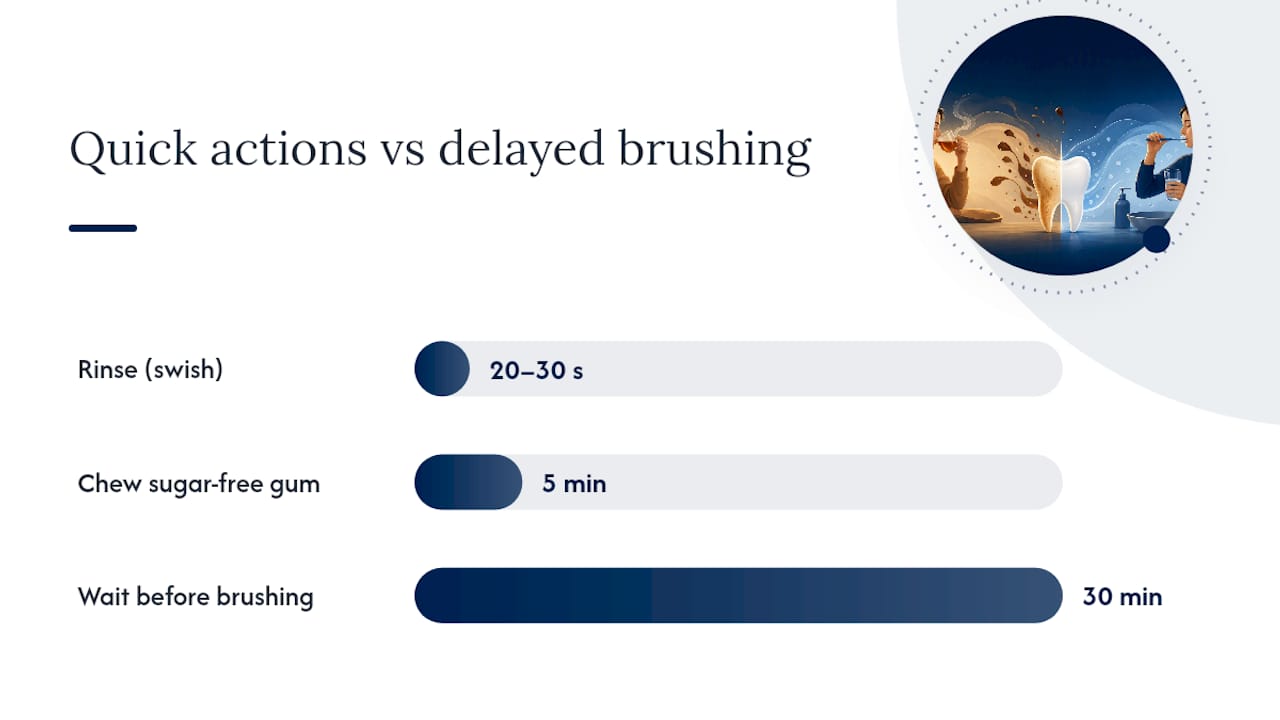
- Rinse with plain water immediately. Swish for 20–30 seconds and spit. This removes free pigments that have not yet bonded to enamel.
- Drink a glass of water alongside or right after your tea. It dilutes residual tannins and keeps saliva flowing.
- Chew sugar-free gum for five minutes. Chewing stimulates saliva, which naturally neutralizes acids and washes away loose chromogens.
- Add milk to your tea before drinking, not as an afterthought. The casein-tannin binding effect is strongest when milk is mixed in early.
- Use a straw for iced or cold-brew tea. Straws direct liquid past the front teeth, cutting direct enamel contact significantly.
The one thing most people get wrong: brushing immediately. Clinical evidence on enamel erosion shows that brushing within 30 minutes of an acidic drink can accelerate enamel wear because the surface is still temporarily softened. Rinse with water instead, then brush after the 30-minute window has passed.
Avoid using abrasive scrubs or concentrated acidic rinses (like undiluted lemon juice) as a quick fix. They strip enamel faster than tannins ever would.
Pro Tip: Keep a small bottle of water at your desk. Sipping water between tea cups is one of the most clinically recommended and lowest-effort habits for preventing stain buildup throughout the day.
Everyday habits that prevent stain buildup
Preventing stains long-term is mostly about consistency, not heroic interventions. A few well-chosen habits do most of the work.
Daily oral hygiene:
- Brush twice daily with a fluoride toothpaste, and swap in a whitening toothpaste two to three times a week. Look for formulas with mild abrasives (like hydrated silica) or low-concentration peroxide — they lift surface stains without grinding enamel.
- Floss every night. Staining compounds accumulate between teeth just as readily as on front surfaces.
- Rinse after every cup of tea, not just the last one of the day.
Lifestyle adjustments that actually move the needle:
Switching from black to green or white tea cuts your tannin exposure significantly without requiring you to quit tea entirely. Reducing the steeping time for black tea also lowers tannin concentration in each cup. Drinking tea in one sitting rather than sipping slowly over an hour limits how long enamel is exposed.

Smoking is worth a direct mention: tobacco staining compounds interact with tea tannins and amplify discoloration far beyond what either does alone. Other high-chromogen foods and drinks — red wine, turmeric, soy sauce — stack on top of tea staining, so moderating them matters for anyone serious about keeping teeth bright. For a broader look at lifestyle changes for whiter teeth, the pattern is consistent: fewer staining inputs plus better rinsing habits equals slower stain accumulation.
Professional dental cleanings every six months remove the calcified deposits that trap surface chromogens, resetting your baseline before stains become embedded.
Safe at-home stain-reduction methods
Home treatments range from genuinely effective to quietly damaging. Knowing the difference saves your enamel.
What works:
- Whitening toothpaste with mild abrasives or low-concentration hydrogen peroxide is the most evidence-supported home option for surface stain removal. Use it two to three times a week rather than replacing your regular toothpaste entirely.
- Baking soda paste (mixed with water to a thin consistency) can lift surface stains when used occasionally, because sodium bicarbonate is a mild abrasive. Limit use to once a week at most. More frequent use risks gradual enamel wear.
- Over-the-counter whitening pens and strips can reduce visible staining when used as directed. Follow the manufacturer’s instructions on frequency — overuse leads to sensitivity and potential gum irritation.
What to avoid:
- Abrasive charcoal powders used daily. Activated charcoal products are often marketed aggressively, but peer-reviewed literature notes that high-abrasion treatments accelerate enamel loss over time.
- Swishing undiluted hydrogen peroxide. Concentrations above 3% can irritate gum tissue and damage enamel when used without professional guidance.
- Household cleaning agents. Nothing on a cleaning shelf belongs near tooth enamel.
Dental guidance consistently identifies whitening toothpaste and professional polishing as the safest and most effective combination for tea-stain management. Home methods handle maintenance; they cannot reverse deep or intrinsic discoloration.
Safety note: If you notice increased sensitivity after any whitening product, stop use and consult a dentist before continuing.
Professional options for removing tea stains
When home care plateaus, a dentist can achieve results that no toothpaste or pen can match.
- Scaling and polishing (prophylaxis): A hygienist removes calculus (hardened deposits) and polishes away surface chromogens using a professional-grade abrasive paste. Most surface tea stains respond well to a single session.
- In-clinic whitening: Procedures using higher-concentration peroxide gels, often activated by a light source, can lift staining several shades in one appointment. Results depend on the depth of discoloration and individual enamel condition.
- Assessment for intrinsic staining: If discoloration persists after polishing and whitening, a dentist will assess whether the staining is intrinsic (inside the tooth structure) rather than surface-level. Intrinsic staining requires different treatment, sometimes veneers or bonding.
When to book an appointment:
- Staining persists despite consistent home care for four to six weeks
- You notice sensitivity that was not there before
- Discoloration appears uneven or has changed color (gray or brown tones can indicate internal issues)
- You have not had a professional clean in over six months
Pro Tip: Ask your hygienist specifically about an air-polishing treatment (sometimes called Airflow). It uses a fine powder jet to remove surface chromogens from areas a standard polish misses, including between teeth and along the gumline — particularly useful for heavy tea drinkers. For a full breakdown of clinical options, Clayton Dental Studio’s stained teeth page covers what to expect from each procedure.
What results to expect and typical costs in Singapore
Timeline varies by method:
- Rinsing and milk addition: Prevents new staining immediately; does not reverse existing stains
- Whitening toothpaste: Visible improvement in two to four weeks of consistent use
- OTC whitening pens or strips: Noticeable lightening within one to two weeks when used as directed
- Professional scaling and polish: Immediate visible improvement after a single session
- In-clinic whitening: Significant shade change in one to two sessions
Typical cost ranges in Singapore (check directly with clinics for current pricing):
Results from professional whitening typically last six to twelve months with good maintenance habits. Once you reach your target shade, maintaining white teeth comes down to consistent rinsing, periodic whitening toothpaste use, and six-monthly cleanings.
An honest take on tea stains and what actually works
Most advice on this topic treats tea stains as a cosmetic inconvenience to be solved by buying something. The reality is more interesting: the single most effective intervention costs nothing. Rinsing with water immediately after every cup, consistently, prevents more staining than any toothpaste you can buy. The evidence for this is straightforward, and yet it is the habit most people skip because it feels too simple.
The milk finding deserves more attention than it gets. The casein-tannin binding mechanism is not a wellness trend — it is a laboratory-confirmed interaction. For Singapore tea drinkers who already take their teh with milk, this is genuinely good news: your habit is working in your favor. For those drinking black tea straight, adding milk is the highest-value, lowest-cost change available.
Where people go wrong is reaching for abrasive DIY methods when stains accumulate. Charcoal powders, baking soda used daily, and concentrated peroxide rinses all carry real enamel risks that compound over years. The smarter approach is prevention first, gentle whitening toothpaste second, and professional cleaning when the baseline needs resetting. That sequence protects enamel while keeping teeth visibly bright.
Getsmilefam’s BLU technology for tea-stain maintenance
Tea drinkers who want a reliable at-home option between dental visits have a clear alternative to harsh DIY methods. Getsmilefam’s BLU Whitening Toothpaste is formulated without hydrogen peroxide, uses an enamel-safe formula suitable for sensitive gums, and is designed for routine stain maintenance rather than one-off bleaching. Use it two to three times a week alongside your regular fluoride toothpaste, always after the 30-minute post-tea window.
For tea drinkers who travel frequently, the Premium Travel Kit keeps the same stain-prevention routine portable. Pair either product with the rinsing and timing habits covered in this article for the best results. If you experience sensitivity or notice staining that does not respond to home care, a professional cleaning is the right next step — no at-home product replaces that. Browse Getsmilefam’s full safe whitening guidance and pick the product that fits your routine.
Sources
- Milk Reduces Enamel Staining Caused by Black Tea and Chlorhexidine Mouthwash
- Dentaly
- How to Remove Coffee and Tea Stains from Your Teeth | Advantage Dental+
- Ncbi
This article is general information, not a substitute for advice from a qualified doctor. Consult a qualified healthcare professional about your own circumstances before acting on anything here.