

Whitening without irritation is the practice of brightening teeth or skin using safe, non-sensitizing ingredients and methods that avoid causing pain, redness, or barrier damage. The industry term for this approach is “gentle brightening,” and it covers both dental and cosmetic applications. Demand for irritation-free whitening has grown sharply as more people with sensitive teeth and reactive skin reject harsh bleaching treatments. Formulations built around PAP+ technology for teeth and niacinamide for skin now deliver visible results without the burning, sensitivity, or inflammation that older methods routinely caused. Getsmilefam’s BLU Whitening Technology is one example of this shift toward safe, effective brightening.
What is whitening without irritation, and why does it matter?
Whitening without irritation means achieving a brighter smile or more even skin tone without triggering sensitivity, inflammation, or barrier damage. Traditional whitening relied on aggressive oxidizers and acids that worked fast but caused real harm. The growing science of gentle brightening proves you do not have to choose between results and comfort.
The demand for this approach is not cosmetic vanity. People with sensitive teeth, reactive skin, or conditions like rosacea and melasma face genuine risks from harsh treatments. Irritation does not just hurt. It can worsen the very discoloration you are trying to fix by triggering post-inflammatory hyperpigmentation.
Gentle brightening works by targeting the source of discoloration, whether surface stains on enamel or excess melanin in skin, without disrupting the surrounding tissue. The key is ingredient selection and application protocol. The right actives at the right concentrations, applied for the right amount of time, deliver results without the side effects.
Why does traditional whitening cause irritation?
Traditional teeth whitening relies on hydrogen peroxide as its primary active. Hydrogen peroxide penetrates tooth structure and reaches the nerve, causing sensitivity that can last days. It also irritates gum tissue on contact, producing the burning sensation many people associate with whitening trays and strips.
Skin whitening products have a parallel problem. Many older formulas use high concentrations of hydroquinone, glycolic acid, or kojic acid in forms that strip the skin barrier. When the barrier breaks down, the skin becomes reactive, red, and prone to stinging with any follow-up product.
The core issue in both cases is barrier damage. Here is what makes it worse: the irritation itself triggers inflammation, and inflammation stimulates melanocytes to produce more pigment. You end up with more discoloration than you started with. This cycle is well documented in dermatology and explains why aggressive whitening often backfires on sensitive skin.
Pro Tip: If a whitening product makes your gums or skin burn, stop using it immediately. Burning signals barrier damage, not efficacy. A product that works correctly should feel neutral or mildly cool, never painful.
The key problems with traditional whitening methods include:
- Peroxide oxidizers penetrate enamel and irritate gum tissue, causing nerve sensitivity
- High-concentration acids in skin products strip the protective barrier layer
- Inflammation from irritation stimulates excess melanin production, worsening pigmentation
- Barrier disruption makes skin and gum tissue reactive to products that would otherwise be tolerable
- Rebound effects leave skin or teeth more sensitive after treatment than before
How does modern teeth whitening achieve results without irritation?
PAP+, or Phthalimidoperoxycaproic Acid, is the most significant advance in irritation-free teeth whitening. PAP+ targets only superficial stains without penetrating deeply into enamel structure. This means it breaks down discoloration molecules at the surface without triggering the nerve sensitivity or gum burning that peroxide causes.
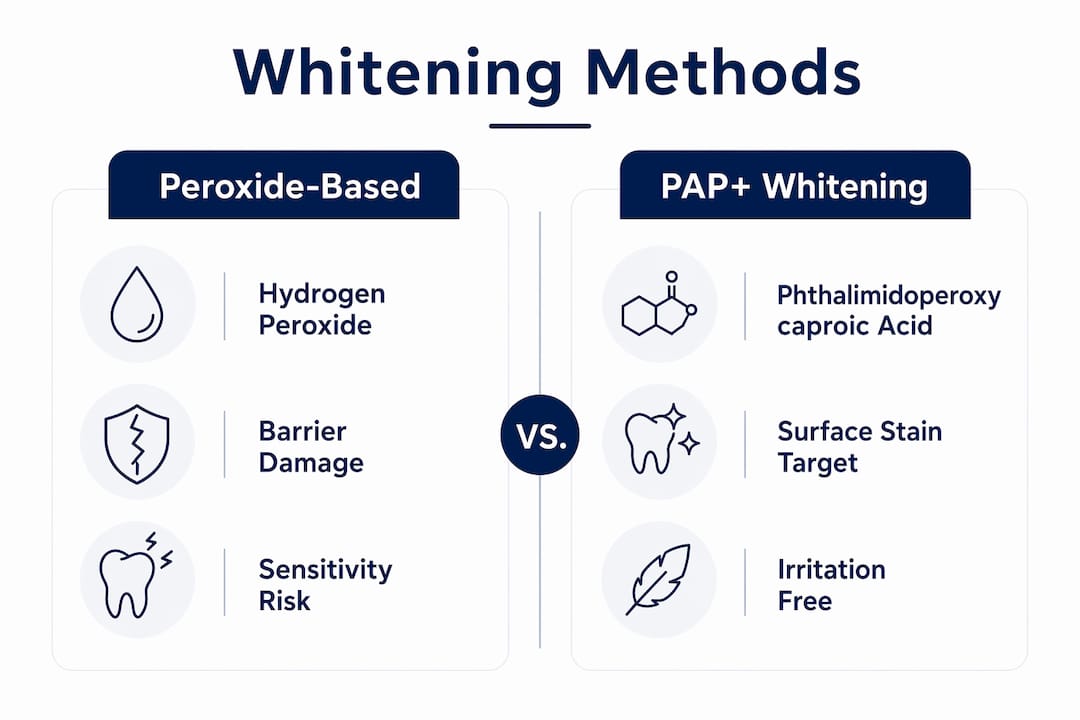
The chemistry matters here. Hydrogen peroxide releases free radicals that oxidize broadly, affecting enamel minerals and soft tissue along with the stain molecules. PAP+ is a more selective oxidizer. It reacts with chromogens, the colored compounds responsible for staining, while leaving enamel mineralization and gum tissue intact. PAP-based formulas cause little to no sensitivity in daily use, even for people who previously found peroxide products unbearable.
Getsmilefam’s Snow Serum™ Whitening Pen uses this principle, delivering brightening actives without harsh chemicals like hydrogen peroxide. The formula is designed specifically for people with sensitive gums who need results without the trade-off of pain.
Pro Tip: When evaluating a whitening product, check the active ingredient list first. If hydrogen peroxide or carbamide peroxide appears at the top, expect sensitivity. PAP+ or enzyme-based formulas are the safer choice for sensitive teeth.
| Feature | Peroxide-based whitening | PAP+ whitening |
|---|---|---|
| Primary active | Hydrogen peroxide | Phthalimidoperoxycaproic Acid |
| Enamel impact | Can demineralize enamel | Targets surface stains only |
| Gum irritation | Common, sometimes severe | Minimal to none |
| Sensitivity risk | High, especially with repeated use | Low, suitable for daily use |
| Speed of results | Fast, often one session | Gradual, consistent improvement |
The 2026 guide on sensitivity-free whitening from Getsmilefam covers these distinctions in detail, including how application time and formula concentration affect outcomes for sensitive users.
Non-irritating skin brightening: ingredients and application strategies
Skin brightening without irritation follows a different science than teeth whitening, but the principle is the same. You target the mechanism of discoloration without damaging the surrounding tissue. The best gentle skin brighteners work by interrupting melanin production or transfer rather than stripping pigmented cells away.
The four most effective non-irritating approaches are:
-
Niacinamide (2–5%): Niacinamide inhibits melanosome transfer from melanocytes to skin cells, reducing visible pigmentation without shutting down melanocyte function entirely. It also strengthens the skin barrier, which makes it uniquely suited to sensitive skin. Products at 2–5% concentration are both effective and well tolerated.
-
Short-contact therapy: Short-contact therapy limits exposure time of brightening agents to 5–15 minutes before rinsing. This method achieves significant pigment reduction without inflammation in reactive skin. It is the same logic as a leave-on versus rinse-off treatment, applied with precision.
-
Kojic acid derivatives: Kojic dipalmitate penetrates skin gradually, reducing irritation compared to pure kojic acid. It inhibits tyrosinase, the enzyme that drives melanin production, with a lower risk of redness or stinging. This makes it a practical option for people who cannot tolerate stronger tyrosinase inhibitors.
-
Antioxidant support: Vitamin C derivatives, resveratrol, and ferulic acid reduce oxidative stress that drives pigmentation. They work best as supporting actives alongside a primary brightener, not as standalone treatments.
Pro Tip: Never layer a brightening acid, a retinoid, and a niacinamide product in the same routine. Fewer, well-chosen actives prevent the combined irritation that comes from stacking too many strong ingredients at once.
Visible improvement from gentle brightening takes 8–12 weeks of consistent use. Rapid or harsh treatments increase the risk of barrier damage and rebound hyperpigmentation. Patience is not optional here. It is the mechanism. Gentle actives work by gradually shifting the skin’s pigment balance, not by forcing an overnight change.
For people managing dark spots alongside sensitive skin, the dark spot strategies at Yuka+Face offer a practical framework for combining Korean beauty principles with minimal irritation protocols.
Why “whitening” really means “brightening,” and why barrier health is everything
The word “whitening” is technically misleading in most cosmetic contexts. True bleaching destroys pigment permanently and carries serious risks, including irreversible skin damage and chemical burns. What most products actually deliver is brightening, which means managing discoloration and evening tone without permanently altering your natural pigment.
This distinction matters for setting realistic expectations and for choosing safe products. A product that promises to “whiten” skin in three days is almost certainly using an aggressive mechanism that will irritate reactive skin. A product that promises gradual brightening over several weeks is describing how the biology actually works.
Barrier repair is the foundation of any effective brightening routine. When the skin barrier is intact, brightening actives work as intended. When it is damaged, the same actives cause stinging, redness, and inflammation that triggers more pigmentation. The sequence is always barrier first, brightening second. Experts confirm that burning signals barrier damage and worsens pigmentation rather than improving it.
Modern nanocarrier-based formulations address this by delivering actives at lower concentrations with greater precision, reducing the irritation risk that comes from high-dose surface application. Nanocarriers allow antioxidants and brightening agents to reach target cells without flooding surrounding tissue with excess active ingredient.
The same logic applies to teeth. Enamel is the barrier. When peroxide damages it, the tooth becomes permanently more sensitive. When PAP+ preserves it, you get the brightening effect without the structural cost. Barrier health is not a secondary concern in whitening. It is the primary one.
For people with sensitive gums specifically, understanding safe whitening options before starting any treatment prevents the most common mistakes.
Key Takeaways
Irritation-free whitening works because it targets discoloration at the source while preserving the barrier integrity of both enamel and skin, making consistent, gentle application the most effective long-term strategy.
| Point | Details |
|---|---|
| PAP+ replaces peroxide | PAP+ breaks down surface stains without penetrating enamel or irritating gum tissue. |
| Niacinamide leads skin brightening | Use 2–5% niacinamide to inhibit melanosome transfer and strengthen the skin barrier simultaneously. |
| Barrier health comes first | Burning signals damage, not progress. Repair the barrier before applying any brightening active. |
| Short-contact therapy reduces risk | Limiting active exposure to 5–15 minutes achieves results while protecting reactive skin. |
| Patience delivers lasting results | Consistent use over 8–12 weeks produces visible brightening without rebound hyperpigmentation. |
The uncomfortable truth about whitening and sensitivity
I have spent years watching people cycle through aggressive whitening treatments, get burned, stop, and then assume whitening simply does not work for them. That is the wrong conclusion. The treatment failed, not the goal.
The most persistent misconception I encounter is that discomfort signals the product is working. It does not. Pain and burning mean the formula is damaging tissue it was never supposed to touch. A well-formulated brightening product should feel like nothing at all.
What I have found actually works is this: start with barrier repair. If your gums are inflamed or your skin is reactive, no brightening active will perform well. You are applying a precision tool to a compromised surface. Fix the surface first.
Product selection is where most people go wrong. They pick the highest-concentration formula available because they assume more active ingredient means faster results. The opposite is usually true for sensitive individuals. Lower concentrations applied consistently outperform high-dose treatments that trigger inflammation and force you to stop.
The common whitening misconceptions that circulate online, especially the idea that sensitivity equals efficacy, have caused real harm. Gentle brightening is not a compromise. It is the correct approach for anyone whose barrier is even slightly reactive.
— Lenney
Getsmilefam’s approach to gentle, effective whitening
Sensitive teeth and gums deserve a whitening solution built around their specific needs, not adapted from a formula designed for people who can tolerate peroxide.
Getsmilefam’s Snow Serum™ Whitening Pen uses lab-approved, enamel-safe ingredients without hydrogen peroxide, making it a practical choice for people who have experienced sensitivity with other products. The BLU Whitening Technology behind it was developed in Singapore and is designed to deliver visible results in a single session without the burning or post-treatment sensitivity that peroxide-based treatments cause. For older adults or anyone with heightened gum sensitivity, the gentle dental care options at Getsmilefam offer formats and formulas built specifically around comfort and safety.
FAQ
What is whitening without irritation?
Whitening without irritation is the practice of brightening teeth or skin using gentle, non-sensitizing ingredients that avoid causing pain, redness, or barrier damage. It relies on actives like PAP+ for teeth and niacinamide for skin rather than harsh peroxides or acids.
Is PAP+ safe for sensitive teeth?
Yes. PAP+ avoids enamel demineralization and gum irritation by targeting only superficial stains, making it the preferred active for people with sensitivity to peroxide-based whitening.
How long does irritation-free brightening take to show results?
Visible improvement from gentle brightening typically requires 8–12 weeks of consistent use. Faster approaches increase the risk of barrier damage and rebound hyperpigmentation, which set progress back further than the time saved.
Can niacinamide really brighten skin without irritation?
Yes. Niacinamide at 2–5% concentration is clinically shown to reduce pigmentation by inhibiting melanosome transfer while simultaneously strengthening the skin barrier, making it one of the safest brightening actives available.
What does burning during whitening actually mean?
Burning signals barrier damage and inflammation, not product efficacy. Experts confirm that burning worsens pigmentation by triggering inflammatory responses that stimulate excess melanin production. Stop the product and focus on barrier repair first.