

Yes, whitening with Invisalign trays is possible, but only with dentist-approved products and conservative protocols. A systematic review of clear aligner bleaching studies found shade improvements comparable to conventional whitening trays, and Align Technology’s aligner-optimized whitening system now lets dentists whiten and straighten teeth on the same schedule. Getsmilefam’s peroxide-free BLU Whitening Technology offers a lower-sensitivity alternative worth raising with your dentist if in-tray gel sounds too harsh.
The safe paths forward look like this:
- Whitening toothpaste for daily surface maintenance
- Dentist-supervised in-tray gel at conservative concentrations
- Professional in-office whitening before or after your aligner phase
- Peroxide-free serums designed for wear alongside clear trays
The main catch: sensitivity and gum irritation are the most common side effects, and any whitening plan has to work around your 20 to 22 hour daily aligner wear schedule, not against it.
TL;DR:
- Using conservative peroxide concentrations and staged application minimizes sensitivity and reduces the risk of gum irritation during whitening with Invisalign trays.
- Whitening gels dispensed by dentists for aligner use can produce shade improvements comparable to traditional trays, even under attachments.
- Whitening should be timed carefully around restorations, with a recommended wait of approximately two weeks post-bleaching for bonding procedures.
- Over-the-counter strips are incompatible with aligner schedules and often cause gum irritation, making professional options preferable.
- Peroxide-free serums, such as Getsmilefam’s Snow Serum, offer a lower-sensitivity alternative suitable for maintenance between professional whitening sessions.
Table of Contents
- What the Research Says About Whitening During Clear-Aligner Treatment
- Which Whitening Methods Work With Invisalign Trays?
- What Side Effects Should You Watch For?
- Should You Whiten Before, During, or After Invisalign?
- A Conservative In-Tray Whitening Protocol Dentists Recommend
- What Do Patients Actually Say About Whitening With Aligners?
- How Much Does Whitening With Invisalign Trays Actually Cost?
- A Lower-Sensitivity Option Worth Discussing With Your Dentist
- Why the “Just Wait Until You’re Done” Advice Is Outdated
- Key Takeaways
- Sources
What the Research Says About Whitening During Clear-Aligner Treatment
The clinical picture on whitening with clear aligners has shifted noticeably in the past few years. A systematic review of aligner-based bleaching covering trials through 2021 found that patients bleaching inside clear aligners often achieved shade improvements on par with conventional whitening trays. That’s a meaningful finding, since it means the aligner itself doesn’t act as a barrier to the whitening gel doing its job.
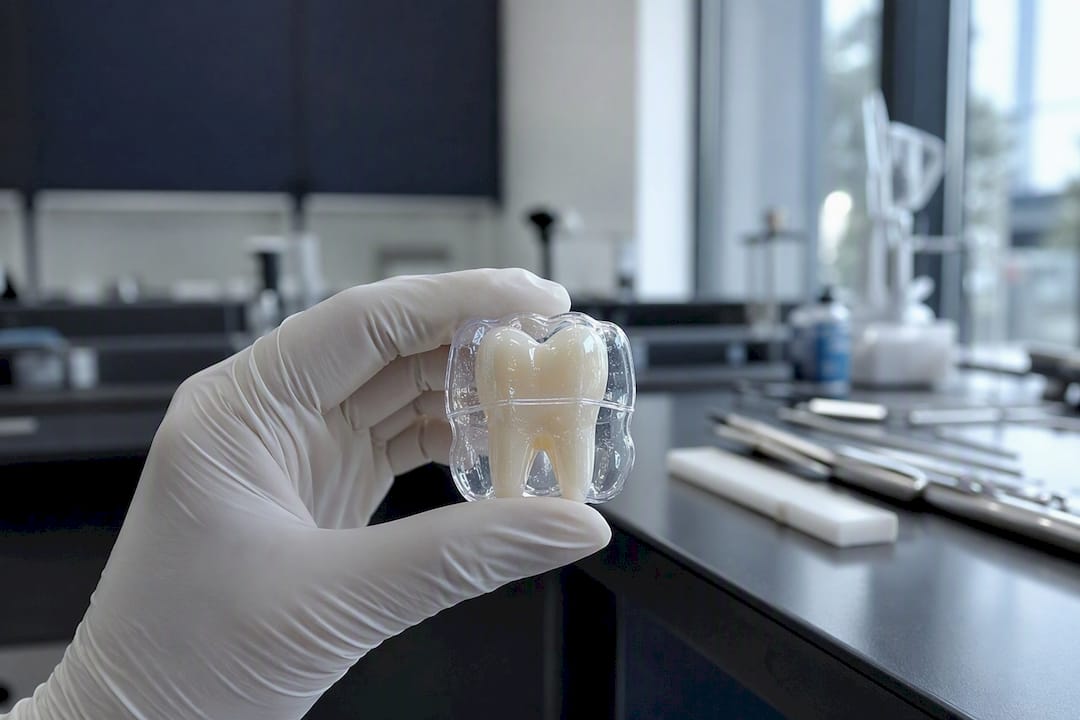
Attachments (the small tooth-colored bumps that help aligners grip your teeth) raise an obvious question: does whitening gel reach the enamel underneath them? Align Technology’s own 2023 survey found that every responding doctor who submitted case examples reported visible whitening occurring beneath attachments. Some patients notice slightly uneven shading around the attachment sites mid-treatment, but clinicians report that these minor irregularities typically resolve once the attachments come off and the tooth surface gets polished. It’s rarely a permanent problem.
That quote captures where mainstream aesthetic dentistry has landed on this. The field has moved away from a blanket “wait until you’re done” stance toward accepting supervised, simultaneous whitening as a legitimate option, largely because it keeps patients motivated through what can be a long orthodontic process.
On concentration, the consensus among dentists is conservative. Rather than reaching for the strongest gel available, most protocols favor lower peroxide concentrations in a conservative range to limit sensitivity
- Staged introduction, starting with one arch before moving to both
- Built-in monitoring checkpoints to catch irritation early
- A baseline shade reading before any whitening begins, so progress can be tracked objectively
None of this is DIY territory. The Invisalign Professional Whitening System, powered by Opalescence, exists specifically because dentists wanted a whitening product engineered for aligner compatibility rather than adapted from products never meant to sit under a tray for hours at a time.
Which Whitening Methods Work With Invisalign Trays?
Not every whitening method plays well with a mouth full of clear aligners. Some are built for it. Others actively fight against your treatment schedule.
In-tray (aligner) whitening gel is the method most clinicians associate with this approach. Your dentist dispenses a small amount of gel into your aligner trays instead of (or alongside) your usual retainer material, and you wear them for a set daily period, often overlapping with normal aligner wear time. Sessions typically run in short daily increments over one to two weeks per arch. Results tend to be gradual and even, since the tray holds the gel in consistent contact with enamel. The tradeoff: it requires a dentist to prescribe concentration and monitor progress, and it’s not something to improvise with a random gel bought online.
Whitening toothpaste is a maintenance tool, not a transformation tool. It works through mild abrasives and low-level chemical agents that lift surface stains from coffee, tea, and food pigments. It won’t touch the deeper, intrinsic discoloration that bothers most people considering a whitening system. Think of it as upkeep between real whitening sessions, not a substitute for one.
Over-the-counter whitening strips create a genuine scheduling conflict. Invisalign treatment depends on 20 to 22 hours of daily tray wear to keep teeth moving on schedule, and strips need direct gum-adjacent contact time of their own. Squeezing both in usually means shortchanging one, and strips applied around aligner edges can irritate gum tissue that’s already adjusting to the trays.
Professional in-office whitening remains the most predictable single-session option. A dentist-administered treatment delivers a dramatic shade change in one visit, using controlled concentrations under direct supervision, and it sidesteps the aligner-wear conflict entirely if scheduled before or after active treatment.
Some patients also look at whitening serums formulated specifically to be worn with clear retainers or night guards, such as ClearRetain’s tooth whitening serum, which is built around the same “wear it in a tray” concept without repurposing orthodontic aligners for a job they weren’t designed for.
Pro Tip: Ask your dentist whether your specific aligner material is rated for gel contact before improvising with any in-tray product. Not every clear tray tolerates peroxide exposure the same way.
What Side Effects Should You Watch For?
Sensitivity is the complaint dentists hear most, and it shows up for a straightforward reason: peroxide-based gels temporarily open the microscopic tubules in your enamel, which briefly exposes nerve endings to temperature and pressure. Gum irritation runs a close second, usually from gel seeping past the tray edges onto soft tissue that’s already working overtime to adjust to your aligners.
Here’s how to keep both in check:
- Switch to a desensitizing toothpaste containing potassium nitrate a few days before starting any whitening protocol.
- Reduce session frequency at the first sign of tingling rather than pushing through it.
- Dry your trays and teeth before applying any gel, since moisture dilutes concentration unevenly and causes patchy results.
- Wipe excess gel from tray edges immediately to limit gum contact.
- Rinse trays thoroughly before reinserting them after a whitening session.
Attachments, existing restorations (crowns, veneers, fillings), and enamel defects all change the calculus. Peroxide gel won’t lighten a crown or filling the way it lightens natural enamel, which can create visible mismatches if you whiten without accounting for existing dental work. People with gum recession, adolescents whose enamel is still maturing, and anyone with molar incisor hypomineralization (MIH, a developmental enamel defect) should treat whitening as a conversation with their dentist first, not a weekend project. If you’re already managing sensitive gums, targeted guidance for sensitive gum whitening is worth reading before you start.
Should You Whiten Before, During, or After Invisalign?
Timing changes what you’re optimizing for, and there’s no single right answer for every patient.
Whitening before your aligners arrive makes the most sense if you’re planning restorative work down the line. Crowns and veneers get color-matched to your natural teeth, so whitening first means your dentist matches restorations to your brightest, final shade rather than guessing at a future one.
Whitening during treatment, under supervision, has picked up support because it keeps patients engaged through a process that can run 12 to 24 months. Seeing two kinds of progress at once, straighter teeth and a brighter smile, tends to keep people compliant with the 20 to 22 hour wear requirement instead of losing motivation halfway through.
Waiting until after treatment has its own logic. Attachments come off, any minor unevenness around them gets polished away, and your dentist gets a clean, uninterrupted view of your finished shade before deciding on any final touch-ups.
One firm rule applies regardless of when you whiten: if adhesive dental work is on the horizon, most dentists recommend waiting roughly two weeks after any bleaching session before bonding procedures, since residual oxygen from the peroxide can interfere with how well bonding agents adhere.
A Conservative In-Tray Whitening Protocol Dentists Recommend
Dentists who supervise whitening during aligner treatment tend to follow a staged, cautious sequence rather than a one-size dosage. Here’s the general shape of it:
- Pre-procedure screening. Your dentist checks for active decay, gum disease, existing restorations, and takes a baseline shade reading along with a sensitivity history.
- Single-arch test. Whitening starts on one arch only, at a conservative concentration.
- A period of evaluation follows, allowing your dentist to check shade progress and assess sensitivity or irritation before deciding whether to extend treatment.
- Extend to both arches if the first arch went smoothly, continuing monitoring.
- Daily application steps. A small gel amount goes into the tray, excess is wiped from the edges, wear time follows your dentist’s exact instructions, then trays get rinsed before your aligners go back in.
Any noticeable sensitivity or gum irritation is a signal to pause and check in with your dentist rather than push through the schedule. Reviewing a whitening prep checklist before your first session gives you a clear list of what to bring up at the appointment.
Pro Tip: Bring a photo of your teeth taken in consistent, natural lighting to your baseline appointment. It gives you and your dentist an objective before comparison that’s far more reliable than memory.
What Do Patients Actually Say About Whitening With Aligners?
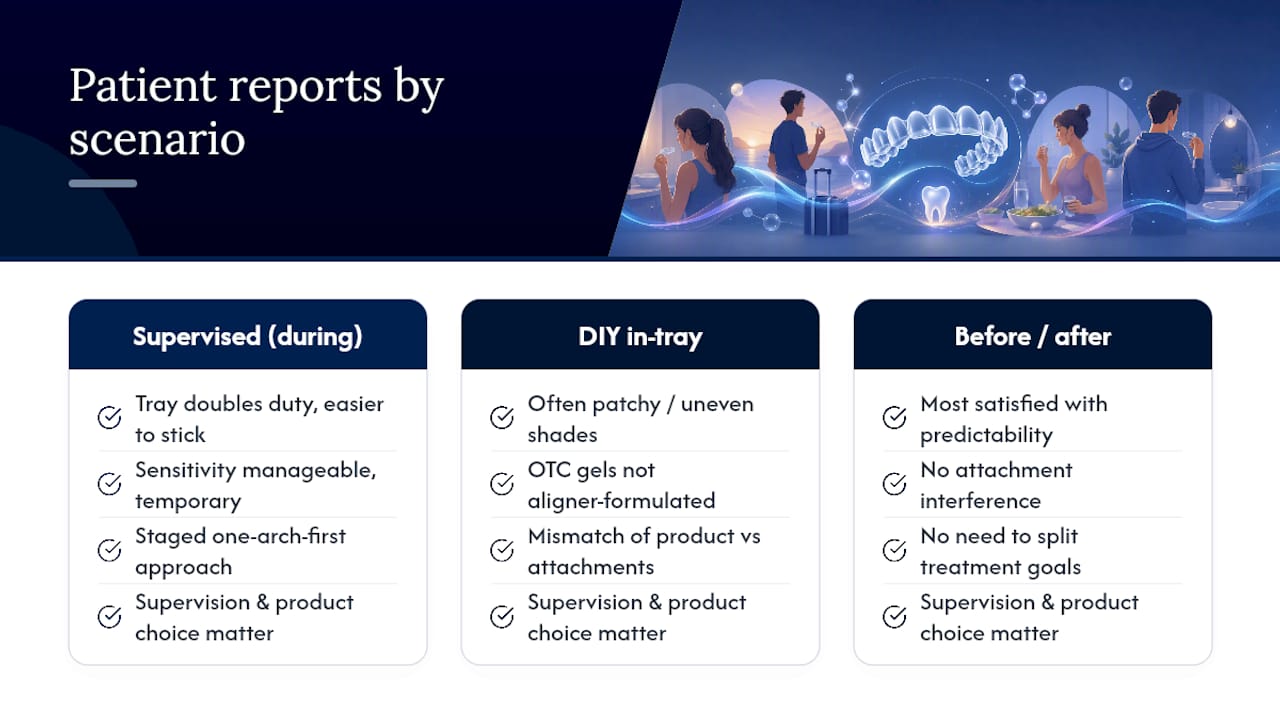
Patient feedback on this topic tends to cluster around two themes: convenience and impatience with uneven results. People who whiten under dentist supervision generally report that the process felt easier to stick with than a separate whitening routine bolted onto an already busy aligner schedule, since the same tray does double duty.
The complaints that surface most often involve DIY attempts gone sideways. Clinicians note that patients who try unsupervised in-tray whitening with generic over-the-counter gels sometimes end up with patchy or uneven shade changes, since consumer-grade products weren’t formulated with aligner compatibility or attachment coverage in mind. That mismatch between expectation and formulation is usually the root cause, not the concept of in-tray whitening itself.
Patients who whiten before starting Invisalign or after finishing tend to report the most satisfaction with predictability, largely because there’s no attachment interference and no need to split attention between two treatment goals at once. Meanwhile, those who whiten during treatment under a dentist’s staged protocol generally describe the sensitivity as manageable and temporary, especially when they follow the one-arch-first approach rather than jumping straight to full-mouth application.
The throughline across most patient accounts: supervision and product choice matter more than timing alone.
How Much Does Whitening With Invisalign Trays Actually Cost?
Cost varies widely depending on which method you choose, and the price gap between options is significant enough to factor into your decision.
Dentist-supervised in-tray whitening added onto existing Invisalign treatment typically runs as an add-on fee to your orthodontic plan, since it uses custom trays you already have and a prescribed gel rather than new equipment. Professional in-office whitening, done as a standalone single-visit treatment, sits at the higher end of the spectrum because it involves chairside time, stronger controlled concentrations, and immediate dramatic results.
At-home maintenance options, including whitening toothpaste and peroxide-free serums like Getsmilefam’s Snow Serum™ Whitening Pen, occupy the lower end of the cost range and work best as an ongoing routine rather than a one-time dramatic fix. Over-the-counter strips fall somewhere in the middle on price but come with the scheduling conflicts already covered, which makes them a poor value proposition for anyone currently wearing aligners.
The practical takeaway: if budget is a major factor, a peroxide-free maintenance product used consistently between dentist visits often delivers a better cost-to-result ratio than repeated strip purchases that fight against your aligner-wear hours.
A Lower-Sensitivity Option Worth Discussing With Your Dentist
If peroxide-based sensitivity is a concern, Getsmilefam’s BLU Whitening Technology, developed in Singapore, takes a different approach. It’s formulated without hydrogen peroxide, using lab-approved ingredients built for sensitive gums rather than the enamel-tubule mechanism that causes most whitening discomfort.
The Snow Serum™ Whitening Pen is designed for quick daily application and fits into a maintenance routine alongside professional whitening rather than replacing dentist-supervised in-tray protocols outright. For anyone who travels or wants a compact option to keep results steady between checkups, the Premium Travel Kit bundles whitening tools sized for exactly that purpose.
Worth discussing with your dentist before use:
- Whether a peroxide-free serum makes sense alongside your current aligner schedule
- How it fits if you already deal with sensitivity from other whitening attempts
- Timing it around any in-tray gel your dentist has already prescribed
For readers managing sensitivity from prior whitening attempts, how to avoid teeth sensitivity during whitening covers practical steps that apply whether you’re using a peroxide gel or a peroxide-free serum. None of this replaces a dentist’s judgment on your specific case, but it gives you another option to bring to that conversation.
Why the “Just Wait Until You’re Done” Advice Is Outdated
The old blanket advice, wait until your aligners come off before touching whitening, made sense when nobody had studied aligner-compatible bleaching closely. That’s no longer where the evidence sits. The systematic review data showing comparable results to conventional trays, combined with dentist-reported whitening under attachments, makes a strong case that simultaneous whitening deserves serious consideration rather than automatic dismissal.
What gets underrated in most consumer advice is the sequencing risk around restorations. Whitening after crowns or veneers go in creates a shade mismatch nobody warns you about clearly enough. That single detail should shape your timing decision more than convenience or impatience.
My take: supervision matters more than the specific method you pick. A conservative, staged protocol with a lower peroxide concentration beats an aggressive unsupervised attempt every time, and a peroxide-free maintenance product between dentist visits is an underused middle ground most guides skip entirely.
— Lenney
Key Takeaways
Whitening with Invisalign trays works best as a dentist-supervised, staged process using conservative concentrations rather than an unsupervised DIY shortcut.
| Point | Details |
|---|---|
| Get dentist clearance first | Screen for restorations, gum recession, and existing sensitivity before any in-tray gel use. |
| Start with one arch | Test a single arch for about two weeks before extending whitening to both. |
| Favor lower concentrations | Conservative 5 percent hydrogen peroxide ranges reduce sensitivity while still improving shade. |
| Time around restorations | Wait roughly two weeks after bleaching before any adhesive or bonding procedure. |
| Consider peroxide-free maintenance | A serum-based option can support results between dentist visits without the sensitivity tradeoff. |
Sources
- Whitening during Invisalign treatment: a modern approach - Dentistry
- Can You Whiten Your Teeth With Invisalign? (Full Guide)
- Systematic review: effectiveness of dental bleaching using orthodontic clear aligners