

Dentist-checked take-home trays remain the best long-term value for whitening at home in Singapore, since they fit your teeth precisely and cause less gum irritation than one-size-fits-all kits. For faster, lower-cost results without a clinic visit, an enamel-safe over-the-counter option like SmileFam’s BLU Whitening Technology works well for most people with healthy teeth. Budget varies widely depending on format. See a dentist first if you have fillings, crowns, or gum disease.
TL;DR:
- Custom trays are the most effective and comfortable at-home whitening option, with the ability to use gel multiple times for long-term savings.
- Over-the-counter products like strips, pens, and LED kits are more affordable upfront but typically require frequent replacement to maintain results.
- Whitening products containing peroxide produce deeper, more noticeable results but can cause sensitivity, especially without proper fitting or moderation.
- Whitening is not safe for teeth with untreated cavities, gum disease, or restorations like crowns and veneers, making dental consultation essential beforehand.
- Maintaining results with a one-time purchase of a reliable delivery system plus gel refills is more economical over time than continuous OTC kit buying.
Table of Contents
- Which At-Home Whitening Format Fits Your Life?
- How Does Teeth Whitening Actually Work?
- What Does Whitening Cost in Singapore?
- Is At-Home Whitening Safe for Your Teeth?
- Choosing Products When Your Teeth Are Sensitive
- How Do You Whiten Safely at Home?
- What’s the Real Cost of Keeping Your Smile White?
- Why an Enamel-First Approach Beats Chasing the Whitest Result
- SmileFam: A Local, Enamel-Safe Way to Whiten at Home
- Sources
Which At-Home Whitening Format Fits Your Life?
Every at-home whitening product falls into one of six formats, and the right one depends on how much time you want to spend and how sensitive your teeth already are.
Whitening strips are thin, peroxide-coated films you press onto your teeth for 15 to 60 minutes a day. They’re cheap and require zero setup, but the flat film often misses gaps between teeth and along the gumline.
Prefilled or boil-and-bite trays hold gel against your teeth for longer, more even contact than strips. Boil-and-bite versions soften in hot water so you can bite an impression, though the fit is still generic compared to something molded for your mouth.
Dentist-made custom trays are built from an actual mold of your teeth. This is the only format on this list that typically requires a dental visit, and it’s also the one dentists recommend most often because a tight seal keeps gel off your gums.
Whitening pens use a small brush to paint gel directly onto teeth. They’re the fastest, most travel-friendly option and good for quick touch-ups, but the thin layer of gel wears off with saliva faster than a tray-based approach.
LED light kits pair a mouthpiece with a blue light meant to speed up the whitening reaction. The gel and tray fit still do most of the work.
Whitening toothpaste relies on mild abrasives or low-dose chemical agents during normal brushing. It’s the gentlest option and the slowest, mainly useful for maintaining results between more active treatments.
In Singapore, strips, pens, LED kits, and whitening toothpaste are widely sold online and in pharmacies. Custom trays are the one format you’ll need a dental clinic for, since they require a physical mold of your teeth.
How Does Teeth Whitening Actually Work?
Whitening chemistry splits into two camps, and knowing the difference changes what results you should expect.
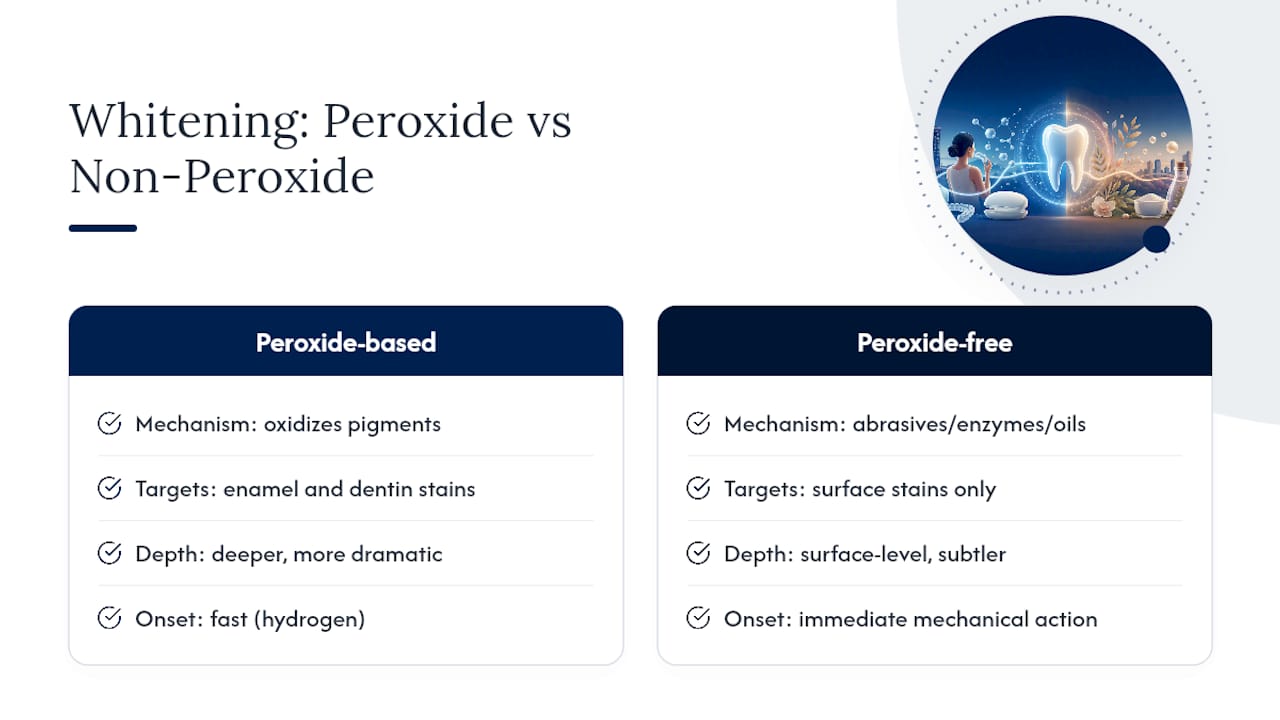
Peroxide-based products, whether hydrogen peroxide or carbamide peroxide, oxidize the pigmented molecules trapped inside enamel and dentin. That’s a chemical change, not a surface polish, which is why peroxide gets deeper, more dramatic results. It also explains the sensitivity trade-off: peroxide-based products are stronger but more likely to cause sensitivity than gentler alternatives. Carbamide peroxide breaks down into hydrogen peroxide over time, so it releases more slowly and tends to feel milder over a longer session.
Peroxide-free products work differently. Most rely on mild abrasives, enzymes, or oils to lift surface stains from coffee, tea, or smoking, rather than bleaching what’s underneath. That means they can brighten a dull smile but won’t touch stains baked into the tooth structure itself, and peroxide-free options typically produce subtler results than peroxide-based products.
What separates a good formula from a rough one often isn’t the whitening agent at all. It’s what else is in the tube. Hydroxyapatite, potassium nitrate, and fluoride help reduce sensitivity and support enamel during treatment, which is why ingredient labels matter more than marketing claims. A product with real desensitizing ingredients lets you whiten without the raw, zinging feeling that sends most people running for cold water.
What Does Whitening Cost in Singapore?
Price in this category tracks fit and delivery system more than brand name. A rough breakdown of what you’ll find shopping in Singapore:
- Budget OTC strips and pens: roughly SGD 20 to SGD 60, single-use or one-month supply.
- Mid-range LED kits: roughly SGD 60 to SGD 150, including mouthpiece, gel syringes, and light unit.
- Premium enamel-safe OTC kits (like BLU Whitening Technology): roughly SGD 80 to SGD 250, positioned between drugstore basics and dentist trays.
- Dentist take-home trays: commonly listed from roughly SGD 380 to SGD 650, covering the consultation, custom mold, and initial gel supply.
- In-clinic or office whitening: commonly listed from roughly SGD 400 to over SGD 1,000, depending on the clinic and whether it includes a follow-up take-home kit.
Custom trays cost more upfront, but the tray itself is reusable indefinitely; only the gel needs replacing. If you whiten twice a year for the next five years, a one-time tray purchase plus cheap gel refills often beats buying a new OTC kit every few months. OTC kits win on convenience and initial cost, particularly if you’re not sure whitening is for you yet and don’t want to commit to a dental visit. A good rule of thumb: if you expect to whiten more than twice a year long-term, the tray pays for itself. If this is a one-off before an event, an enamel-safe OTC kit is the more sensible spend.
Is At-Home Whitening Safe for Your Teeth?
Whitening is safe for most healthy mouths, but it isn’t safe for every mouth, and that distinction gets lost in a lot of marketing.
Untreated cavities, active gum disease, thin or worn enamel, and visible restorations like crowns or veneers all change how your teeth react to bleaching gel. Peroxide can seep into a cavity and irritate the nerve inside a tooth, and gel that pools around inflamed gums makes irritation worse, not better. Dentists advise resolving cavities or gum disease before whitening specifically to avoid this. Crowns and veneers also don’t whiten the same way natural enamel does, so bleaching around them can leave you with a mismatched smile rather than a uniform one.
Most consumer-grade products stay within concentration ranges considered safe for supervised home use, but an ill-fitting tray or a strip left on too long turns a mild formula into a rough two days of gum soreness. Overuse of strong bleaching agents can expose dentin and increase sensitivity, which is the opposite of the result you’re paying for.
Before you buy anything, run through this checklist:
- Do you have any untreated cavities or gum bleeding? See a dentist first.
- Do you have crowns, veneers, or bonding on front teeth? Ask your dentist how whitening will affect the overall look.
- Have you had a dental checkup in the past 12 months? If not, book one before starting.
- Are you already experiencing tooth sensitivity? Start with a gentler, peroxide-free format.
- Are you pregnant or breastfeeding? Delay elective whitening and check with your doctor.
Choosing Products When Your Teeth Are Sensitive
Sensitive teeth don’t rule out whitening. They just narrow which products belong on your shortlist.
Look for labels that list hydroxyapatite, potassium nitrate, or fluoride alongside the active whitening ingredient, since these are the additives most consistently tied to lower sensitivity during treatment. Skip anything that advertises “maximum strength” peroxide without a stated concentration; vague labeling is usually a sign the brand isn’t being upfront about what you’re putting on your gums.
Format matters as much as ingredients here:
- Short-session strips (15 to 20 minutes) beat long-wear trays for a first attempt.
- Whitening pens let you control exactly how much gel touches each tooth, useful if certain spots feel more sensitive than others.
- Lower-strength gels used in a well-fitted custom tray often cause less irritation than a stronger gel in a loose, generic tray, because fit controls gel overflow onto gums more than concentration does.
Pro Tip: Brush with a hydroxyapatite or potassium nitrate toothpaste for about a week before you start whitening, and keep using it between sessions. Priming your enamel this way blunts the zinging sensation a lot of first-time users report.
How Do You Whiten Safely at Home?
A little prep work separates a smooth whitening experience from a sore, disappointing one.
Start with the basics: get a dental checkup if it’s been over a year, snap a photo of your current shade for comparison later, and brush and floss right before your first session so the gel contacts clean enamel.
From there, the schedule depends on format. Strips and pens are typically used daily for 7 to 14 days. OTC trays usually run 30 to 60 minutes a session, several times a week. LED kits follow a similar rhythm, since the light itself adds only a marginal boost over the gel and tray fit doing the real work. Most people notice some visible shade change after consistent use, though full results may take the entire recommended course.
A short safe-use routine:
- Apply only the amount of gel the instructions specify. More gel does not mean faster results.
- Wipe away any gel that touches your gums immediately rather than letting it sit.
- Never exceed the daily session time listed on the packaging, even if teeth still look stained.
- Rinse and brush gently afterward with a sensitivity toothpaste, not a whitening one, on treatment days.
- Stop and consult a dentist if sensitivity lasts more than a day or two after finishing a course.
The most common mistake is stacking two whitening products at once, like using strips and a whitening mouthwash the same week, thinking it will double the speed. It mostly just doubles the irritation.
What’s the Real Cost of Keeping Your Smile White?
Whitened teeth don’t stay that way forever. Most people see results fade over several months, faster if you drink a lot of coffee, tea, or red wine, or if you smoke.
This is where the math on custom trays gets interesting. A dentist tray is a one-time cost; after that, you’re only buying gel refills, which run far cheaper than a brand-new kit each time. Repeating an OTC kit purchase every time results fade adds up faster than most people expect, especially if you’re buying a fresh delivery system along with the gel every single round.
The most economical long-term setup mirrors what dental professionals already recommend: buy a reliable delivery system once, whether that’s a custom tray or a well-made reusable kit, and budget only for gel refills or an occasional touch-up pen after that. Treat whitening as maintenance, not a one-time fix, and your ongoing costs drop considerably compared to starting from scratch every few months.
Why an Enamel-First Approach Beats Chasing the Whitest Result
Most people shopping for at-home whitening ask “how white can I get?” when the better question is “how do I get whiter without wrecking my enamel along the way?” That reframe changes almost every decision that follows: which format you pick, how long you leave gel on, and whether you bother with a dental checkup first.
The conventional advice treats sensitivity as an unavoidable side effect of getting results. It isn’t. Formulas built around hydroxyapatite and potassium nitrate, paired with a tray that actually fits, get you most of the way to dentist-office results without the raw-gum aftermath. That’s exactly the gap SmileFam’s BLU Whitening Technology is built to close for Singapore users who want a fast, enamel-safe option without booking a clinic appointment.
Three things to act on: book a dental checkup if it’s been over a year, pick a product with real desensitizing ingredients listed on the label, and budget for refills instead of full repurchases.
— Lenney
SmileFam: A Local, Enamel-Safe Way to Whiten at Home
If you’ve read this far, you already know what to look for: an enamel-safe formula, sensible ingredients, and a fair price against dentist trays. SmileFam’s BLU Whitening Technology was built around exactly that brief, formulated for visible results from a single session without hydrogen peroxide in the mix.
The BLU Teeth Whitening Kit is designed for sensitive gums and sits well below dentist tray pricing while still delivering same-session brightening, backed by a purchase guarantee and real customer reviews on the SmileFam site. If your teeth already feel sensitive, pair it with the BLU Whitening Toothpaste to maintain results between sessions without reaching for a stronger kit. Check the product page for current stock and start with the kit if you want a fast, local alternative to booking a dentist appointment this week.
Sources
The safety and sensitivity guidance in this article draws on research into remineralizing agents and desensitizers, which supports the case for hydroxyapatite and potassium nitrate in sensitive-teeth formulas. Warnings against DIY peroxide mixing and the case for a dental checkup before bleaching come from University of Rochester Medicine’s consumer health guidance. Background on enamel structure and the risks of overuse comes from the Cleveland Clinic. Expected shade change and peroxide-free performance benchmarks come from Health’s teeth whitening product testing.
This article is general information, not a substitute for advice from a qualified doctor. Consult a qualified healthcare professional about your own circumstances before acting on anything here.
- Role of remineralizing agents and desensitizers in dental products
- The 10 Best Teeth Whitening Products of 2026 for Tough Stains — Health
- DIY Teeth Whitening: Too Good to Be True? — University of Rochester Medicine
- Tooth enamel — Cleveland Clinic