

Yes, chlorhexidine stains teeth. The discoloration is typically extrinsic, meaning it sits on the tooth surface rather than inside the enamel, and most cases respond well to professional cleaning. If you’re already noticing brown or yellowish deposits along your gumline or on your tongue, the right first move is to call your dentist or hygienist and schedule a prophylaxis appointment. Don’t wait for the staining to worsen. According to FDA clinical testing data, a majority of chlorhexidine oral rinse users showed a measurable increase in facial anterior stain after six months compared to controls, including a notable portion with heavy staining. That’s a meaningful difference, and it tells you this isn’t a rare or unpredictable side effect.
The reassuring part: extrinsic stains are removable. A standard hygienist cleaning, including scaling and polishing, clears most chlorhexidine dental stains without aggressive intervention. The key is catching them early and not continuing unsupervised use longer than your dentist prescribed.
Key Takeaways
Chlorhexidine staining is extrinsic, common, and manageable: professional cleaning removes most deposits, and short prescribed courses with good oral hygiene prevent the worst of it.
| Point | Details |
|---|---|
| Staining is common and extrinsic | FDA data shows 56% of CHX users develop measurable anterior staining; deposits sit on the surface and are usually removable. |
| Professional cleaning is the primary fix | Scaling and polishing by a hygienist clears most CHX stains; aggressive bleaching is not the first-line approach. |
| ADS formulations may help | RCT evidence shows significantly lower staining with ADS (sodium metabisulfite + ascorbic acid), though benefits are less consistent with routine brushing. |
| Prevention beats treatment | Brush before rinsing, avoid chromogenic drinks post-rinse, and schedule a cleaning after your CHX course to prevent stain buildup. |
| Getsmilefam as a post-cleaning adjunct | After dental clearance, Getsmilefam’s BLU Whitening Toothpaste and Snow Serum Whitening Pen offer a gentle, hydrogen-peroxide-free option for brightness maintenance. |
Table of Contents
- How does chlorhexidine cause tooth staining?
- How quickly do stains appear, and are they permanent?
- How do you remove chlorhexidine stains from teeth?
- How can you prevent chlorhexidine staining while still getting its benefits?
- Do anti-discoloration systems in CHX mouthwashes actually prevent staining?
- When is chlorhexidine still the right choice?
- What do the key studies show about CHX staining?
- What to do if you already have CHX stains
- The real trade-off most patients don’t hear about
- After your cleaning: a gentle cosmetic option worth considering
- Sources
How does chlorhexidine cause tooth staining?
Chlorhexidine gluconate (CHX) is a cationic bisbiguanide antiseptic, which means it carries a positive charge that makes it bind tightly to negatively charged surfaces in the mouth, including tooth enamel, dentin, and soft tissue. That binding is what gives it its antibacterial staying power, called substantivity. It’s also what makes staining almost inevitable with regular use.
The main staining mechanisms
- Chromogen binding: CHX’s positive charge attracts anionic (negatively charged) chromogens from food, drink, and bacteria. Once bound to the tooth surface, these pigmented molecules are hard to rinse away.
- Maillard-type reactions: CHX can react with proteins and sugars in saliva and dietary sources, producing brownish compounds similar to the browning reaction in cooked food.
- Iron (III) complexes: CHX interacts with iron-containing compounds and thiol groups from sulfur-containing amino acids, forming dark-colored iron complexes that deposit on tooth surfaces.
- Increased calculus buildup: CHX promotes tartar formation, and calculus acts as a rough scaffold that traps additional chromogens, compounding stain accumulation over time.
Stains tend to cluster along the gingival margins (where teeth meet the gums), on exposed dentin, on the dorsum of the tongue, and on dental restorations. Restorations deserve a specific mention: composite resin and older ceramic surfaces are more porous than natural enamel, so they absorb staining compounds more readily. Patients with visible anterior restorations face a higher cosmetic risk.
Stain severity also correlates directly with plaque levels. Patients who brush and floss thoroughly before and during CHX use consistently show less staining in clinical trials. Plaque provides a sticky matrix for chromogens to adhere to, so the cleaner the tooth surface going in, the less there is for CHX to work with.
Pro Tip: Brush and floss thoroughly immediately before using chlorhexidine mouthwash. A clean tooth surface gives chromogens far less to grip.
How quickly do stains appear, and are they permanent?
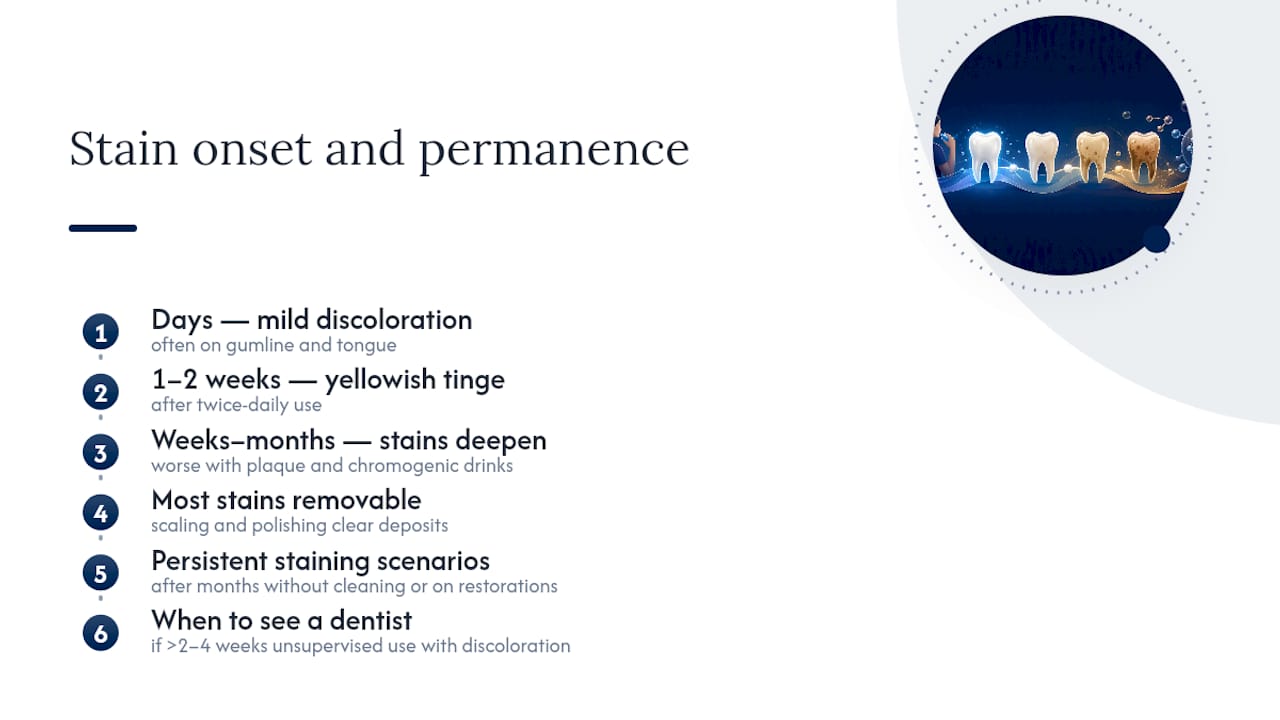
Mild discoloration can appear within days of starting a chlorhexidine rinse, particularly along the gumline and on the tongue. Most people notice a yellowish or light-brown tinge within one to two weeks of twice-daily use. With continued use over weeks to months, staining typically deepens and spreads, especially in patients with heavier plaque or frequent consumption of chromogenic beverages like coffee, tea, and red wine.
The good news is that the vast majority of CHX stains are extrinsic and removable. A professional prophylaxis, scaling followed by polishing, clears most surface deposits effectively. Studies and peer-reviewed analyses of concentration- and time-dependent staining confirm that stain severity increases with both the duration of use and the CHX concentration, which is why short, prescribed courses produce far less discoloration than open-ended self-directed use.
Persistent staining becomes a concern in two scenarios. First, when CHX has been used for months without professional cleaning, deposits can harden and become more resistant to standard polishing. Second, when staining occurs on rough or marginal restorations, the porous surface may absorb pigment deeply enough that prophylaxis alone doesn’t fully restore the original shade. In those cases, restoration replacement may be the only option.
If you’ve been using chlorhexidine without a dentist’s supervision for more than two to four weeks and notice significant discoloration, that’s the point to seek a dental evaluation rather than continuing to rinse and hope it resolves.
How do you remove chlorhexidine stains from teeth?
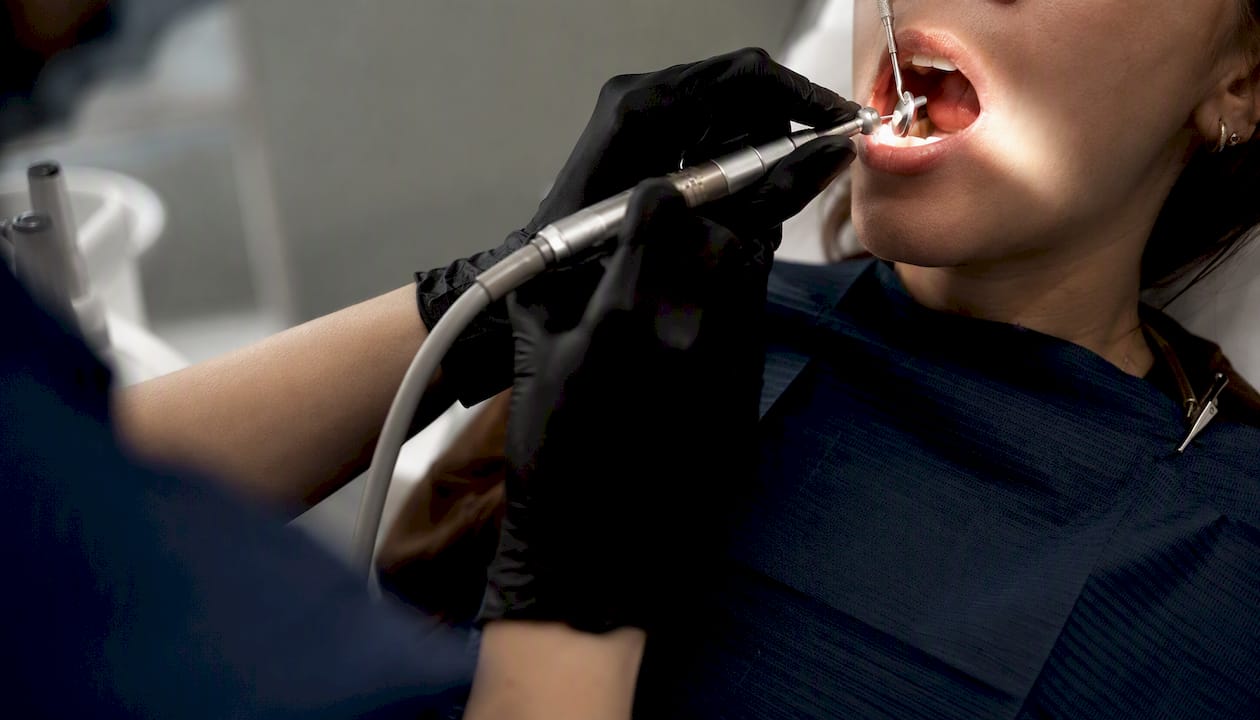
Professional cleaning is the primary and most effective treatment. A hygienist’s scaling and polishing session removes the extrinsic deposits that CHX produces without damaging enamel. For heavier staining, rotary prophy polishing or air-polishing systems (where available) can reach interproximal areas and gingival margins more thoroughly than hand instruments alone.
At-home options play a supporting role, not a lead one. Whitening toothpastes containing mild abrasives or low-concentration peroxide can help slow new stain accumulation between dental visits and may lighten mild surface deposits with consistent use. They won’t clear established CHX staining on their own, but they’re a reasonable interim measure if you can’t get to a dentist immediately. Tartar-control formulas are particularly useful because they address the calculus buildup that CHX promotes.
Pro Tip: Avoid reaching for strong peroxide bleaching products as your first response to CHX staining. Bleaching agents work on intrinsic discoloration; CHX stains are extrinsic deposits that sit on the surface. A hygienist cleaning removes them more efficiently, and bleaching without dental clearance can irritate already-sensitive gum tissue. Check out safe vs. harsh whitening approaches before choosing a product.
When you see your dentist, tell them which CHX product you’ve been using, how long you’ve been using it, and whether you have any visible restorations in the stained areas. That information shapes the cleaning approach and helps them assess whether any restorative surfaces need special attention.
How can you prevent chlorhexidine staining while still getting its benefits?
Prevention is far easier than removal, and most of it comes down to timing, hygiene, and duration of use.
Before you start
- Brush and floss thoroughly. A clean tooth surface reduces the chromogen-binding sites CHX can exploit.
- Tell your dentist about any restorations, especially anterior composites or older ceramics, so they can factor in cosmetic risk when prescribing.
- Confirm the prescribed duration. CHX is most often indicated for short courses (one to four weeks post-surgery or during acute gingival inflammation). Long-term use significantly raises staining risk.
During use
- Rinse your mouth with water after brushing to remove toothpaste residue before using CHX. Toothpaste surfactants can inactivate CHX, and residual fluoride compounds can interact with it to increase staining. A brief water rinse between brushing and rinsing is the standard clinical recommendation.
- Avoid coffee, tea, red wine, and other chromogenic foods and drinks for at least 30 minutes after rinsing, or longer if the product label specifies.
- Stick to the prescribed frequency. Twice daily is standard; using CHX more often than directed doesn’t improve antibacterial outcomes and increases staining exposure.
After your course
- Schedule a hygienist cleaning shortly after finishing a CHX course. This removes any accumulated deposits before they harden.
- Continue daily flossing and use a tartar-control toothpaste to limit calculus buildup, which Mayo Clinic guidance specifically recommends for CHX users.
- If staining is a recurring concern, ask your dentist about lower-concentration CHX formulas or products that include an anti-discoloration system (ADS).
For practical lifestyle habits that reduce staining beyond CHX use, the lifestyle changes for whiter teeth guide covers food choices, brushing routines, and daily habits worth building in.
Do anti-discoloration systems in CHX mouthwashes actually prevent staining?
Anti-discoloration systems (ADS) are additive formulations included in some CHX mouthwashes specifically to reduce tooth discoloration. The most studied ADS ingredients include:
- Sodium metabisulfite: A reducing agent that competes with CHX for chromogen binding sites.
- Ascorbic acid (vitamin C): An antioxidant that interferes with the oxidative reactions that produce brown pigments.
- Polyvinylpyrrolidone (PVP): A polymer that binds chromogens before they can deposit on tooth surfaces.
- Peroxoborate compounds: Mild bleaching agents that oxidize staining precursors.
The clinical evidence is real but context-dependent. A systematic review and meta-analysis found that ADS formulations substantially reduced staining in non-brushing experimental models, where participants used CHX without any mechanical cleaning. In those controlled conditions, ADS made a clear difference. But when CHX was used alongside normal toothbrushing, as most patients actually use it, the staining reduction from ADS was minimal and inconsistent across trials.
A randomized controlled trial in 46 patients with chronic periodontitis showed a more encouraging result: a 0.2% CHX mouthwash containing sodium metabisulfite and ascorbic acid produced significantly lower staining scores than CHX without ADS (P < 0.001), while plaque and gingival outcomes were equivalent. That’s a meaningful finding, though it comes from a single crossover trial with a specific patient population.
| Evidence type | Setting | Staining outcome | Evidence strength |
|---|---|---|---|
| Systematic review / meta-analysis | Non-brushing experimental model | Substantial staining reduction with ADS | Moderate |
| Systematic review / meta-analysis | Routine brushing use | Minimal or inconsistent ADS benefit | Limited |
| RCT (46 patients, crossover) | Chronic periodontitis, 0.2% CHX + ADS | Significantly lower staining vs. CHX alone | Moderate |
The practical takeaway: ADS formulations are worth asking about, particularly if you have visible anterior restorations or a history of heavy CHX staining. They’re not a guarantee, and they don’t replace good mechanical hygiene, but in a supervised short course, an ADS product may reduce the cosmetic burden.
When is chlorhexidine still the right choice?
CHX remains a gold-standard antiseptic for specific clinical situations. Dentists most commonly prescribe it for:
- Post-surgical oral care (extractions, periodontal surgery, implant placement) where mechanical brushing is temporarily contraindicated
- Acute gingival or periodontal inflammation that requires rapid bacterial load reduction
- Pre-procedural rinses to reduce aerosol contamination during dental procedures
- Short-term adjunct therapy during active periodontal treatment
The benefit-to-risk calculation shifts when staining risk is high. Factors that increase cosmetic risk include heavy plaque accumulation, smoking, frequent coffee or tea consumption, and visible anterior restorations. For patients in those categories, a dentist should weigh whether long-term CHX use is appropriate or whether alternatives make more sense.
When staining risk is unacceptable, consider these strategies:
- Shorter courses: Limit CHX use to the prescribed window (typically one to four weeks) rather than extending indefinitely.
- ADS formulations: Ask specifically for a CHX product with an anti-discoloration system.
- Enhanced mechanical cleaning: Prioritize brushing and flossing to reduce the plaque that amplifies staining.
- Non-CHX antiseptics: For long-term maintenance, cetylpyridinium chloride (CPC) or essential-oil-based mouthwashes carry lower staining risk, though they also have less robust evidence for periodontal benefit than CHX.
- Professional supervision: Any CHX use beyond four weeks should involve regular dental check-ins and scheduled prophylaxis.
For a deeper look at extrinsic stain types and treatment options, including when whitening helps and when it doesn’t, that resource covers the full picture.
What do the key studies show about CHX staining?
| Study type | Key finding | Evidence strength |
|---|---|---|
| RCT, 46 patients, crossover (PMC, 2022) | 0.2% CHX + ADS (sodium metabisulfite + ascorbic acid) significantly reduced staining vs. CHX alone; P < 0.001 | Moderate |
| FDA product label (clinical testing) | 56% of CHX users showed increased anterior stain vs. 35% of controls; 15% developed heavy stain | Strong (label data) |
Taken together, the evidence confirms that CHX staining is common, dose- and time-dependent, and most effectively managed through professional cleaning. ADS formulations show promise in controlled settings but are not a substitute for good oral hygiene or professional prophylaxis. Ongoing clinical trials registered at Clinicaltrials continue to explore ADS formulations and staining outcomes in broader populations.
What to do if you already have CHX stains
This week: Contact your dentist or hygienist and book a cleaning appointment. If you’ve been using CHX without a prescription or beyond the recommended duration, stop and let your prescriber know.
In the meantime: Switch to a tartar-control or mild whitening toothpaste, floss daily, and cut back on coffee, tea, and red wine until after your cleaning. These steps won’t erase established staining, but they slow new accumulation. For practical guidance on treating surface stains safely at home, that resource outlines conservative options worth considering.
At your dental visit: Expect scaling and polishing as the primary treatment. Tell your hygienist you’ve been using chlorhexidine and point out any restorations in the affected area. Most extrinsic CHX stains clear in a single prophylaxis session.
When to escalate: If staining persists after professional cleaning, particularly on composite or ceramic restorations, ask your dentist whether the restoration surface has been permanently stained. In some cases, a restoration replacement is the only way to restore the original appearance. Persistent discoloration on natural teeth after cleaning warrants a closer look to rule out other causes.
The real trade-off most patients don’t hear about
Chlorhexidine is genuinely effective. For post-surgical healing, acute gingival flare-ups, and short-term bacterial control, it does things that gentler antiseptics simply can’t match. The staining side effect is real and common, but it’s also manageable when patients and clinicians plan for it rather than treating it as a surprise.
The part that often gets missed in clinical conversations is timing. Most staining accumulates during the CHX course and hardens if left unaddressed. Scheduling a hygienist cleaning within two to four weeks of finishing a CHX course, rather than waiting for the next routine appointment six months out, prevents most of the cosmetic fallout. That single scheduling decision makes a bigger difference than switching products or adding ADS.
Restorations are the exception worth flagging early. If you have visible composite or ceramic work in the front of your mouth, tell your dentist before starting CHX, not after you notice the staining. The options for managing restoration staining are narrower, and prevention is far easier than correction.
Cosmetic whitening has a role, but it comes after professional cleaning, not instead of it. CHX stains are surface deposits, not intrinsic discoloration, so bleaching agents address the wrong layer. Get the deposits removed first, then consider a cosmetic adjunct for brightness maintenance.
After your cleaning: a gentle cosmetic option worth considering
Professional cleaning is step one. Once your hygienist has cleared the CHX deposits and your dentist has confirmed your enamel and restorations are in good shape, a gentle at-home whitening product can help you maintain brightness and address any residual surface discoloration.
Getsmilefam’s BLU Whitening Toothpaste is formulated without harsh hydrogen peroxide, making it a sensible daily-use option for people who’ve just come through a CHX course and want to keep their teeth looking their best without irritating already-sensitive gum tissue. It fits naturally into the post-cleaning routine: use it daily, follow the product directions, and check with your dentist if you have restorations that need special consideration. For targeted touch-ups, the Snow Serum Whitening Pen lets you address specific spots between dental visits. Start with your dental clearance, then add the cosmetic step.
Sources
- Chlorhexidine (oral route) - Side effects & dosage - Mayo Clinic
- The Impact on Dental Staining Caused by Beverages in Combination with Chlorhexidine Digluconate - PMC
Systematic reviews and RCTs sit at the top of the evidence hierarchy for clinical questions like this one. When a finding appears in a single RCT but not yet in a meta-analysis, treat it as promising but not definitive. The ADS evidence is a good example: one well-designed trial shows a clear benefit, but the broader meta-analysis finds the effect inconsistent in everyday use. Both data points matter.