

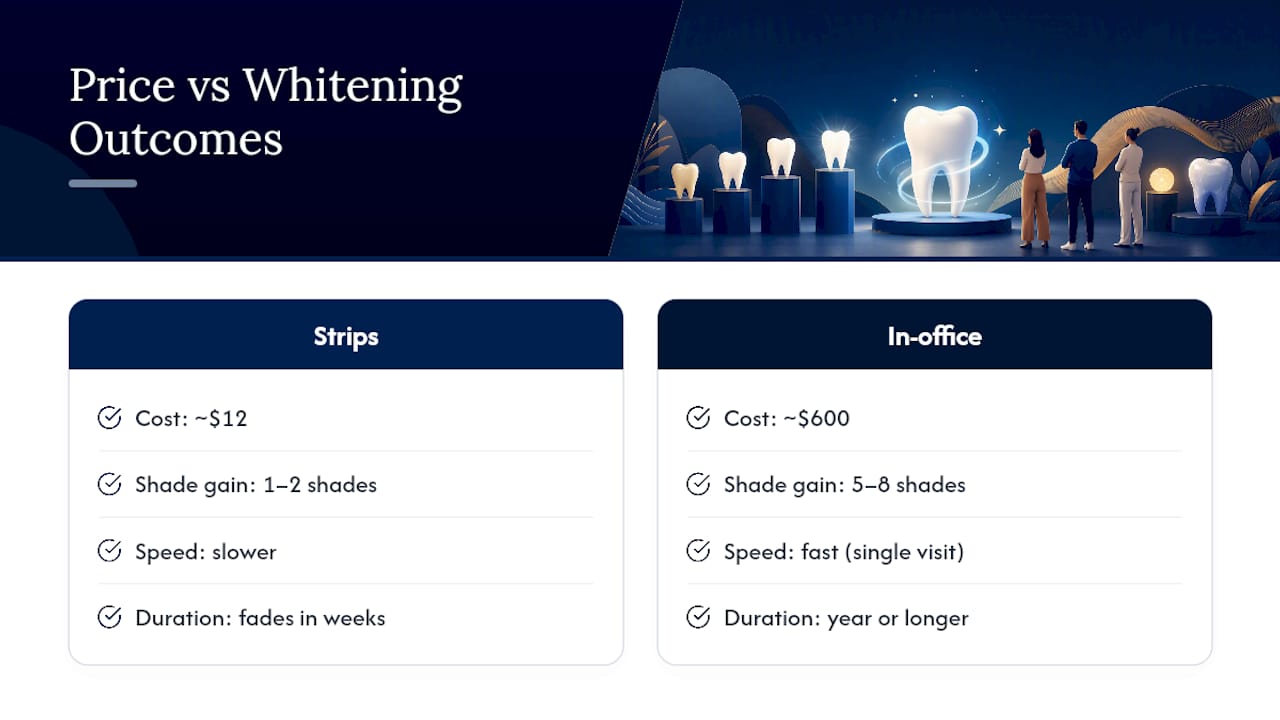
Price mostly buys speed, durability, and professional oversight. Cheaper products buy slower, smaller, and shorter-lived shade gains, while premium clinic work buys faster and longer-lasting results. That’s the honest verdict behind the role of price in whitening choices, and it holds up whether you’re comparing a $12 drugstore strip or a $600 in-office session.
Two examples make it concrete. Whitening strips cost little and might lift your shade a point or two, but the color often fades within weeks. In-office bleaching costs far more upfront and can jump you 5 to 8 shades in a single visit, with results lasting a year or longer. One safety note before anything else: peroxide-based products carry sensitivity risks, and the cheapest option isn’t automatically the safest one over a full year of use.
Key Takeaways
The role of price in whitening choices comes down to one rule: pay for speed and supervision when your situation demands it, and calculate annualized cost before assuming a cheap product is the better deal.
| Point | Details |
|---|---|
| Price maps to outcomes | Higher-cost methods generally deliver faster, bigger shade gains and longer-lasting results. |
| Use cost-per-shade math | Divide total price by shade change gained to compare options honestly, not by sticker price alone. |
| Factor in annualized cost | Reusable trays with cheap refills often beat repeated OTC purchases over a full year. |
| Match spending to stain type | Intrinsic stains need professional evaluation regardless of budget; surface stains respond to most methods. |
| Consider Getsmilefam for at-home value | The Snow Serum™ Whitening Pen offers an enamel-safe, single-session option between OTC and clinic pricing. |
Table of Contents
- The Role of Price in Whitening Choices Across Methods
- How Do You Compare Price to Actual Results?
- Why Do Whitening Quotes Vary So Much in Price?
- Does a Higher Price Mean a Safer Whitening Treatment?
- A Simple Way to Choose Based on Budget and Goals
- Where an Affordable At-Home Option Fits the Price Equation
- What the Price Debate Gets Wrong
- Try an Enamel-Safe Whitening Option Built Around Value
- Frequently Asked Questions
- Sources
The Role of Price in Whitening Choices Across Methods
Every whitening method sits at a different point on the price ladder, and that placement usually tells you something real about supervision, strength, and how long results stick.
Whitening toothpaste is the cheapest entry point, using mild abrasives or low-dose peroxide to lift surface stains gradually. Strips and LED kits step up slightly, using higher peroxide concentrations for faster, more visible change. Dentist-dispensed take-home trays cost more because you get a custom-fitted tray and stronger gel under a dentist’s guidance. In-office bleaching and laser-assisted whitening sit at the top, combining high-concentration peroxide with protective gum barriers and professional application.
- Whitening toothpaste: minimal cost, surface stains only, results over several weeks
- Strips and LED kits: low to moderate cost, visible change in one to two weeks
- Take-home trays: moderate cost, supervised gel strength, results in one to three weeks
- In-office bleaching: high cost, dramatic change in a single one-hour session
- Laser-assisted whitening: highest cost, similar speed to in-office bleaching with added light activation
These ranges reflect aggregated cost data from dental practices and clinics, and they explain most of the sticker-price confusion shoppers run into when comparing a tube of toothpaste to a chairside procedure.
How Do You Compare Price to Actual Results?
Headline price tells you almost nothing on its own. Cost-per-shade and annualized cost tell you what you’re actually paying for.
Cost-per-shade is simple: divide total price by the number of shade levels gained. A $25 strip kit that lifts two shades costs $12.50 per shade. A $500 in-office session that lifts seven shades costs about $71 per shade upfront, but that number flips once you factor in how long results last. Annualized cost spreads the total price, plus any touch-ups, across the months the result actually holds.
A 2024 cost-effectiveness analysis found that 10% carbamide peroxide take-home bleaching had a better cost-effectiveness ratio than whitening toothpastes over a 12-month period, largely because the toothpaste requires continuous repurchasing while the tray-based gel produces a bigger, longer-lasting jump per dose, according to research published in the Journal of Applied Oral Science.
- OTC strips: low per-unit price, but frequent repurchasing raises annualized cost
- Take-home trays: higher upfront price, lower annualized cost thanks to reusable trays and cheap gel refills
- In-office bleaching: highest single payment, but infrequent touch-ups can keep annualized cost reasonable for people who whiten once a year
Pay more when you have a fixed deadline, like a wedding, or intrinsic staining that responds slowly to mild formulas. A lower-cost trial makes sense when your stains are mild, surface-level, and you’re not in a hurry.
Why Do Whitening Quotes Vary So Much in Price?
Clinic overhead, dentist expertise, and peroxide concentration explain most of the spread between a $150 quote and an $800 one. A dentist in a high-rent urban practice with advanced imaging equipment charges differently than a smaller practice, even for the same basic bleaching protocol.
- Clinic overhead and location drive baseline pricing more than most people expect
- Dentist expertise and reputation add a premium, especially for cosmetic specialists
- Higher peroxide concentration costs more but works faster and needs closer monitoring
- Equipment like LED activation lamps or laser systems adds to the quoted price
- Preparatory work, such as treating cavities or gum disease first, adds separate line items
- Multiple sessions for stubborn or intrinsic stains multiply the total cost
Hidden costs sneak in too. Consultations, cleanings, and touch-up sessions commonly add $50 to $400 to the total bill, and gel refills for take-home trays become a recurring line item long after the initial purchase. Geography matters as well: whitening in a major metro area typically costs more than the same procedure in a smaller market, purely because of overhead.
Does a Higher Price Mean a Safer Whitening Treatment?
Sensitivity and gum irritation are the most common side effects across nearly every whitening method, and price doesn’t eliminate that risk. It changes who’s managing it. Supervised professional treatments use protective gum barriers and controlled peroxide strength, which is why dental researchers link frequent unsupervised whitening to higher irritation risk.
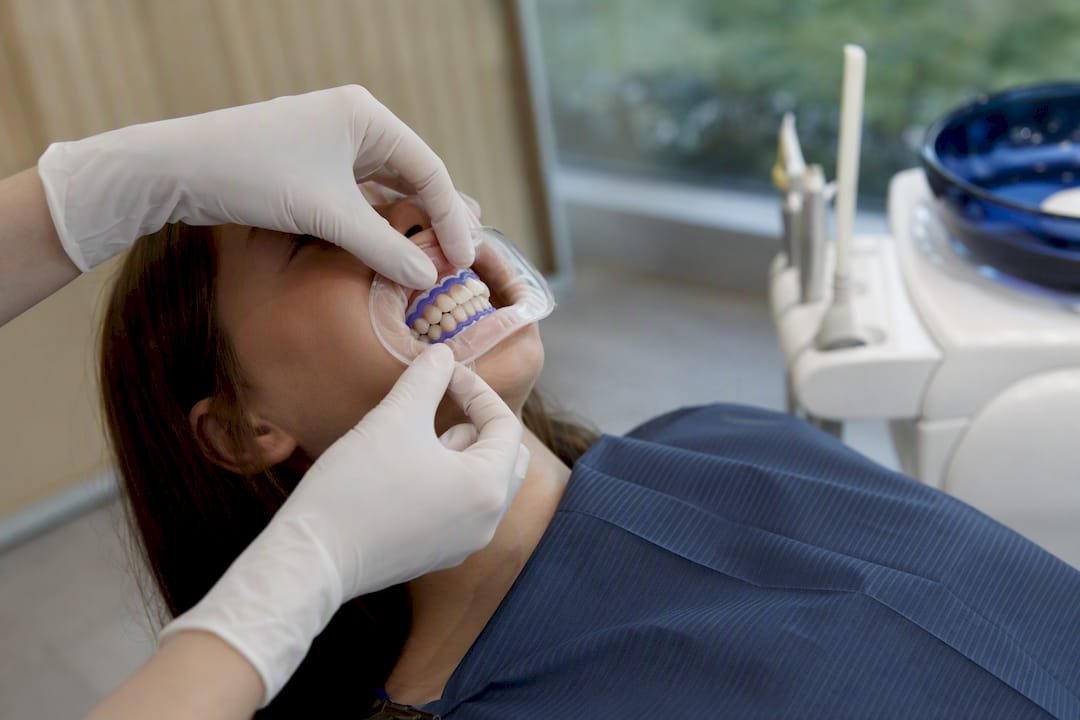
The American Dental Association points out that whitening is a cosmetic procedure where effectiveness and safety both depend on the specific product and peroxide concentration used, not just the price tag attached to it.
Choose a supervised option when you have intrinsic stains from tetracycline or fluorosis, existing dental restorations like crowns or veneers, or active gum disease. These situations need a professional eye before any peroxide touches your enamel.
Pro Tip: If your teeth feel unusually sensitive to cold within the first two days of any whitening product, pause treatment and switch to a lower-concentration formula rather than pushing through for faster results.
A Simple Way to Choose Based on Budget and Goals
Most people overspend or underspend because they skip the assessment step and jump straight to comparing prices. Here’s a cleaner path.
- Identify your stain type. Surface stains from coffee or wine respond well to almost any method. Intrinsic stains need professional evaluation first.
- Set your timeline. A deadline in two weeks pushes you toward strips, LED kits, or a single in-office visit rather than a slow toothpaste routine.
- Calculate value-per-shade, not just sticker price. Divide the total cost by expected shade change to compare options fairly.
- Ask providers direct questions: What’s the peroxide concentration? Are touch-ups included? What’s the total all-in cost? What shade change should I realistically expect?
- Trial an OTC product first if your stains are mild and you’re not on a deadline. Go straight to a professional option if you have restorations, sensitivity history, or intrinsic staining.
Pro Tip: Ask any clinic for their total all-in price, including consultation and one follow-up visit, before comparing it to an OTC product’s shelf price. The comparison only works when both numbers include the same hidden extras.
Where an Affordable At-Home Option Fits the Price Equation
Getsmilefam built its approach around the gap between expensive in-office treatment and slow, inconsistent OTC results. The Snow Serum™ Whitening Pen uses proprietary BLU Whitening Technology, developed in Singapore, aimed at visible results from a single session without the chairside price tag.
- Enamel-safe formula free from harsh chemicals like hydrogen peroxide
- Designed for sensitive gums, addressing the sensitivity concern that affects nearly every whitening method
- Positioned for buyers who want quick, at-home results without booking a dental appointment
- Backed by a guarantee and customer reviews on the product page
This fits readers who want a middle ground: faster and more consistent than a basic toothpaste, without the cost or scheduling of an in-office visit. It’s not built for intrinsic staining or complex restorative cases, where a dentist’s assessment still matters most.
What the Price Debate Gets Wrong
The conventional advice tells people to “get what you pay for,” and that’s only half true. A moderate positive link between price and consumer satisfaction shows up in product research on lightening products, but the correlation is far from perfect. Plenty of expensive treatments underdeliver on stains that were never going to respond to peroxide in the first place, and plenty of inexpensive products satisfy buyers with modest, realistic expectations.
What gets overlooked is the annualized math. People fixate on the number at checkout instead of what they’ll spend over 12 months once refills, touch-ups, and fading are factored in. A $500 procedure that lasts two years can beat a $200 kit repurchased four times.
My take: assess your stain type honestly before you look at a single price tag. If it’s surface-level and you’re not on a deadline, an enamel-safe at-home option like Snow Serum™ is a reasonable first move. If it’s intrinsic or you have restorative work, skip the discount and book the dentist.
Try an Enamel-Safe Whitening Option Built Around Value
If you’ve read this far, you already know the trap: paying clinic prices for a problem an at-home product could fix, or buying three rounds of cheap strips that never quite get you there. Getsmilefam built the Snow Serum™ Whitening Pen to sit in that gap, using BLU Whitening Technology for visible results from a single session, without hydrogen peroxide and without a dental chair.
It’s formulated for sensitive gums, backed by a guarantee, and priced for people who want a faster result than toothpaste delivers without paying in-office rates. If your stains are surface-level and you’re weighing a lower-cost trial before committing to anything bigger, start with the Snow Serum™ Whitening Pen product page and check current availability before your next event or deadline.
Frequently Asked Questions
Does a higher price always mean a whiter smile? Not always. Price correlates with satisfaction in consumer research, but stain type matters more. Intrinsic stains from tetracycline or fluorosis often resist peroxide regardless of how much you spend.
Is it worth paying for in-office whitening instead of an at-home kit? It depends on your timeline and stain type. In-office treatment delivers faster, bigger shade jumps in a single visit, which justifies the higher cost when you have a deadline or need professional supervision for sensitive teeth or existing dental work.
How do I calculate the real cost of a whitening product over a year? Add the purchase price to any refills or touch-ups needed to maintain results, then divide by 12 months. This annualized cost often tells a different story than the sticker price alone.
Are cheaper whitening products less safe? Not inherently, but supervision changes the risk. The ADA notes that peroxide concentration and supervision both affect safety, so unsupervised high-strength products can carry more sensitivity risk than a lower-strength supervised option.
This article is general information, not a substitute for advice from a qualified doctor. Consult a qualified healthcare professional about your own circumstances before acting on anything here.
Sources
- Factors influencing consumer preference for topical skin-lightening products (PubMed)
- At-home bleaching versus whitening toothpastes: a cost-effectiveness analysis (J Appl Oral Sci., 2024)
- ADA: Whitening (oral health topic)
- ToothCostGuide: Teeth whitening cost (2026 guide)