

Replace your toothbrush head regularly every few months. That’s the baseline for manual and electric brushes alike, and you should move that date up the moment bristles start looking frayed, matted, or splayed. The American Dental Association backs this three-to-four-month window, and Time recently rounded up dental experts who say the same thing, while adding that most people quietly ignore it and wait far longer than they should.
A few situations shrink that window considerably:
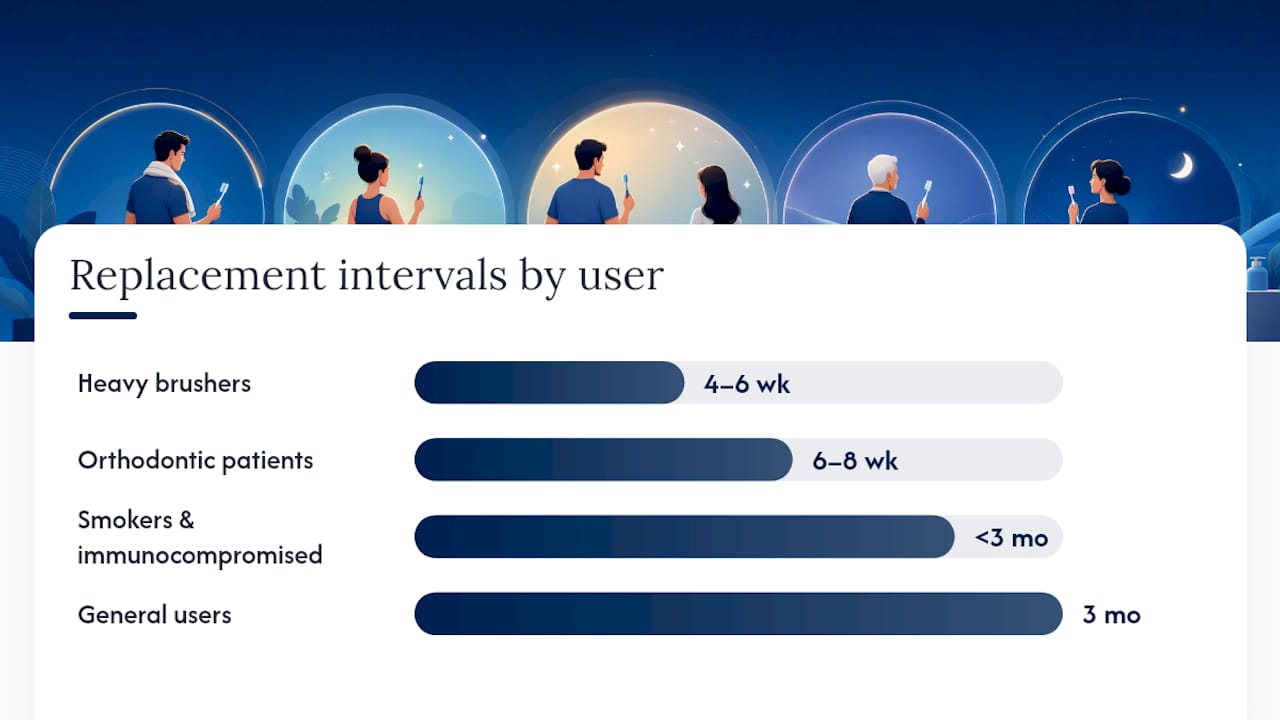
- Heavy-handed brushers: if you press hard enough to bend bristles sideways, you might need a new head every four to six weeks.
- Orthodontic patients: braces wear bristles down faster, so check every six to eight weeks.
- Anyone recovering from a serious illness: clinicians sometimes recommend a swap, though after a routine cold it’s mostly personal preference.
- Visible wear, no matter the calendar date: frayed or discolored bristles mean replace now, not next week.
Key Takeaways
Replacing your toothbrush head roughly every three months, adjusted for wear and personal habits, is the single most reliable way to keep plaque removal effective and gums healthy.
| Point | Details |
|---|---|
| Baseline interval | Replace manual and electric heads about every three months, or sooner if bristles look worn. |
| Watch for physical signs | Splayed, faded, or bent bristles mean replace now regardless of the calendar date. |
| Adjust for habits | Heavy pressure or braces can shrink the interval to four to eight weeks. |
| Build a reminder system | Pair a calendar alert with a physical cue like a dated sticker on the handle. |
| Match the right head | Getsmilefam’s refill heads pair soft, angled bristles with a whitening-focused electric toothbrush bundle. |
Table of Contents
- Toothbrush Head Replacement Frequency: Signs You’re Overdue
- Why Toothbrush Head Lifespan Affects Your Oral Health
- Manual, Electric, and Sonic: How Often to Replace Brush Heads by Type
- Toothbrush Head Replacement Schedule: Reminder Systems That Actually Work
- What to Look for When Buying Replacement Heads
- What Dental Research Says About Brushing and Bristle Wear
- How I Keep My Own Brush Head Schedule on Track
- Stay on Schedule With Refill Heads From Getsmilefam
- Frequently Asked Questions
- Sources
Toothbrush Head Replacement Frequency: Signs You’re Overdue
Bristle wear doesn’t wait for a calendar reminder, and your eyes will usually catch the problem before you consciously think about it. Look at the brush head straight on. Bristles that splay outward in a fan shape, or that stay bent even after drying, have already lost their ability to reach between teeth the way they should.
Faded indicator bristles are another giveaway. Many electric brush heads, including Philips Sonicare models, use blue dye that fades to roughly half its color at the halfway point of the head’s useful life. Once the color is gone, you’re brushing on borrowed time. A musty smell or yellowish discoloration at the base of the bristles points to bacterial buildup that no amount of rinsing will fix.
Performance tells its own story too. If brushing suddenly feels softer or less “grippy” against your teeth, or if you notice plaque still clinging to your teeth after a full two minutes, the bristles have likely lost their structural snap. New or worsening gum bleeding during brushing is a signal worth paying attention to, since it can mean the bristles are either too worn to clean effectively or too stiff for your gumline.
Try this quick three-step check once a week: look at the bristle shape from the side, feel the stiffness with a fingertip, and test by running a fingernail lightly across the bristle tips to see if they’ve lost their spring. If you have to stop and think about when you last swapped the head, treat that hesitation as your answer.
Pro Tip: If you genuinely can’t remember your last replacement date, assume the head is overdue and swap it today. Memory is a terrible tracking system for a habit this small.
Why Toothbrush Head Lifespan Affects Your Oral Health
Worn bristles aren’t just cosmetically sad. A peer-reviewed study found that new toothbrushes remove noticeably more plaque than brushes with degraded bristles, and additional clinical research confirms that bristle degradation directly reduces cleaning performance. That’s not a marginal difference. It’s the gap between actually disrupting the plaque biofilm along your gumline and just pushing it around.
Fresh bristles hold their shape and angle long enough to slide into the small gaps between teeth and along the gum margin. Once they splay, they glide over the surface instead of scrubbing it, which is exactly the area where gingivitis tends to start.
Reduced interdental cleaning matters most at the gumline, where plaque hides and where most early gum disease develops. Worn bristles can’t flex into those tight spaces the same way, so plaque sits longer and the risk of gingivitis climbs.
There’s a storage piece too. A wet, unrinsed brush head left in a closed container or cup builds up bacteria far faster than one stored upright and allowed to air dry. Combine proper storage with on-schedule replacement, and you cut both mechanical wear and microbial buildup at the same time.
Manual, Electric, and Sonic: How Often to Replace Brush Heads by Type
The three-month rule holds as a starting point across brush types, but the fine print shifts depending on what’s in your hand and how you use it.
- Manual toothbrushes: replace every three to four months, or sooner once bristles splay.
- Electric and sonic heads: replace roughly every three months; shorter, densely packed bristles on sonic heads can wear out faster than standard manual bristles because they move at a much higher frequency against the same surface.
- Oscillating-rotating heads: similar three-month window, though the rounded bristle tips tend to hold their shape a bit longer under light pressure.
- Multi-level or angled bristle heads: check monthly for splaying at the tips, since the angled design wears unevenly.
Habits change the math more than brush type does. Heavy pressure is the single biggest accelerant of bristle wear, according to dental guidance summarized by Verywell Health, and it also tends to irritate gums over time. If you press hard enough that bristles fan out within weeks of a fresh head, drop to a four to six week replacement cycle and work on lightening your grip.
Orthodontic patients face a similar squeeze. Brackets and wires catch and fray bristles faster than they would on smooth enamel alone, so inspect the head every six to eight weeks rather than waiting for the three-month mark. People who smoke, or anyone who is immune compromised, should lean toward the shorter end of every interval mentioned here, since both situations raise the stakes of using a bacteria-laden brush.
Toothbrush Head Replacement Schedule: Reminder Systems That Actually Work
Knowing the rule and following it are two different problems. Most people don’t forget the three-month guideline. They forget to act on it.
Low-tech reminders work surprisingly well precisely because they don’t rely on remembering a date buried in a phone calendar you rarely open:
- Write the replacement date directly on the brush handle with a permanent marker.
- Store spare heads in labeled slots by month, so grabbing “March” tells you it’s fresh.
- Keep a sticky note on the bathroom mirror with the next swap date.
Device features can do some of the heavy lifting too. Indicator bristles that fade signal wear visually, and some electric handles or their companion apps send push notifications when a head is due for replacement. These features remove the guesswork, but they still require you to notice and act.
If you want a system that runs itself, follow these steps:
- Set a repeating calendar reminder for every three months, dated from your last known swap.
- Pair that digital nudge with a physical cue, like a dated sticker on the brush handle.
- Stock at least one spare head at all times so a worn brush never buys you an extra week of use.
- Consider a subscription or refill pack that ships new heads automatically on a fixed cadence, which removes the “did I order this yet” step entirely.
What to Look for When Buying Replacement Heads
Before you add a head to your cart, confirm it actually fits your handle. Mismatched connectors are a common and avoidable mistake, so check the head’s connection style and shape against your existing handle rather than assuming universal compatibility.
Bristle firmness matters more than most people realize. Dental guidance consistently favors soft bristles, even though medium and firm options sit on the same shelf. Firmer bristles feel more “thorough” in the moment, but they’re more likely to irritate gum tissue and wear down enamel at the gumline over months of use. Soft bristles flex around tooth contours instead of scraping against them, which is the entire point of brushing in the first place.
Look for these features when comparing heads:
- Indicator bristles that fade to show wear progress.
- Multi-level or angled bristle patterns designed to reach the gumline and between teeth.
- A head shape that’s small enough to access your back molars comfortably.
- Soft bristle rating, confirmed on the packaging rather than assumed.
A whitening-focused electric toothbrush bundle built around these standards keeps replacement heads consistent in quality every time you swap, which matters more than most people expect once you’ve gone through a few cheap, inconsistent refills.
What Dental Research Says About Brushing and Bristle Wear
The clinical picture is consistent: fresh bristles clean better, and that gap widens the longer you wait to replace a head. The ADA’s guidance treats the three-to-four-month window as a floor, not a strict rule that overrides what your eyes tell you.
Self-inspection matters more than the calendar. A head that looks worn at week six needs replacing at week six, and a head that still looks sharp at month three can sometimes go a little longer, though most people should still err on the side of the shorter interval.
Technique plays a bigger role in bristle longevity than most people assume. A gentle touch paired with a full two-minute, twice-daily routine slows down bristle wear considerably compared to aggressive scrubbing. Pressing too hard doesn’t clean better. It just bends bristles out of shape faster and can irritate your gums in the process.
Pro Tip: Hold your toothbrush the way you’d hold a pen, not a scrub brush. Light pressure with a small circular motion cleans just as well and roughly doubles how long your bristles hold their shape.
How I Keep My Own Brush Head Schedule on Track
I pair my replacement schedule with something else that already happens every three months, so the swap piggybacks on a habit I’ve already built instead of competing for its own space in my memory. For me that’s a recurring bill or a seasonal errand. The specific anchor doesn’t matter much. What matters is tying a small, easy-to-forget task to something that already has momentum.
The one thing I’ve stopped doing is trusting my own judgment about when a head “still looks fine.” Bristles degrade gradually enough that day-to-day comparisons are unreliable, and a slow decline is nearly impossible to notice from the inside. A fixed interval, checked against visible wear rather than vague memory, beats intuition every time.
Stay on Schedule With Refill Heads From Getsmilefam
Buying replacement heads one at a time is exactly the kind of task that falls through the cracks. Getsmilefam sells compatible refill heads for its whitening electric toothbrush that match the same soft bristle standard dental guidance recommends, so you’re not stuck guessing whether a head fits or whether the bristle firmness is right for your gums.
The bundle is built around soft, angled bristles designed to reach the gumline without the wear-and-tear shortcuts that cheaper heads take. Pairing fresh heads with BLU Whitening Toothpaste keeps your whitening results consistent between sessions, since a worn brush can dull the surface polish that keeps teeth looking bright. If you’d rather not think about reorder timing at all, check the bundle page for refill options and set your own repeat order around the three-month mark. It’s a small five-minute task now that saves you from brushing with a worn-out head for weeks without noticing.
Frequently Asked Questions
How often should you replace an electric toothbrush head? About every three months, matching the manual brush guideline, though you should replace sooner if indicator bristles fade or bristles start splaying.
When should you replace a toothbrush head after being sick? For a routine cold, replacement is a personal choice rather than a strict requirement. After a more serious illness, some clinicians recommend swapping the head as a precaution.
Do heavy brushers need to replace heads more often? Yes. Pressing hard bends and frays bristles faster, so heavy-handed brushers should check every four to six weeks instead of waiting the full three months.
What are the clearest signs a toothbrush head needs replacing? Splayed or permanently bent bristles, faded indicator coloring, a musty smell, and reduced plaque removal during brushing are the most reliable signs.
Is soft bristle firmness really better than medium or firm? Yes, for most people. Soft bristles clean effectively while flexing around the gumline, whereas firmer bristles increase the risk of gum irritation over time.
Sources
- Toothbrushes | American Dental Association
- Here’s How Often You Should Replace Your Toothbrush
- Pmc
- Ncbi