

Brush before whitening strips, but not right before. Wait 15–30 minutes after brushing before you apply the strips, and after you remove them, rinse your mouth first and wait about 30 minutes before brushing again. That two-window rule covers the whole session.
The short version: Brush gently, wait 15–30 minutes, apply strips, remove strips, rinse, wait 30 minutes, then brush gently with a soft-bristled toothbrush and a non-abrasive fluoride toothpaste.
Here is why those gaps matter:
- Strip adhesion: Brushing stirs up saliva and leaves a thin, slippery film on your teeth. Strips need dry, clean enamel to sit flush and deliver the whitening gel evenly.
- pH and enamel recovery: Brushing temporarily lowers oral pH and slightly roughens the enamel surface. Giving saliva time to rebalance that environment reduces how much the peroxide gel irritates your gums and enamel.
- Post-strip sensitivity: The peroxide in strips keeps working briefly after you peel them off. Brushing immediately can push that active gel into already-open enamel pores and spike sensitivity.
If you already deal with tooth sensitivity during whitening, talk to your dentist before starting a strip regimen.
Key Takeaways
Brushing before whitening strips is recommended, but the 15–30 minute wait window before applying and the 20–30 minute wait after removal are what protect your enamel and keep sensitivity manageable.
| Point | Details |
|---|---|
| Wait before applying strips | Brush gently, then wait 15–30 minutes before putting strips on. |
| Rinse first after removal | Rinse with water immediately after removing strips; delay brushing 20–30 minutes. |
| Choose a non-abrasive toothpaste | Avoid baking soda and charcoal formulas before and after whitening sessions. |
| Manage sensitivity proactively | Start a desensitizing toothpaste 7–10 days before treatment and shorten sessions if needed. |
| Getsmilefam for gentle daily care | The BLU Whitening Toothpaste and Snow Serum™ Pen are enamel-safe options that fit the brush-and-wait routine. |
Table of Contents
- How whitening strips work and why timing affects your results
- Brushing before applying strips: the right approach and timing
- When and how to brush after removing whitening strips
- How to reduce and manage tooth sensitivity from whitening strips
- A simple brush-and-wait routine for treatment days
- When to stop whitening and consult a dentist first
- Why the 15–30 minute wait is backed by dental guidance
- A safety-first whitening routine is the only routine worth following
- Getsmilefam fits naturally into this routine
- Sources
How whitening strips work and why timing affects your results
Whitening strips carry a thin layer of peroxide-based gel, usually hydrogen peroxide or carbamide peroxide, pressed directly against your enamel. The peroxide diffuses through the enamel surface and breaks apart the carbon bonds in stain molecules, which is what produces the lighter color. Professional dental education resources confirm that this oxidation process does not stop the moment you peel the strip off. The gel residue left on your teeth continues acting for a short window after removal.
Two things make timing critical:
- Surface debris blocks contact. Plaque, food particles, and even a thick saliva layer prevent the gel from sitting flush against enamel. A clean surface means more even, consistent whitening.
- Freshly brushed enamel is more permeable. Brushing, especially with an abrasive toothpaste, temporarily opens enamel pores and can micro-abrade the surface. Applying peroxide to that state raises the odds of sensitivity.
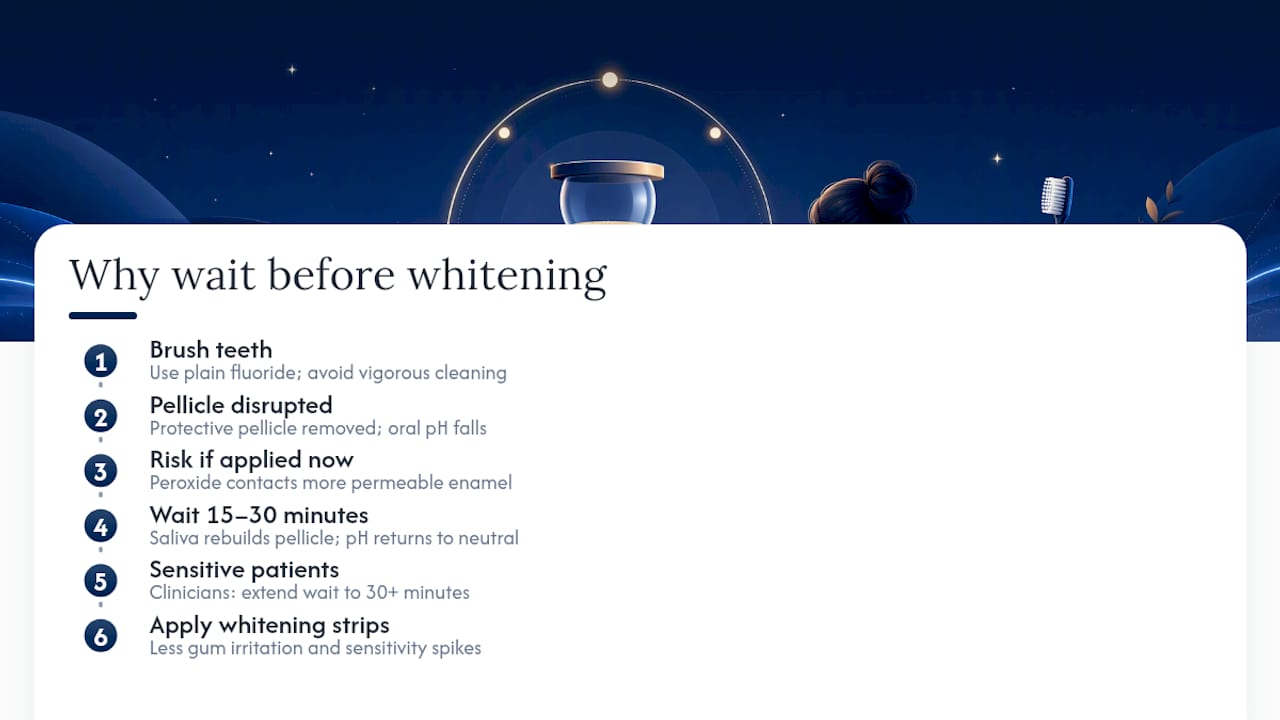
Saliva is your natural buffer here. It rebuilds a protective pellicle on enamel and normalizes oral pH within roughly 15–30 minutes after brushing. That recovery window is the entire reason the “brush and wait” rule exists.
Brushing before applying strips: the right approach and timing
Dentists advise brushing gently before whitening but waiting about 15–30 minutes after brushing before applying strips, so saliva and oral pH can rebalance and reduce gum irritation. That is the consensus across dental practices, and it holds whether you are using a 30-minute strip or an overnight formula.
What toothpaste to avoid right before whitening:
Reach for a plain fluoride toothpaste, not your strongest whitening formula. Abrasive toothpastes, including baking soda formulas, create micro-abrasions that raise enamel permeability. When peroxide hits that rougher surface minutes later, sensitivity goes up noticeably. Charcoal toothpastes carry the same risk.
Pro Tip: Floss before you brush on whitening days. Removing interproximal debris lets strips sit flush between teeth and prevents the patchy, uneven results that happen when food particles block gel contact. Brushing and flossing before whitening is one of the most consistently recommended prep steps.
| Brushing timing | Best for | Sensitivity risk |
|---|---|---|
| Brush 30+ minutes before strips | Most users, including sensitive teeth | Low |
| Brush 15–30 minutes before strips | Standard users with no sensitivity history | Low to moderate |
| Brush immediately before strips | Not recommended for anyone | High |
| Skip brushing entirely | Not recommended (reduces whitening evenness) | Moderate |
When and how to brush after removing whitening strips
The moment you peel off a strip, the instinct is to brush. Resist it. Many dentists recommend rinsing first and delaying brushing to avoid increasing sensitivity, with gentle brushing later using a soft brush confirmed as safe.
Here is the sequence that works:
- Remove the strip and discard it. Do not fold it back onto your teeth or leave residue sitting.
- Rinse thoroughly with water. This clears the gel residue without the mechanical friction of a toothbrush on sensitized enamel.
- Wait 20–30 minutes. Drink water if you want. Avoid coffee, tea, red wine, or anything acidic during this window since enamel pores are still slightly open.
- Brush gently with a soft-bristled toothbrush. Use a standard fluoride toothpaste. Light pressure only.
- Hold off on whitening toothpaste until the next morning. Using an abrasive whitening toothpaste right after a strip session compounds irritation.
Multiple practice-level sources converge on rinsing immediately after strip removal and waiting before brushing, with the 15–30 minute delay cited most often. Colgate’s consumer guidance aligns with this, recommending gentle brushing after a waiting period to avoid irritation.
If you feel a sharp, shooting pain after removing strips, skip brushing entirely that session and rinse with cool water instead.
How to reduce and manage tooth sensitivity from whitening strips
Sensitivity during whitening is common, but it is largely manageable with the right prep. The key is starting before your first strip session, not after the zingers hit.
- Start a desensitizing toothpaste 7–10 days before treatment. Formulas containing potassium nitrate or stannous fluoride help block the dentinal tubules that transmit sensitivity signals. Use it as your regular toothpaste in the lead-up period.
- Shorten your sessions if needed. If a 30-minute strip causes discomfort, try wearing it for 15–20 minutes instead. Less contact time means less peroxide exposure per session.
- Space out treatment days. Clinicians warn that skipping the wait between sessions is a common reason people abandon whitening mid-course due to painful experiences. Every other day, or three days per week, is gentler than daily use.
- Rinse with cool water after removal. It eases the immediate post-strip zing without interfering with the whitening process.
- Avoid temperature extremes for a few hours. Very hot coffee or ice-cold drinks hit sensitized enamel hard right after a session.
Pro Tip: For a deeper look at protecting enamel while whitening, the combination of a desensitizing toothpaste pre-treatment and a non-abrasive fluoride toothpaste post-treatment covers most sensitivity cases without requiring you to stop whitening entirely.
Stop whitening and see a dentist if sensitivity persists beyond 48 hours after a session, if your gums bleed or turn white, or if you notice any visible changes to your enamel surface.
A simple brush-and-wait routine for treatment days
Follow this sequence on every whitening day and the timing takes care of itself.
- Floss to clear interproximal debris.
- Brush gently with a soft-bristled toothbrush and a plain fluoride toothpaste (not baking soda or charcoal).
- Wait 15–30 minutes. Drink water; avoid food.
- Apply whitening strips per the product instructions.
- Remove strips after the recommended wear time.
- Rinse mouth thoroughly with water.
- Wait 20–30 minutes before brushing again.
- Brush gently with a soft brush and fluoride toothpaste.
- Avoid staining foods and drinks (coffee, red wine, tomato sauce) for at least one hour after brushing.
For a full pre-treatment walkthrough, the teeth prep guide from Getsmilefam covers each step in detail.
When to stop whitening and consult a dentist first
At-home strips are safe for most healthy adults, but a few situations call for a professional check before you start or a pause mid-course.
Stop and see a dentist if you experience:
- Sharp, persistent pain that lasts more than 48 hours after a session
- Gum tissue that turns white, bleeds, or pulls back after strip use
- Any visible pitting, chalky spots, or surface changes on your enamel
- Sensitivity so severe it disrupts sleep or eating
Get a dental clearance first if you have:
- Recent fillings, crowns, or veneers (peroxide does not whiten restorations, and it can irritate fresh margins)
- Exposed root surfaces or gum recession
- Untreated cavities (peroxide entering a cavity is painful and can worsen decay)
- A history of severe sensitivity to whitening products
Ask your dentist these questions before starting: “Do I have any cavities or exposed roots that would make strips risky?” “Given my sensitivity history, what peroxide concentration is appropriate?” “Is there a gentler whitening method that would work better for me?” Getting those answers takes five minutes and can save you a week of discomfort.
If you are weighing whether to continue at-home strips or move to a clinical option, Clayton Dental Studio’s whitening services outline what professional evaluation involves and when in-office treatment makes more sense.
Why the 15–30 minute wait is backed by dental guidance
The 15–30 minute window is not arbitrary. Dental professionals link the wait time directly to saliva and pH recovery, explaining that saliva rebuilds the protective pellicle on enamel and restores a neutral oral pH after brushing. Applying peroxide before that recovery happens means the gel contacts a more permeable, more irritable surface.
The clinical reasoning: Brushing disrupts the salivary pellicle and temporarily lowers oral pH. Waiting 15–30 minutes allows saliva to re-establish that protective layer, so the peroxide in whitening strips contacts a more stable enamel surface with less risk of gum irritation or sensitivity spikes.
Clinicians recommend cleaning teeth about 30 minutes before applying gel-based whitening products and specifically advise against vigorous cleaning immediately beforehand. For patients with a sensitivity history, some practitioners extend that recommendation to 30 minutes or more. The logic is consistent: the more sensitive the patient, the longer the buffer needed.
Abrasive toothpastes are a separate concern. They roughen the enamel surface at a microscopic level, and that roughness increases how deeply peroxide penetrates. That is useful for whitening depth but hard on sensitivity. A plain fluoride toothpaste sidesteps the problem entirely.
A safety-first whitening routine is the only routine worth following
The timing rules in this guide are not overcautious. They reflect what dental professionals consistently recommend, and they exist because the most common whitening complaints, sensitivity spikes and uneven results, are almost always caused by skipping the wait windows or using the wrong toothpaste at the wrong time.
My honest position: if you are not willing to build in the 15–30 minute pre-strip wait and the 20–30 minute post-strip wait, you are not ready to whiten safely. Those gaps are the routine. Everything else, the toothpaste choice, the flossing, the soft brush, is just supporting detail.
Getsmilefam’s enamel-safe formulas are designed for exactly this kind of conservative, sensitivity-aware approach, which makes them a natural fit for anyone following the timing guidance above.
Getsmilefam fits naturally into this routine
Readers who follow the brush-and-wait routine need products that do not undo the care they just took. The Getsmilefam Snow Serum™ Whitening Pen applies precisely where you need it, without the peroxide load of traditional strips, making it a gentler option for touch-ups between strip sessions or as a standalone treatment for sensitive users.
The BLU Whitening Toothpaste is formulated without harsh abrasives, so it works as your pre-strip brush and your post-strip brush without raising sensitivity risk either time. That matters because most whitening toothpastes are too abrasive to use safely right before a strip session. Getsmilefam’s formula is built around enamel safety first, results second, which is the right order of priorities. Check the full product range at Getsmilefam and find the option that fits your routine.
Sources
- Should I Brush My Teeth Before Whitening Them? Here’s What Dentists Say | Blog
- Should I Brush My Teeth Before Teeth Whitening Tips
- Dentalcare
- Should I Brush My Teeth Before Using Whitening Strips
- Can I Brush My Teeth Before or After Using Whitestrips?
- Do You Brush Your Teeth After Whitening Strips? What Patients Should Know
This article is general information, not a substitute for advice from a qualified doctor. Consult a qualified healthcare professional about your own circumstances before acting on anything here.