

Enamel-safe whitening is defined as any whitening method that removes stains through oxidation without disrupting the mineral structure of your tooth’s outer layer. Enamel is the hardest substance in your body, but it cannot regenerate once lost. That makes it critical to protect enamel while whitening teeth, because the wrong product or technique can cause permanent sensitivity and surface erosion. The good news: professionally supervised whitening produces no clinically significant changes to enamel microhardness when used correctly. This guide explains exactly how to whiten safely, which products earn their place on the top enamel-safe whitening products list, and what aftercare actually works.
How do whitening agents interact with enamel?
Whitening gels work by releasing oxygen molecules that penetrate enamel pores and oxidize the chromogen compounds responsible for staining. This process temporarily opens those pores, which is why the role of enamel minerals during whitening is so critical. Enamel undergoes continual cycles of mineral loss and recovery. Effective whitening manages the pore-opening window so natural remineralization can occur before any permanent softening sets in.
The chemistry of the gel matters more than most people realize. Professional pH-neutral gels preserve enamel integrity by avoiding the acidic demineralization that many over-the-counter products trigger. Acidic OTC strips and gels etch the enamel surface, making it rougher and more porous over time. That roughness traps more stain, which leads users to whiten more often, which compounds the damage.
Modern protocols address this through what researchers call Neutral-Zone Whitening. This approach uses pH-balancing gels that protect the hydroxyapatite layer while still lightening deep chromogens. Hydroxyapatite is the mineral crystal that gives enamel its strength. Protecting it is the foundation of any enamel-safe whitening process.
Remineralizing agents play a direct protective role. CPP-ACP (casein phosphopeptide-amorphous calcium phosphate) and fluoride both restore enamel microhardness after bleaching, with studies showing recovery to or exceeding baseline levels. Think of them as the repair crew that fills in the pores opened during treatment. Gels that include these agents do not just whiten. They actively rebuild.
Key factors that make a whitening method enamel-safe:
- pH-neutral or alkaline gel formulation (pH 6.5 or above)
- Concentration appropriate for the delivery method (lower for at-home, higher for in-office)
- Inclusion of fluoride, CPP-ACP, or chitosan as protective additives
- Custom-fitted trays that prevent gel contact with gum tissue
- Strict adherence to recommended application times
Pro Tip: Adding 2% chitosan to a bleaching gel has been shown to maintain baseline enamel surface microhardness. When shopping for at-home kits, look for chitosan or nano-hydroxyapatite on the ingredient label as a signal of a well-formulated product.
What are the best products and techniques for safe whitening?
Choosing the right delivery method is the single most important decision in the enamel-safe whitening process explained simply: the closer the supervision, the safer the outcome.
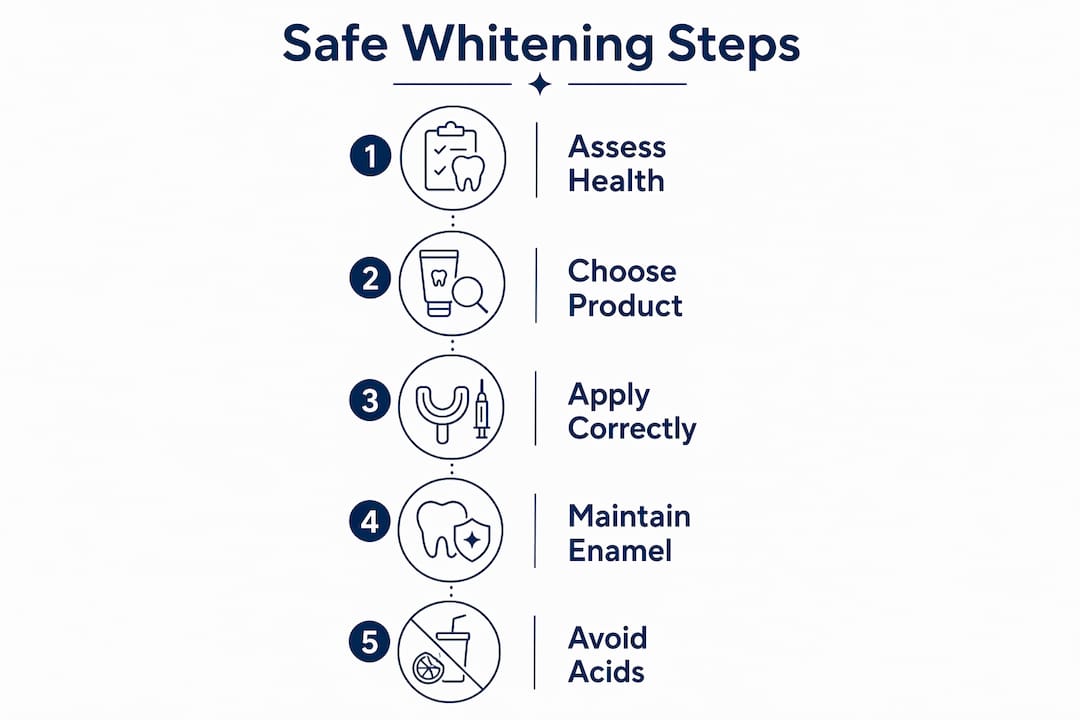
Professional in-office treatments
In-office whitening uses high-concentration gels (typically 25–40% hydrogen peroxide) applied by a trained clinician. The dentist controls contact time, monitors enamel response, and applies protective barriers to gum tissue. Results are immediate and the risk of misuse is essentially zero. The tradeoff is cost, which typically runs $300–$1,000 per session.
Supervised at-home kits
Dentist-dispensed at-home kits use custom-fitted trays and lower-concentration gels (10–22% carbamide peroxide). Custom trays are critical because they prevent gel pooling on gum tissue and distribute the whitening agent evenly. This method takes 1–2 weeks but delivers results close to in-office quality. For most people, this is the best balance of safety, effectiveness, and cost.
OTC whitening products
Over-the-counter strips, pens, and trays use the lowest concentrations (3–10% hydrogen peroxide or equivalent). The problem is not always the active ingredient. It is the acidic carrier gel and the one-size-fits-all tray design. Poorly fitted trays allow gel to contact gums and pool unevenly on teeth. For a safe at-home whitening experience with OTC products, choose strips with a neutral pH and avoid leaving them on beyond the stated time.
| Method | Concentration | Enamel Safety | Cost Range | Best For |
|---|---|---|---|---|
| In-office professional | 25–40% H₂O₂ | Highest (supervised) | $300–$1,000 | Fast results, complex cases |
| Dentist-dispensed at-home | 10–22% carbamide peroxide | High (custom trays) | $100–$400 | Gradual, controlled whitening |
| OTC strips/pens | 3–10% H₂O₂ | Moderate (if pH-neutral) | $20–$80 | Maintenance, mild staining |
| DIY acidic scrubs (lemon, baking soda) | Variable/uncontrolled | Low (enamel erosion risk) | Minimal | Not recommended |
Avoid DIY remedies like lemon juice or straight baking soda. Lemon juice has a pH around 2.0, which actively dissolves enamel minerals. Baking soda is mildly abrasive and not formulated for controlled whitening. Neither belongs in a serious enamel-safe whitening products checklist.
Pro Tip: If you use OTC strips, apply them after brushing but wait 30 minutes. Brushing immediately before whitening removes the protective pellicle layer on enamel, leaving it more vulnerable to the gel. You can learn more about whitening without sensitivity in Getsmilefam’s 2026 guide.
How should you care for enamel before, during, and after whitening?
Enamel protection is not just about the product you choose. The routine around your treatment determines how well your enamel holds up and how long your results last.
Before treatment
- Schedule a dental checkup to identify existing cavities, cracks, or restorations that could complicate whitening.
- Use a remineralizing toothpaste containing fluoride or nano-hydroxyapatite for two weeks before starting. This strengthens enamel before it faces any chemical stress.
- Avoid acidic foods and drinks (citrus, soda, vinegar-based dressings) for 48 hours before treatment to keep enamel in its strongest state.
- If you have known sensitivity, ask your dentist about a desensitizing gel application before your first session.
During treatment
- Never exceed the recommended application time. Leaving products on too long causes enamel dehydration and heightened sensitivity without any additional whitening benefit.
- Do not brush your teeth immediately after removing whitening strips or trays. Enamel is temporarily softened and more vulnerable to abrasion in the first 30 minutes post-treatment.
- Space treatments according to the product schedule. More frequent applications do not produce faster results. They produce more damage.
- Rinse with water after removing trays to clear residual gel from the enamel surface.
After treatment
- Avoid dark-pigmented and acidic foods for at least 48 hours post-whitening. Coffee, red wine, tomato sauce, and citrus are the main offenders. Enamel pores remain open during this window and absorb pigment more readily.
- Drink plenty of water. Staying hydrated increases saliva production, and saliva is your mouth’s built-in remineralization system. It delivers calcium and phosphate directly to enamel pores.
- Switch to a fluoride-containing toothpaste for at least two weeks after treatment. Fluoride accelerates the recrystallization of hydroxyapatite in the pores opened during bleaching.
- Use a soft-bristle toothbrush. Hard bristles on freshly whitened enamel cause micro-scratching that increases long-term stain retention.
For more on building habits that support your results, Getsmilefam’s guide on lifestyle changes for whiter teeth covers the full picture.
What mistakes and myths put enamel at risk during whitening?
The most damaging whitening errors are not dramatic. They are small, repeated habits that compound over time.
Common myths and the facts behind them:
- Myth: Whitening thins your enamel. Whitening works through stain oxidation, not physical abrasion. Properly formulated products do not sand or erode enamel. The thinning myth comes from misuse of acidic OTC products, not from whitening chemistry itself.
- Myth: More sessions mean whiter teeth. Whitening reactions are time-limited. Once the active ingredient is exhausted, additional contact time adds zero whitening and measurable enamel stress.
- Myth: Sensitivity means the product is working. Sensitivity signals that the gel is reaching the dentin layer, which means the enamel barrier is compromised. It is a warning, not a feature.
Practices that genuinely damage enamel:
- Leaving strips on overnight or well beyond the stated time
- Using whitening products on cracked or decayed teeth without prior dental treatment
- Brushing aggressively with a hard-bristle brush immediately after treatment
- Applying whitening gel to dental veneers, crowns, or composite fillings. Restorations do not whiten and aggressive whitening can cause surface erosion and color mismatches on these materials.
“Enamel cannot regenerate. Every whitening decision you make is permanent at the structural level. The goal is to achieve your cosmetic result while keeping that structure intact.”
If you have multiple restorations, significant sensitivity, or a history of enamel erosion, consult a dentist before starting any whitening program. A professional assessment costs far less than repairing the damage from a poorly chosen protocol. Getsmilefam’s resource on safe versus harsh whitening breaks down exactly what separates the two categories.
Key takeaways
Protecting enamel while whitening teeth requires pH-neutral formulations, correct application timing, and active remineralization before, during, and after treatment.
| Point | Details |
|---|---|
| Choose pH-neutral products | Acidic gels demineralize enamel; pH-neutral or alkaline formulas preserve the hydroxyapatite layer. |
| Never exceed application time | Leaving whitening products on too long causes dehydration and sensitivity without improving results. |
| Use remineralizing agents | Fluoride and CPP-ACP restore enamel microhardness after bleaching and reduce post-treatment sensitivity. |
| Avoid acidic foods for 48 hours | Enamel pores stay open after treatment, making teeth more vulnerable to staining and acid erosion. |
| Consult a dentist before whitening restorations | Crowns, veneers, and fillings do not whiten and can be damaged by aggressive whitening protocols. |
Why i think most people approach whitening backwards
People come to whitening focused entirely on the result: how many shades, how fast, how cheap. That framing almost guarantees they will make at least one decision that harms their enamel. I have seen it repeatedly. Someone buys the strongest OTC strips they can find, leaves them on twice as long as directed, and then wonders why their teeth ache and look translucent at the edges.
The smarter frame is to start with enamel health and work toward whitening from there. That means getting a dental checkup first, not after something goes wrong. It means choosing a product based on its pH and additive profile, not just its advertised shade improvement. And it means accepting that a two-week gradual protocol with a dentist-dispensed kit will outperform a three-day aggressive OTC push every single time, both in results and in long-term enamel condition.
The other thing most articles skip: whitening is not a one-time event. It is a maintenance practice. The people with the best long-term results treat it like skincare. They do short, infrequent touch-up sessions with enamel-safe products, they stay hydrated, and they use remineralizing toothpaste as a baseline habit. That approach keeps enamel strong and results consistent without the boom-and-bust cycle of aggressive whitening followed by sensitivity and staining.
Realistic expectations matter too. Whitening works on natural tooth structure. It does not change the color of restorations, and it cannot lighten teeth beyond their genetic baseline. Knowing that before you start saves a lot of frustration and a lot of unnecessary product use.
— Lenney
Getsmilefam’s enamel-safe whitening solutions
If you want whitening results without putting your enamel at risk, Getsmilefam has built its product line around exactly that standard.
The BLU Teeth Whitening Kit uses BLU Whitening Technology developed in Singapore, formulated without hydrogen peroxide and designed to be safe for sensitive gums. The kit delivers visible results in a single session while keeping the whitening process within a pH range that protects enamel integrity. For daily maintenance, the BLU Whitening Toothpaste includes remineralizing ingredients that support enamel recovery between treatments. Both products are lab-approved and built for people who take their dental health seriously. Getsmilefam also offers a Snow Serum™ Whitening Pen for targeted touch-ups between full sessions.
FAQ
What is enamel-safe whitening?
Enamel-safe whitening uses pH-neutral or alkaline bleaching agents that remove stains through oxidation without acidic demineralization of the enamel surface. Products that include remineralizing additives like fluoride or CPP-ACP provide an additional layer of protection during treatment.
Does whitening damage enamel permanently?
Professionally supervised whitening at appropriate concentrations produces no clinically significant changes to enamel microhardness or surface morphology. Damage occurs primarily from misuse of acidic OTC products, excessive application times, or whitening over untreated decay.
How long should you wait to eat after whitening?
Avoid acidic and dark-pigmented foods for at least 48 hours after whitening. Enamel pores remain open during this recovery window, making teeth more susceptible to restaining and acid erosion.
Can you whiten teeth with crowns or veneers?
Dental restorations do not respond to whitening agents. Applying whitening products to teeth with crowns, veneers, or composite fillings can cause color mismatches and surface erosion on the restoration material. A professional assessment before whitening is the only way to avoid this outcome.
How often should you whiten to protect enamel?
Most dentist-dispensed at-home protocols recommend whitening no more than once or twice per year for maintenance. Frequent whitening without remineralization intervals prevents enamel from recovering fully between sessions and increases long-term sensitivity risk.