

At-home whitening can lighten a tooth discolored after root canal treatment, but only if the staining sits mostly on or near the enamel surface. Deeper, sealer-driven pigmentation often resists topical products entirely. A dental check first tells you which category you’re in, and enamel-safe, peroxide-free formulas give you a low-risk way to test for improvement without gambling on sensitivity or damage.
TL;DR:
- External whitening works only on surface stains and is ineffective for discoloration caused by internal sealer breakdown, which often requires dental intervention.
- Sealers like zinc oxide eugenol can cause discoloration that develops over years, making surface whitening unlikely to produce significant results.
- Enamel-safe, peroxide-free whitening products lower sensitivity risks and are the recommended first choice for teeth with root canals and restorations.
- Use a whitening pen conservatively for two weeks, starting with a dental check to confirm suitability and taking baseline photos to accurately track progress.
- Seek professional advice if there is no improvement after four weeks, or if sensitivity, restoration damage, or recurrent discoloration occurs during at-home whitening routines.
Table of Contents
- Whitening After Root Canal: How It Works and What It Can’t Fix
- What Makes a Whitening Kit Safe for a Root Canal Tooth?
- How Do You Use a Whitening Pen or Kit Safely at Home?
- When Should You See a Dentist Instead of Whitening at Home?
- Why We Push Enamel-Safe Whitening First
- Finding the Right Starter Product for Your Routine
- Sources
Whitening After Root Canal: How It Works and What It Can’t Fix
External whitening products work by lifting stain molecules that sit in the outer layers of enamel and the thin dentin just beneath it. That’s the same mechanism that clears coffee and tobacco stains from vital teeth. A root canal tooth, though, often discolors from the inside out, which changes the calculation entirely.
Discoloration after root canal treatment shows up in more than 30% of cases, and the timing and severity depend heavily on which sealer the dentist used. Some sealers release pigment gradually, with staining that can start within a week and progress for up to three years as the material breaks down inside the tooth. Zinc oxide eugenol based sealers tend to produce more noticeable color shifts than resin-based alternatives.
That pattern explains why two people with the same root canal history can get very different results from the same whitening pen. If the discoloration is mostly surface residue, dietary staining layered on top of a slightly darker tooth, a topical product can genuinely brighten the visible shade. If the darkening comes from sealer byproducts or breakdown products trapped in the dentin, no amount of surface product reaches that pigment. Topical whitening acts on the enamel surface, while staining that originates deeper in the tooth structure needs a different approach entirely, one that involves a dentist rather than a pen.
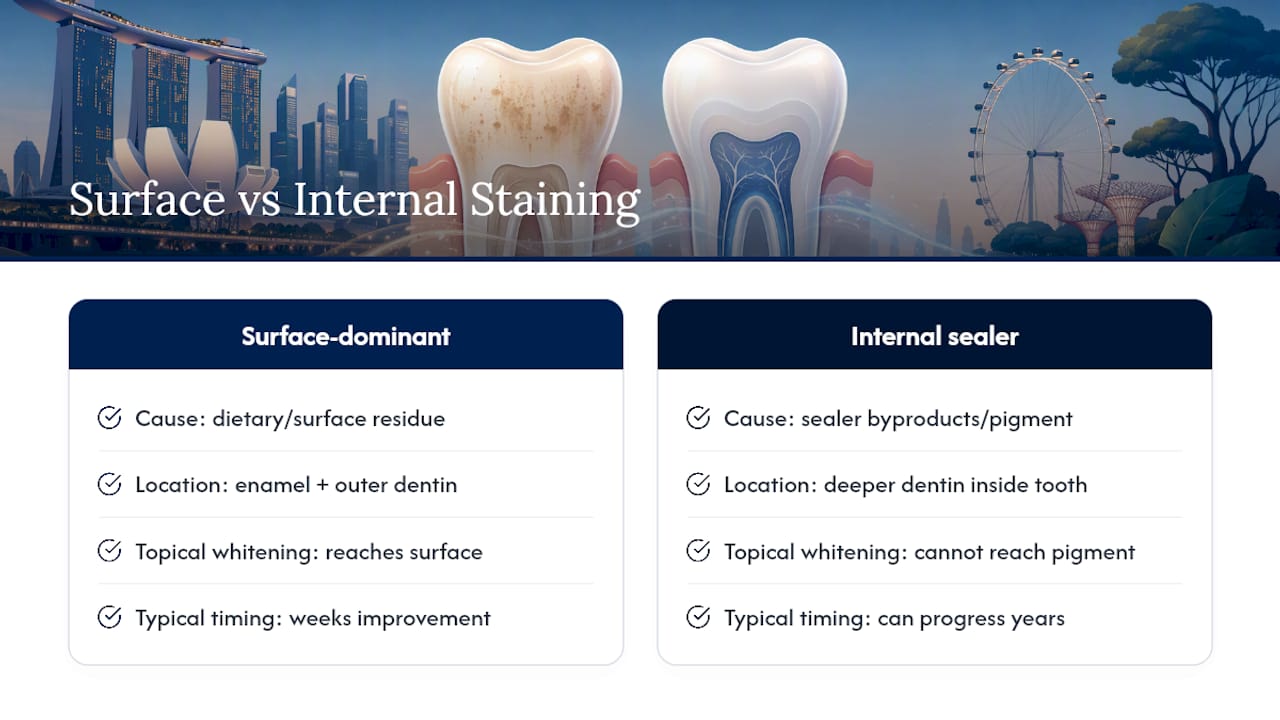
Realistically, expect one of two outcomes. Surface-dominant cases often show a visible, modest shade improvement within a couple of weeks of consistent use. Cases driven by internal sealer pigmentation usually show little to no change, no matter how long you continue. Knowing which one you’re dealing with before you spend weeks on a routine saves both money and frustration.
What Makes a Whitening Kit Safe for a Root Canal Tooth?
Not every whitening product on the shelf is built with a compromised tooth in mind. A root canal tooth has already been through drilling, filling, and possibly a crown, so the margin for error on enamel-safe formulation matters more here than for a healthy smile doing routine touch-ups.
Run any product you’re considering through this checklist before you buy:
- Formula base: look for lab-approved, hydrogen peroxide–free formulas rather than high-concentration bleaching gels, which raise sensitivity risk without necessarily improving results on a compromised tooth.
- pH balance: a balanced, non-acidic formula protects enamel from erosion during repeated applications.
- Desensitizing agents: ingredients like potassium nitrate in the formula or a companion toothpaste reduce the zinger sensation that stops many people mid-routine.
- Clinical claims: verify the brand states clear concentration levels and wear times rather than vague “professional strength” language with no numbers attached.
- Sensitive-gum suitability: products explicitly tested for sensitive gums are a safer starting point if you’ve had any nerve or gum irritation near the treated tooth.
Restorations add a separate wrinkle. Crowns, veneers, and composite bonding are made of materials that don’t respond to whitening agents the way natural enamel does. If your root canal tooth has a crown, whitening the surrounding natural teeth can leave the crown looking noticeably darker than everything around it. Check with your dentist about the restoration’s material and age before starting, and read through how whitening interacts with veneers and crowns so you know what to expect before you buy anything.
Pro Tip: Take a well-lit photo of your smile before your first whitening session. It’s the only reliable way to judge real change two weeks later instead of guessing from memory.

How Do You Use a Whitening Pen or Kit Safely at Home?
Treat the first two weeks as a controlled trial, not a race to the whitest shade you can reach.
- Get a dental check first. Confirm the root canal tooth and any restorations are sound, and ask your dentist to flag anything that might interfere with whitening.
- Take baseline photos. Natural light, same angle, same time of day. This is your only honest measure of progress.
- Read the wear-time instructions exactly. Peroxide-free pens and gels typically call for shorter, more frequent applications rather than one long soak.
- Apply to clean, dry teeth. Brush first, let the tooth surface dry briefly, then apply the product only where instructed.
- Wipe away excess immediately after the recommended contact time to avoid over-exposure to gums.
- Track results every few days, not daily. Enamel-safe formulas work gradually, and daily checking mostly breeds impatience.
- Pause if sensitivity spikes. Skip a day or two rather than pushing through discomfort.
- Escalate conservatively. If two weeks bring no change, extend the cycle length before considering a stronger product, not the reverse.
Peroxide-free and lower-concentration formulas tend to lower sensitivity risk, though they may need more time to produce the same shade shift a stronger product would deliver faster. That trade-off is worth accepting on a root canal tooth, where nerve status and restoration integrity make aggressive bleaching a bad gamble.
A whitening pen pairs naturally with a whitening toothpaste for daily maintenance between full application cycles, and a compact travel kit keeps the routine consistent even when you’re away from home. Professional guidance also recommends waiting at least two weeks before any new adhesive restoration work after a whitening course, so mention your routine if a filling or crown replacement is on the calendar.
When Should You See a Dentist Instead of Whitening at Home?
Stop the at-home routine and book an appointment if you see any of these signs. No visible change after a full recommended course, usually two to four weeks, suggests the discoloration is coming from deeper in the tooth than surface products can reach. Severe or escalating sensitivity, discoloration that keeps returning after it briefly lightens, or any sign of a cracked, chipped, or loosening restoration all warrant a professional look rather than a longer whitening cycle.
A dentist will typically start with an assessment of the tooth and any existing restoration, checking whether the coronal seal, the barrier sealing off the root canal filling from the rest of the tooth, is still intact. Removing residual staining material and confirming that seal often changes what’s even possible with future whitening attempts. Bring your baseline photos, note when the discoloration started, and mention the root canal date and any prior whitening products you’ve tried. That history speeds up the diagnosis considerably.
Why We Push Enamel-Safe Whitening First
Most of the frustration people report with whitening after a root canal doesn’t come from the tooth itself. It comes from starting with the wrong product: a high-concentration peroxide gel meant for healthy enamel, applied to a tooth that’s already been through a procedure and possibly a restoration. That’s a formula mismatch, not a failure of whitening as a concept.
Some companies have developed whitening technologies around that exact gap: enamel-safe, hydrogen peroxide–free formulas suited to adults dealing with restoration-driven cosmetic concerns rather than routine coffee stains. The Snow Serum™ Whitening Pen follows the same logic, alongside educational resources on the SmileFam blog and a satisfaction guarantee behind every purchase.
Lower sensitivity risk isn’t a marketing footnote for this audience. It’s the difference between a routine you can actually stick with for two weeks and one you abandon after day three.
— Lenney
Finding the Right Starter Product for Your Routine
If your root canal tooth is dealing with surface-level dust rather than deep internal staining, a peroxide-free pen gives you a low-risk way to find out. The Snow Serum™ Whitening Pen uses Getsmilefam’s BLU formula, built without hydrogen peroxide, so you can run a conservative two-week trial without the sensitivity spike that high-concentration gels tend to trigger around restorations.
First-time buyers usually do best starting with a single pen to gauge response before committing further. If you want daily maintenance built in alongside the pen, the BLU Whitening Toothpaste covers the days between application cycles, and the Premium Travel Kit bundles both for anyone who doesn’t want to break routine while traveling. Some products come with satisfaction guarantees to support customers if results fall short.
See your dentist before you start, especially if you’ve had crown or restoration work near the treated tooth. Once you’ve got the green light, pick up a Snow Serum™ Whitening Pen and start your two-week baseline trial today.
Sources
- Tooth Discoloration Induced by Endodontic Sealers of Different Chemical Bases: A Systematic Review - PMC
- Tooth whitening information for adult patients — Leeds Teaching Hospitals NHS Trust
- Endodontic materials and their role in tooth discoloration — Wiley Online Library