

Remineralizing agents protect and stabilize enamel after whitening by returning lost minerals and reducing surface porosity. When bleaching opens microscopic pores in enamel, calcium, phosphate, and fluoride ions from a remineralizing product diffuse back in, rebuilding the mineral lattice and sealing the surface against staining. A bioengineering review confirms fluoride is the traditional gold standard for reversing mineral loss, while hydroxyapatite (HAP) is an emerging alternative with strong biomimetic potential.
The practical takeaway: apply an evidence-backed remineralizing product after your at-home whitening session, or alongside it per product instructions, to protect enamel hardness without undoing your results.
- Remineralizers are protective, not primary whiteners.
- They reduce post-bleaching sensitivity and slow re-staining.
- The three main agent classes are fluoride, HAP, and CPP-ACP.
- Consistent use for 7 or more days produces measurable enamel recovery.
Table of Contents
- How remineralizing agents actually work in your enamel
- Comparing the main remineralizing agent classes
- Where remineralizers fit into your at-home whitening routine
- How to use remineralizing agents safely with at-home whitening
- Risks to avoid and common myths about whitening at home
- How long remineralization takes and what it costs
- What the clinical evidence actually shows
- Key Takeaways
- Why the “whitening vs. remineralization” framing misses the point
- Getsmilefam’s enamel-safe whitening fits right into this routine
- Selected sources and further reading
How remineralizing agents actually work in your enamel
The mechanism starts with ion reservoirs. Remineralizing agents create concentrated pools of calcium (Ca²⁺), phosphate (PO₄³⁻), and fluoride (F⁻) ions at the tooth surface. Those ions diffuse into micro-defects and subsurface porosities through capillary action, gradually rebuilding the mineral structure from the inside out.
Fluoride takes a shortcut: it reacts with calcium at the surface to form fluorapatite (FAP), a compound more acid-resistant than native hydroxyapatite. That surface precipitation is fast but relatively shallow. Biomimetic agents like nano-HAP and CPP-ACP work differently. They act as scaffolds that attract Ca and phosphate ions and guide oriented crystal growth that closely resembles native enamel, which explains why they can recover deeper subsurface porosity that fluoride alone misses.
Formulation pairing matters more than most people realize. Agents that combine fluoride with a calcium-phosphate source, such as CPP-ACPF or HAP+F, tend to produce synergistic effects on hardness and color stability. Sodium fluoride alone often acts superficially without filling deeper defects.
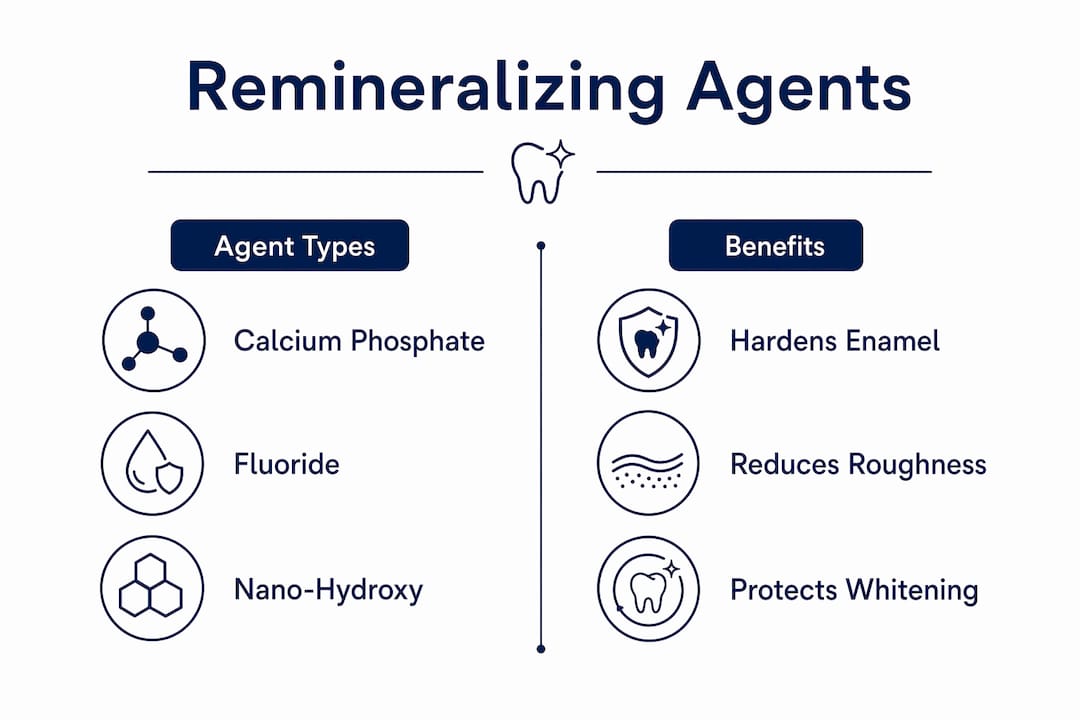
- Fluoride: fast surface precipitation, forms acid-resistant FAP
- HAP / nano-HAP: biomimetic crystal growth, fills subsurface gaps
- CPP-ACP / CPP-ACPF: ion reservoir delivery, reduces sensitivity
- Combination agents: synergistic hardness and color stability gains
Pro Tip: Apply your remineralizing product consistently for at least 7 days after a whitening course. A single application creates a surface deposit; repeated use is what drives measurable re-hardening deeper in the enamel.
Comparing the main remineralizing agent classes
All major classes can improve microhardness and reduce surface roughness after bleaching, but they differ in how they work, how strong the clinical evidence is, and where you can actually buy them.
| Agent | Mechanism | Evidence level | Best use case | US OTC availability |
|---|---|---|---|---|
| Fluoride (NaF, SnF₂) | Surface FAP precipitation | Strong — decades of clinical data | Quick protection, caries prevention | Widely available (toothpastes, rinses, gels) |
| Hydroxyapatite (HAP) | Biomimetic crystal deposition | Good — growing clinical support, needs long-term validation | Sensitivity, subsurface repair, peroxide-free routines | Growing — specialty toothpastes, serums |
| CPP-ACP / CPP-ACPF | Calcium-phosphate ion reservoir | Good — documented post-bleaching benefits | Post-bleaching smoothness, sensitivity reduction | Available in select OTC pastes and professional products |
| Calcium silicate + phosphate + fluoride (CSSPF) | Multi-ion rehardening | Emerging — in vitro data shows near-baseline hardness recovery | Erosion recovery, post-bleaching rehardening | Limited — mostly professional settings |
| Bioactive glass (NovaMin) | Ion release on contact with saliva | Moderate in vitro support | Sensitivity, surface smoothing | Limited OTC in US |
A few practical notes worth keeping in mind:
- CPP-ACP and CPP-ACPF improve microhardness, reduce roughness, and lower sensitivity without blocking whitening efficacy.
- HAP fills subsurface gaps fluoride cannot reach; it suits peroxide-free routines well.
- One study found Remin Pro showed the least post-bleaching discoloration potential compared to NaF and CPP-ACPF groups, a reminder that formulation details affect color outcomes.
- For a deeper look at how ingredients stack up on labels, the guide to enamel-safe whitening ingredients breaks it down clearly.
Where remineralizers fit into your at-home whitening routine
Remineralizers protect and stabilize the enamel surface after whitening. They do not make teeth whiter on their own. What they do is smooth the surface so it picks up less pigment, restore hardness so enamel resists staining, and reduce the sensitivity that makes people quit whitening too soon.
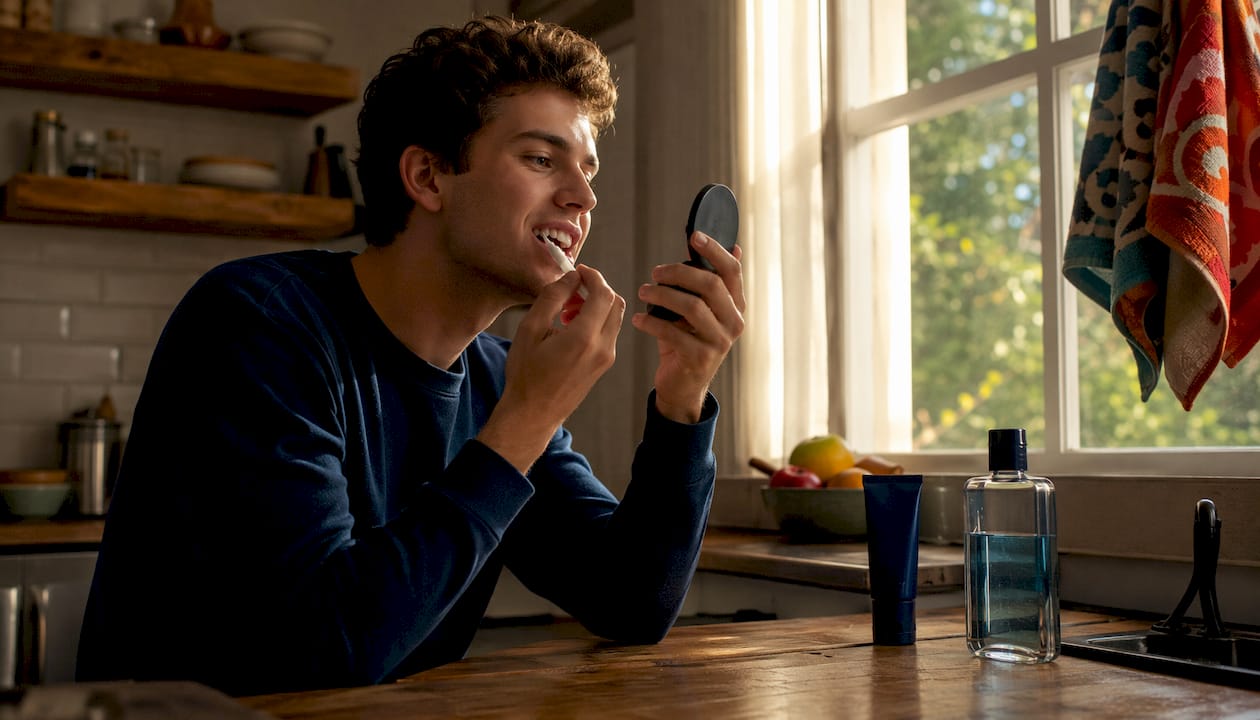
Think of it this way: bleaching opens the door for stains to re-enter. Remineralization closes it. Studies show that HAP and CPP-ACPF applied immediately after bleaching improved post-bleaching color stability compared to fluoride-only or control groups. That is a protective cosmetic benefit, not a whitening one.
Timing guidance:
- Immediately after a single whitening session: apply a remineralizing gel or serum to seal pores while they are most open.
- Daily for 7–14 days after a whitening course: consistent application drives measurable re-hardening and surface smoothing.
- Ongoing maintenance: a remineralizing toothpaste used twice daily helps sustain optical integrity and slow re-staining between whitening sessions.
Combining remineralizing care with whitening does not reduce bleaching efficacy when products are used per manufacturer guidance. It tends to preserve results and reduce sensitivity instead.
How to use remineralizing agents safely with at-home whitening
A safe routine integrates whitening and remineralization so neither step cancels the other out. Follow these steps:
- Pre-check your baseline. If you have active decay, visible erosion, or severe sensitivity, see a dentist before starting any whitening. Remineralizers cannot repair structural damage.
- Choose your agent. Fluoride for quick surface protection; HAP for biomimetic repair and peroxide-free compatibility; CPP-ACP for sensitivity and reservoir action. Combination formulas (CPP-ACPF, HAP+F) offer synergistic benefits.
- Sequence correctly. Apply your whitening product first, per its instructions. Follow immediately with your remineralizing product, or wait the interval the whitening product specifies.
- Commit to frequency. Daily use for 7–14 days after a whitening course produces measurable microhardness recovery. Skipping days slows the process.
- Monitor for warning signs. Increased sensitivity, chalky white spots, or visible surface pitting mean stop whitening and consult a dentist.
Label cues to look for:
- “Hydroxyapatite” or “nano-hydroxyapatite” listed in active ingredients
- Fluoride concentration stated in ppm (1,000–1,500 ppm is standard for OTC)
- “CPP-ACP” or “Recaldent” on the label
- ADA Seal of Acceptance where applicable
For practical aftercare steps, protecting enamel while whitening covers the full routine in detail.
Pro Tip: Avoid acidic rinses, lemon water, or apple cider vinegar immediately after whitening. Acid dissolves the very mineral layer your remineralizer just rebuilt.
Risks to avoid and common myths about whitening at home
Acidic DIY methods and over-bleaching are real risks. They cause irreversible enamel erosion that remineralizers can only partially repair, not reverse.
Common myths, corrected:
- “Lemon juice or vinegar whitens teeth safely.” False. Both are highly acidic and erode enamel on contact. Dental health guidance explicitly warns against these methods.
- “Remineralizers will undo bleaching damage overnight.” False. Meaningful re-hardening takes consistent daily use for a week or more.
- “More bleaching sessions mean whiter teeth.” Over-bleaching thins enamel and exposes the yellowish dentin underneath, making teeth look darker.
- “Natural means safe.” Charcoal, baking soda, and acidic fruit pastes are abrasive or erosive. “Natural” on a label is not a safety claim.
For a full breakdown of DIY whitening risks and safer alternatives, that resource is worth reading before you experiment.
Stop whitening and see a dentist if you notice: chalky or white-spot lesions, sharp sensitivity to cold air, visible surface pitting, or gum recession near whitened teeth. These are signs of enamel damage that no OTC product can fix.
Red flags on product labels: no ingredient list, vague “mineral complex” language with no named compounds, unverified claims of clinical testing, and no manufacturer contact information.
How long remineralization takes and what it costs
Meaningful re-hardening and surface smoothing require consistent daily use for at least 7–14 days. Deeper improvements take longer.
| Timeline | Expected outcome | Typical product type | Approximate cost |
|---|---|---|---|
| 7 days | Initial surface re-hardening, reduced roughness | OTC remineralizing toothpaste or mouthwash | — |
| 2–4 weeks | Measurable microhardness recovery, sensitivity reduction | OTC remineralizing paste or serum | — |
| 1–3 months | Sustained color stability, deeper subsurface repair | Professional in-office remineralization or prescription fluoride | — |
A few affordability notes:
- Multi-week value kits cost less per application than single-use products.
- A professional visit is worth the cost when you have persistent sensitivity, visible erosion, or white-spot lesions that do not respond to OTC care after 4 weeks.
- Whitening aftercare that lasts covers how to extend results without spending more.
What the clinical evidence actually shows
Multiple clinical and in vitro studies confirm that remineralizing agents restore microhardness and reduce roughness after bleaching. The magnitude and timeline differ by agent.
- Fluoride remains the traditional gold standard for mineral recovery, with decades of clinical validation.
- HAP and CPP-ACPF show strong biomimetic effects and improved post-bleaching color stability in multiple studies.
- A BMC Oral Health study found remineralizing agents restored microhardness and partially recovered phosphorus and fluoride weight percentages over 30 days.
- Biomimetic agents like nano-HAP can act as scaffolds for oriented crystal growth, explaining superior microhardness recovery in some lab models.
“Clinical studies show fluoride effectively reverses mineral loss; hydroxyapatite shows potential but needs further long-term clinical validation.” — Bioengineering review, DOI: 10.3390/bioengineering12010093
Getsmilefam’s formulations use lab-approved ingredients and enamel-safe chemistry without hydrogen peroxide, positioning them within the evidence-backed, sensitivity-conscious approach the literature supports.
Key Takeaways
Remineralizing agents are primarily protective tools that restore enamel hardness, reduce surface roughness, and limit re-staining after whitening, not whitening agents themselves.
| Point | Details |
|---|---|
| Remineralize after whitening | Apply a remineralizing product immediately after each whitening session to seal open enamel pores. |
| Choose evidence-backed agents | Fluoride, HAP, and CPP-ACP all have clinical support; combination formulas (CPP-ACPF, HAP+F) offer synergistic benefits. |
| Avoid acidic DIY methods | Lemon juice, vinegar, and charcoal pastes erode enamel and cannot be fully repaired by remineralizers. |
| Expect 7+ days for results | Measurable microhardness recovery and surface smoothing require consistent daily use for at least one week. |
| Getsmilefam’s approach | Getsmilefam’s enamel-safe, peroxide-free formulas are designed to complement remineralizing care for sensitive teeth. |
Why the “whitening vs. remineralization” framing misses the point
Most guides treat whitening and remineralization as competing priorities. That framing is wrong, and it leads people to skip remineralizing care because they fear it will dull their results.
The evidence says the opposite. Combining remineralizing agents with whitening, when products are used correctly, tends to preserve whitening results and reduce sensitivity rather than undermining either. The real risk is not remineralization. It is the people who skip it, over-bleach to compensate for sensitivity, and end up with thinner enamel that stains faster and hurts more.
The other thing most guides underplay: not all remineralizing products behave the same after bleaching. Formulation details, specifically whether a product pairs fluoride with a calcium-phosphate source, determine whether you get superficial surface coating or genuine subsurface repair. Reading a label for “hydroxyapatite” or “CPP-ACP” is not paranoia. It is the difference between a product that works and one that just sounds like it does.
Getsmilefam’s enamel-safe whitening fits right into this routine
Skipping peroxide does not mean settling for slower results. Getsmilefam’s Snow Serum™ Whitening Pen uses proprietary BLU Whitening Technology with lab-approved, enamel-safe ingredients, no hydrogen peroxide, and a formula designed for sensitive gums. That makes it directly compatible with the remineralizing care routine described throughout this article.
The BLU Whitening Toothpaste pairs daily whitening with enamel-safe chemistry, fitting naturally into the maintenance phase after a whitening course. For on-the-go touch-ups, the Snow Serum™ Whitening Pen delivers a quick, precise application without the sensitivity risk that peroxide-based pens carry. Both products come with a satisfaction guarantee. Browse the full range at Getsmilefam and find the option that fits your routine.
Selected sources and further reading
- Bioengineering review: fluoride and hydroxyapatite in enamel remineralization — peer-reviewed overview of fluoride as gold standard and HAP as emerging alternative
- Tooth remineralization agents: an evidence-based review — dental hygiene literature on ion reservoir mechanisms
- BMC Oral Health: effects of remineralizing agents on bleached enamel — microhardness and roughness recovery data over 30 days
- CPP-ACP and initial carious lesions — clinical evidence for CPP-ACP post-bleaching benefits
- Effect of remineralizing agents on tooth color after home bleaching — discoloration potential comparison across agent types
- In vitro enamel remineralization: calcium silicate vs. NovaMin after whitening — emerging CSSPF data for erosion recovery
- Remineralization and bleaching compatibility — evidence that remineralizers do not reduce bleaching efficacy
- MouthHealthy: natural teeth whitening guidance — ADA-affiliated consumer guidance on acidic DIY risks
- What is teeth whitening? Methods, safety, and results — partner overview of whitening safety and method comparisons