

Approved whitening ingredients for teeth whitening products are defined as active agents recognized by regulatory bodies like the FDA for safe, effective stain removal. Hydrogen peroxide and carbamide peroxide are the two primary approved whitening agents in cosmetic dental products. Both work by releasing active oxygen molecules that break down organic stains on and within tooth enamel. Understanding what is approved whitening ingredient versus what is simply marketed as “whitening” is the most important distinction you can make before buying any product. Stabilizers like polyvinylpyrrolidone (PVP) are also recognized as safe supporting agents that reduce sensitivity and protect enamel during treatment.
What is an approved whitening ingredient for teeth?
Hydrogen peroxide is the core bleaching molecule in virtually every clinically validated teeth whitening product. It penetrates the enamel surface and releases oxygen radicals that chemically break apart the carbon bonds in organic stain molecules. The result is a lighter tooth color without physically removing enamel.
Carbamide peroxide is a compound that delivers hydrogen peroxide in a more stable, slower-release form. When carbamide peroxide contacts saliva, it breaks down into hydrogen peroxide and urea. This slower release makes it better suited for extended-wear trays and at-home treatments where prolonged contact time is needed.
The concentrations used vary significantly by product type:
- Professional in-office treatments: 25%–40% hydrogen peroxide, applied under dental supervision
- Prescription take-home trays: 10%–22% carbamide peroxide
- Over-the-counter (OTC) strips and pens: 3%–10% hydrogen peroxide or equivalent carbamide peroxide
Higher concentration does not automatically mean better results. Professional vs. OTC formulations differ in both peroxide concentration and carrier polymer use, and that balance directly affects how safe and effective a product is for your enamel and gums.
Pro Tip: If you have sensitive teeth, look for products using carbamide peroxide rather than straight hydrogen peroxide. The slower release rate gives your enamel more time to recover between treatments.
Are hydrogen peroxide and carbamide peroxide fda-approved?
The FDA recognizes hydrogen peroxide and carbamide peroxide as the standard active agents in approved whitening products, but it does not approve every product containing them. The distinction matters. A product must use these agents at safe concentrations and meet labeling requirements to be considered compliant.
The FDA prohibits OTC skin lightening products containing hydroquinone or mercury due to serious, documented health risks. Hydroquinone is prescription-only in the United States. Mercury is outright banned. Both substances have appeared in illegally imported whitening products, causing permanent damage to users who assumed “whitening” meant safe.
Here is what regulatory-compliant teeth whitening products must do:
- Declare all active ingredients clearly on the label in English
- List hydrogen peroxide or carbamide peroxide at concentrations within safe OTC limits
- Include stability agents such as PVP or ethyl cellulose where applicable
- Avoid undeclared additives or ingredients with no safety data
PVP polymers play a specific role in stabilizing peroxide gels, controlling how fast the active oxygen releases, and reducing enamel sensitivity. Products that skip these stabilizers tend to cause more irritation at equivalent peroxide concentrations.
Enamel damage and gum irritation are the two most common side effects of misused whitening products. Both risks increase sharply when concentration limits are exceeded or when products lack proper stabilizers. Consumers who experience persistent sensitivity after whitening are often using products with no stabilizing polymer in the formula.
Pro Tip: Check the label for both the active ingredient (hydrogen peroxide or carbamide peroxide) and a stabilizer like PVP. A product listing only the bleaching agent with no carrier or stabilizer is a red flag.
Approved vs. unapproved whitening agents: a direct comparison
Not every ingredient marketed as “whitening” qualifies as an approved whitening agent. Some popular ingredients create the appearance of whiter teeth through abrasion rather than actual bleaching. Others are simply ineffective. A few are genuinely dangerous.
| Ingredient | Approval Status | Effect | Risk Level |
|---|---|---|---|
| Hydrogen peroxide | FDA-recognized | Bleaches intrinsic stains | Low at safe concentrations |
| Carbamide peroxide | FDA-recognized | Slow-release bleaching | Low with proper stabilizers |
| Activated charcoal | Not approved for whitening | Surface abrasion only | High enamel abrasion risk |
| Baking soda | Mild abrasive, not a bleaching agent | Removes surface stains | Low to moderate abrasion |
| Hydroquinone | Prescription-only or banned OTC | Pigment suppression | High toxicity risk |
| Mercury compounds | Banned | Pigment suppression | Severe, permanent damage |
| Thiamidol | Emerging, OTC-supported research | Tyrosinase inhibition | Very low |
| Phenyllactic acid (PLA) | Emerging bio-safe research | Enzymatic pigment regulation | Very low |
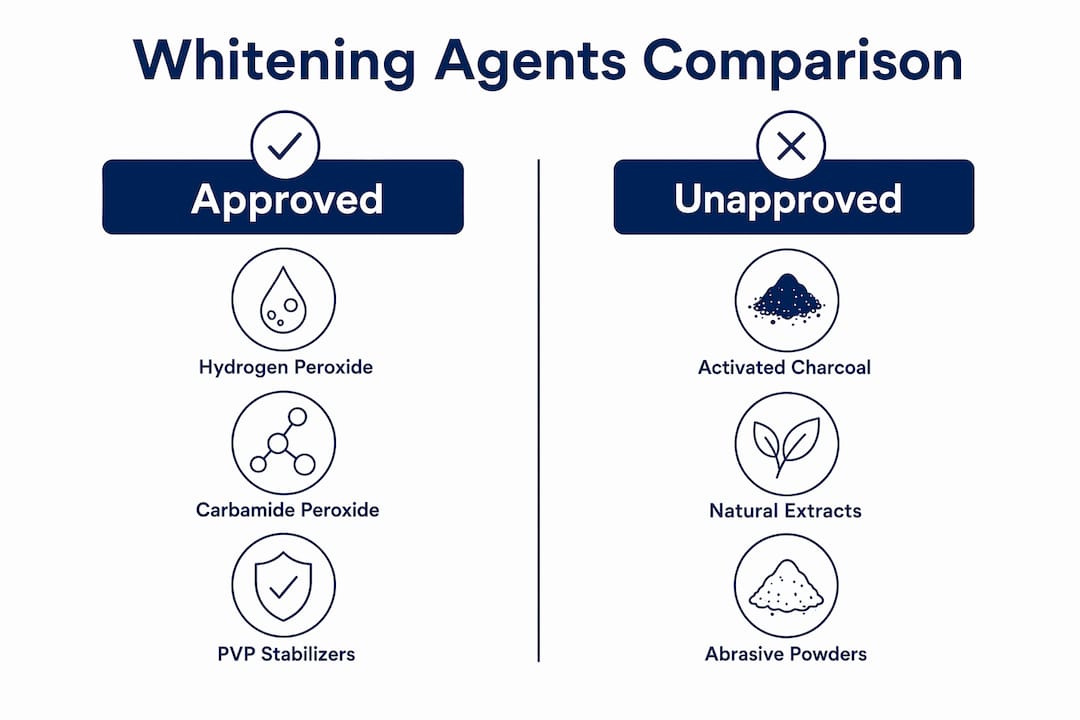
Charcoal-based whitening products cause high enamel abrasion despite their popularity. That abrasion can make teeth look brighter short-term by removing surface debris, but it thins enamel over time and increases long-term staining and sensitivity.
Two newer agents are gaining serious research support as safe alternatives:
- Thiamidol is identified as the most effective human tyrosinase inhibitor out of 50,000 screened compounds, with clinical safety data supporting OTC cosmetic use. It works by selectively blocking the enzyme responsible for pigment production rather than chemically bleaching.
- Phenyllactic acid (PLA), derived from probiotic fermentation, provides whitening effects through metabolic pathways rather than oxidative bleaching. Early data shows a safety profile that outperforms traditional agents.
The “natural” or “chemical-free” label on whitening products is not a regulatory category. It carries no legal definition in the United States. A product can legally call itself natural while containing abrasive compounds that damage enamel more aggressively than properly formulated peroxide gels.
How to choose safe and effective whitening products
Choosing among the best whitening ingredients starts with reading the label before anything else. The ingredient list tells you more than any marketing claim on the front of the package.
Here is a practical checklist for evaluating any whitening product:
- Confirm the active ingredient. Hydrogen peroxide or carbamide peroxide should be listed with a percentage. No percentage listed means no way to assess safety.
- Look for a stabilizer. PVP, ethyl cellulose, or a similar polymer should appear in the inactive ingredients. This signals the formula was designed to protect enamel.
- Check the label language. Products with missing or foreign language labels frequently contain undeclared high-risk substances. If you cannot read the full ingredient list, do not use the product.
- Match concentration to your needs. OTC products at 3%–10% hydrogen peroxide are appropriate for most consumers. Higher concentrations require professional supervision.
- Consult a dentist for high-concentration products. Professional-grade formulas above 15% hydrogen peroxide can cause irreversible enamel damage without proper application technique.
For sensitive teeth specifically, the goal is to find a product that whitens without triggering prolonged sensitivity. Lower peroxide concentrations with a good stabilizer polymer deliver consistent results with less irritation than high-concentration products used infrequently. Frequency and consistency at lower intensity outperform single high-dose treatments for most people.
Understanding how whitening ingredients work at a basic level also helps you set realistic expectations. Peroxide agents whiten intrinsic stains inside the enamel. Abrasive agents only clean the surface. If your staining is intrinsic, a charcoal product will not solve the problem regardless of how it is marketed.
Pro Tip: For the safest at-home whitening, choose a product with carbamide peroxide at 10%–16% and a listed stabilizer. This range is effective for most stain types and well-tolerated by sensitive enamel.
Key takeaways
Safe, effective teeth whitening depends on choosing products with FDA-recognized active agents at appropriate concentrations, supported by stabilizers that protect enamel and reduce sensitivity.
| Point | Details |
|---|---|
| Primary approved agents | Hydrogen peroxide and carbamide peroxide are the two FDA-recognized active whitening agents. |
| Stabilizers matter | PVP and similar polymers control peroxide release and reduce enamel sensitivity in quality formulas. |
| Unapproved agents carry real risk | Charcoal causes enamel abrasion; mercury and hydroquinone are banned or prescription-only for serious reasons. |
| Concentration determines safety | OTC products at 3%–10% hydrogen peroxide are appropriate for most consumers without professional supervision. |
| Emerging alternatives show promise | Thiamidol and phenyllactic acid offer bio-safe whitening through enzymatic pathways rather than chemical bleaching. |
Why “approved” means more than you think
I have spent years watching consumers get burned by the gap between marketing language and regulatory reality. The word “approved” on a whitening product does not mean the FDA reviewed that specific product. It means the active ingredient has recognized safety data at specific concentrations. That distinction gets lost constantly.
The most common mistake I see is people treating “natural” as a synonym for “safe.” Activated charcoal is natural. It also abrades enamel in ways that cause long-term damage. Baking soda is natural. Used aggressively, it thins enamel over time. The chemistry does not care about the marketing category.
What actually protects you is knowing the specific ingredient, its concentration, and whether the formula includes a stabilizer. Those three data points tell you more than any claim on the front of the package. Consumers who understand a safe whitening formula make better decisions and get better results without damaging their teeth in the process.
The emerging research on Thiamidol and phenyllactic acid genuinely excites me. These agents work with your biology rather than against it. They are not replacing peroxide-based whitening tomorrow, but they represent a real shift toward formulas that are safer by design rather than safer only when used correctly.
My honest advice: treat your enamel like the irreplaceable structure it is. You cannot grow it back. A product that whitens 20% faster but requires professional supervision to avoid damage is not a better product for most people. Slow, consistent, and stabilized beats fast and aggressive every time.
— Lenney
Getsmilefam’s approach to safe whitening
Getsmilefam builds its whitening products around lab-approved ingredients and enamel-safe formulas designed for real people, not clinical settings. The flagship Snow Serum™ Whitening Pen uses BLU Whitening Technology developed in Singapore, delivering visible results without the harsh chemical exposure that causes sensitivity and enamel damage.
Every formula is designed for sensitive gums and everyday use, so you get consistent whitening without the tradeoffs that come with high-concentration peroxide products. If you want a product built on the same ingredient principles this article covers, Getsmilefam is the place to start. Explore the full range of whitening solutions at getsmilefam.com and find the right fit for your teeth and lifestyle.
FAQ
What is the most common approved whitening ingredient?
Hydrogen peroxide is the most widely used approved whitening agent in teeth whitening products. It is recognized by the FDA and dental associations as the primary active bleaching molecule.
Is carbamide peroxide safer than hydrogen peroxide?
Carbamide peroxide releases hydrogen peroxide more slowly, making it gentler for extended-wear applications like overnight trays. Both are safe at appropriate concentrations when used with proper stabilizers.
Why is charcoal not an approved whitening agent?
Activated charcoal is not recognized as an approved whitening agent because it whitens through abrasion rather than bleaching. Charcoal formulations can cause enamel damage with regular use.
What concentration of hydrogen peroxide is safe for OTC use?
OTC whitening products typically use 3%–10% hydrogen peroxide. Concentrations above 15% require professional supervision to avoid enamel and gum damage.
Are there safe alternatives to peroxide-based whitening?
Emerging agents like Thiamidol and phenyllactic acid show strong safety profiles in clinical research. They work through enzymatic pathways rather than chemical bleaching, though peroxide-based products remain the most clinically validated option for now.