

Whitening mouthwashes work, but modestly. Clinical and in vitro research shows they lift surface stains and produce a measurable color change over weeks of use, but they fall well short of professional or at-home bleaching gels because low peroxide concentrations and a 30-to-60-second swish simply can’t match the contact time a tray-based gel gets. Treat whitening mouthwash as a maintenance tool that slows new staining, not a primary way to erase years of yellowing. If you have intrinsic discoloration, a stronger, longer-contact method still does the heavier lifting.
TL;DR:
- Whitening mouthwashes produce only modest surface stain removal and are best used for maintenance rather than deep or intrinsic discoloration.
- Contact time limits their effectiveness, with gels offering longer exposure and higher peroxide concentrations providing significantly better whitening results.
- Clinical evidence shows rinses achieve smaller shade changes than gels, often reaching only under one shade even after several weeks of consistent use.
- Sensitivity risks increase with higher peroxide levels, so sensitive individuals should consider enzyme-based, peroxide-free options for maintenance.
- For noticeable whitening, combining products like strips or gels with lifestyle changes like reducing staining foods and drinks yields the best results.
Table of Contents
- How Does Whitening Mouthwash Work on Teeth?
- What Does the Clinical Evidence Actually Show?
- How Long Does It Take to See Results From Whitening Mouthwash?
- Is Whitening Mouthwash Safe for Your Enamel?
- How to Use Whitening Mouthwash for the Best Results
- Whitening Mouthwash vs. Strips, Toothpaste, and Professional Gels
- A Realistic Take on Whitening Mouthwash
- A Gentler Adjunct Worth Considering
- Sources
- FAQ
How Does Whitening Mouthwash Work on Teeth?
Most whitening mouthwashes work one of two ways: oxidation or mechanical stain removal. The first uses hydrogen peroxide, which breaks down into free radicals that react with the pigmented molecules trapped in your enamel’s outer layer, breaking them into smaller, less colored compounds. The second relies on enzymes or polishing agents that lift the thin protein film, called pellicle, where surface stains from coffee, wine, and tobacco tend to collect.
The active ingredient list on most whitening rinses reads shorter than you’d expect. The usual suspects:
- Low-concentration hydrogen peroxide (typically well under the 6% to 40% range used in professional or take-home bleaching gels), which drives the oxidation reaction.
- Papain and bromelain, plant-derived enzymes that break down the protein pellicle holding surface stains in place.
- Sodium hexametaphosphate, a stain-dispersing agent that keeps new pigment from resettling on enamel.
- Pyrophosphates, which help slow the redeposit of stain particles and are often paired with peroxide in maintenance formulas.
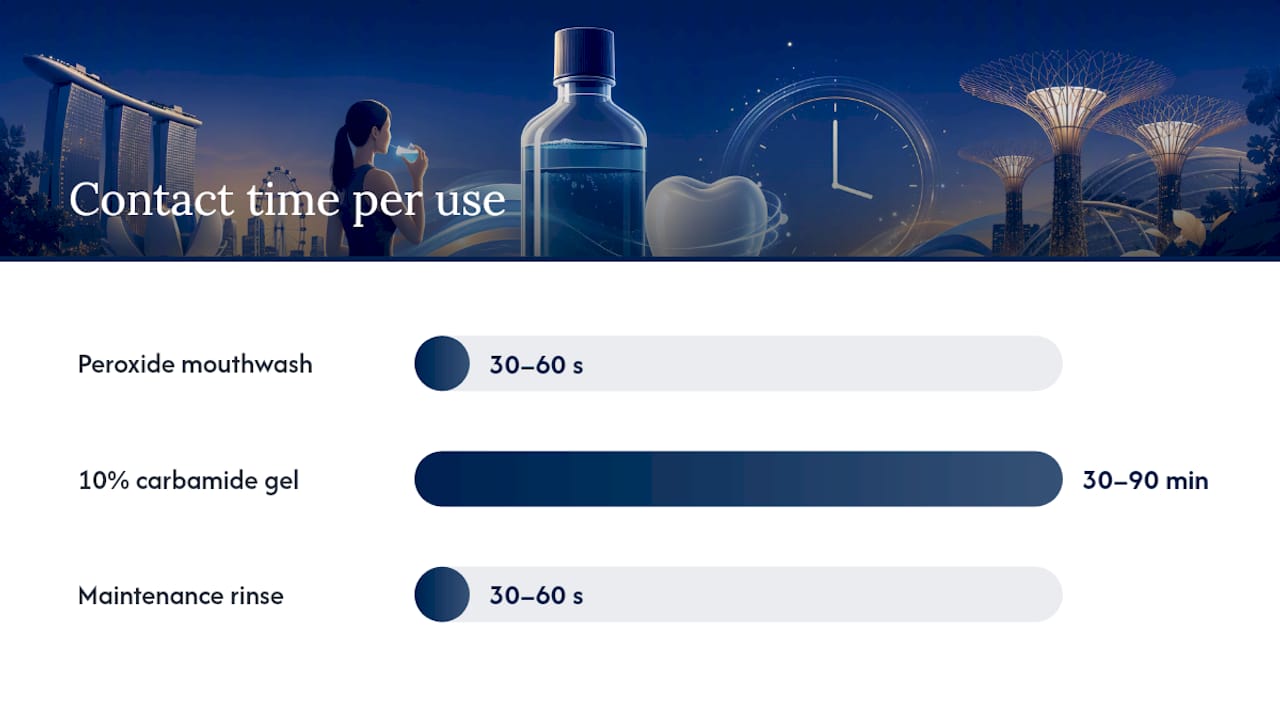
Contact time is where mouthwash loses ground to gels. Research comparing formulations containing hydrogen peroxide on tooth whitening found that swishing exposes enamel to active ingredients for a fraction of the time a bleaching tray does, which limits how deep the peroxide can penetrate before it’s rinsed away. A gel sits against your teeth for 30 to 90 minutes; a mouthwash rinse is gone in under a minute.
There’s a trade-off baked into every formula here. Push the peroxide percentage up and whitening speeds up, but so does the risk of sensitivity and gum irritation. Keep it low and gentle, and you get a slower, safer result. That’s the central tension every whitening mouthwash brand is negotiating, whether the label says so or not. It’s also why comparing carbamide peroxide against hydrogen peroxide formulas matters if you’re weighing a rinse against a gel for the same job.
What Does the Clinical Evidence Actually Show?
The short version: whitening mouthwashes produce a real, measurable color change, but it’s consistently smaller than what 10% carbamide peroxide gel delivers over the same period.
An in vitro study measuring hydrogen peroxide mouthwash whitening tracked color change using a spectrophotometer, the standard tool for objectively quantifying shade shift (expressed as a ΔE value, which captures changes in lightness and color together rather than relying on the naked eye). The mouthwash groups showed statistically significant whitening compared to baseline, but the gel group’s ΔE values were significantly higher across every measured interval. In other words, both worked. The gel just worked harder.
A more recent study looking at whitening mouthwash used after home bleaching shifted the question from “can mouthwash whiten teeth on its own” to “can it protect whitening you’ve already paid for.” The answer leaned positive: a rinse containing hydrogen peroxide and pyrophosphate helped maintain color stability after a home bleaching regimen. Its effect on enamel surface hardness, though, varied depending on the specific formulation and how long it was used, which is the kind of detail that gets lost when a bottle just says “enamel safe” on the front label.
A broader review indexed on PubMed comparing whitening agents reinforces the pattern: reviews and comparative trials consistently find that gels with sustained contact time and higher active concentrations outperform rinses on the magnitude of whitening achieved. This isn’t one study finding a fluke. It’s the same result showing up across different research groups and formulations.
The numbers, side by side:
| Method | Typical active concentration | Contact time per use | Reported whitening magnitude |
|---|---|---|---|
| Whitening mouthwash (peroxide-based) | Low percent hydrogen peroxide | 30–60 seconds | Statistically significant but modest ΔE increase |
| 10% carbamide peroxide gel | Equivalent to low-concentration hydrogen peroxide, sustained | 30–90 minutes | Significantly higher ΔE than mouthwash in direct comparisons |
| Post bleaching maintenance rinse | Low percent HP with pyrophosphate | 30–60 seconds, daily | Helps preserve existing shade; not a primary whitener |
A key figure worth sitting with: across the studies comparing mouthwash to 10% carbamide peroxide gel, the gel group’s spectrophotometer readings came out significantly higher at every measured checkpoint, which is the clearest evidence that contact time, not just active ingredient, drives how much whitening you actually see.
There’s an important methodological wrinkle here that most marketing copy glosses over. Many of the strongest whitening studies use in vitro immersion protocols, meaning extracted teeth (sometimes bovine, sometimes human) are continuously submerged in the test solution for hours, not swished for a minute twice a day. That continuous exposure produces a bigger effect than real-world use ever will, because nobody keeps mouthwash in contact with their enamel for six hours straight. When you read a study claiming a big shade jump from a rinse, check whether it was testing swishing behavior or submersion. They’re not the same experiment, and conflating them is how inflated whitening claims get made.
Other variables that swing results from one study to the next include the exact hydrogen peroxide percentage used, whether the formula includes a stain-dispersing agent like pyrophosphate, and whether the test teeth had already been through a prior bleaching cycle. Teeth that just finished a bleaching treatment respond differently to a maintenance rinse than teeth that have never been whitened, which is part of why the “after home bleaching” study and the standalone efficacy study don’t report identical numbers.
How Long Does It Take to See Results From Whitening Mouthwash?
Patience matters more with mouthwash than with almost any other whitening product on the shelf. Consumer trials and clinical reports suggest a rough, consistent pattern:
- Weeks 2 to 4: Subtle changes start to show up, usually only noticeable if you’re photographing your teeth under the same lighting each time.
- Weeks 6 to 12: Clearer, more visible change for many peroxide-containing rinses used consistently, according to consumer timeline data tracking regular users.
- Ceiling for most OTC rinses: Often under one full shade on a standard shade guide, though daily use of a peroxide-containing formula over several weeks can push slightly past that for some users.
Surface stains respond faster and more completely than intrinsic discoloration. A rinse can chip away at the yellow-brown film left by coffee or red wine sitting on your enamel’s surface. It has a much harder time reaching discoloration that originates inside the tooth, from aging, certain medications, or old trauma, because that pigment sits beneath the layer a 60-second swish can influence.
If you have a wedding, a big interview, or a photo shoot in three weeks, whitening mouthwash alone is not going to get you there. It’s a slow-burn maintenance tool, not a rescue plan.
Is Whitening Mouthwash Safe for Your Enamel?
The evidence on enamel safety is genuinely mixed, and any article claiming otherwise is oversimplifying. Some in vitro research using Raman spectroscopy, a method that measures mineral content directly, found no significant mineral loss after mouthwash exposure. But other lab tests measuring microhardness and surface roughness, a different property entirely, sometimes found changes with prolonged or repeated use. The takeaway isn’t “mouthwash damages enamel” or “mouthwash is completely harmless.” It’s that the answer depends on which property you measure and how long you’re testing.
Sensitivity is the side effect people notice long before any lab result would show up. Peroxide and the alcohol found in some formulas can irritate gum tissue or trigger the short, sharp zing many people associate with whitening in general. Enzyme-based rinses using papain or bromelain carry a lower sensitivity profile, largely because they’re not oxidizing anything. They’re mechanically loosening surface debris instead.
Pro Tip: If your teeth are already sensitive to cold drinks or you’ve had a recent professional whitening treatment, start with an enzyme-based, peroxide-free rinse for two weeks before introducing anything with hydrogen peroxide. It gives your enamel time to acclimate instead of stacking two irritants at once.
A few signs mean it’s time to stop and see a dentist rather than push through:
- Sensitivity that lasts more than a few days after you stop using the product.
- Mouth sores, white patches, or persistent gum irritation.
- Any sign of active gum disease, which changes how your mouth should be treated entirely.
- No visible change after a full 8 to 12 weeks of consistent use, which often signals intrinsic staining that a rinse can’t reach.
On frequency: most peroxide-containing whitening mouthwashes are formulated for up to twice-daily use, with a swish time in the 30-to-60-second range. Going longer than the label recommends doesn’t speed up results in any meaningful way. It just increases your exposure to whatever is causing the sensitivity.
How to Use Whitening Mouthwash for the Best Results
Getting real value out of a whitening rinse comes down to sequencing and consistency more than brand choice. Here’s the order that gets you the most out of each swish:
- Brush and floss first. Removing plaque and loosening the pellicle layer gives the rinse’s active ingredients a cleaner surface to work against, rather than fighting through a film of debris.
- Swish for the full recommended time, usually 30 to 60 seconds, timed rather than estimated. Most people underswish by half when they’re not watching a clock.
- Spit, don’t swallow, and avoid eating or drinking for at least 30 minutes afterward so the active ingredients aren’t immediately diluted or washed away.
- Stick to the labeled frequency, typically once or twice daily, and dial it back to once a day if you notice any tingling or heightened sensitivity.
- Stagger with other whitening products. If you’re also using whitening toothpaste or strips, don’t use them in the same session. Alternate morning and evening, or use the mouthwash on days you’re not applying strips, to avoid compounding sensitivity.
- Track progress with photos, taken in the same spot, under the same lighting, roughly every two weeks. Your eyes adjust to gradual change; a camera doesn’t.
If you’re rebuilding a routine after finishing a whitening treatment, a maintenance guide for post-kit care walks through how to layer a rinse into your existing habits without undoing the work you already paid for. And if your main stains come from a specific culprit like tea or coffee, it’s worth reading up on removing tea stains from teeth specifically, since the approach differs slightly from general whitening maintenance.
Whitening Mouthwash vs. Strips, Toothpaste, and Professional Gels
Every whitening method trades speed for cost, convenience, or sensitivity risk. None of them win on all four fronts.
Whitening mouthwash sits at the low-effort, low-intensity end. It costs the least per month, requires no extra time beyond a normal oral care routine, and carries the lowest sensitivity risk of the peroxide-based options. What it doesn’t do is deliver dramatic change quickly. Whitening toothpaste occupies similar territory. It relies mostly on mild abrasives and low-dose peroxide to polish surface stains during brushing, so its results overlap heavily with what a rinse can achieve, just through a different delivery method.
Whitening strips step up the intensity considerably. Direct contact with a higher peroxide concentration for 15 to 30 minutes at a time gives strips noticeably more whitening power than a rinse, though at a higher price point and a real risk of gum irritation if they’re cut poorly or applied unevenly.
Professional or take-home bleaching gels sit at the top of the effectiveness curve for a reason: extended contact time (30 to 90 minutes) combined with a much higher active concentration than any rinse, and the research comparing these methods head to head confirms it consistently. That power comes with a higher cost and, for many people, more noticeable sensitivity during treatment.
- Choose mouthwash if your goal is maintaining an already-decent shade or you’re managing sensitivity and want the gentlest option available.
- Choose whitening toothpaste alongside a rinse for a low-cost, low-intensity combination routine.
- Choose strips if you want a visible jump in a few weeks and can tolerate mild sensitivity.
- Choose a professional or take-home gel if you need dramatic change for an event, or if intrinsic staining is the main issue a surface product can’t touch.
Diet and habits move the needle regardless of which method you pick. Heavy coffee, tea, or red wine intake, and especially smoking, reintroduce staining compounds faster than any rinse can clear them, which is why lifestyle adjustments alongside whitening products tend to outperform whitening products used in isolation. A rinse fighting against a two-cup-a-day coffee habit is playing defense, not offense.
A Realistic Take on Whitening Mouthwash
Here’s what gets lost in most product marketing: whitening mouthwash was never designed to be judged against a bleaching gel, even though every bottle on the shelf gets compared to one anyway. Judged as a standalone whitening treatment, it’s underwhelming. Judged as a maintenance tool that slows the return of surface stains between more intensive treatments, it earns its place in a routine.
The mistake I see people make constantly is treating a one-month supply of mouthwash as a test of whether “whitening mouthwash works,” get unimpressed results, and abandon the entire category. That’s the wrong experiment. A fairer trial runs eight to twelve weeks, tracked with consistent photos, paired with realistic expectations about what surface-level rinsing can and can’t reach. If you’ve run that trial honestly and see nothing after three months, that’s a real signal your discoloration is intrinsic, not the kind of staining a rinse was ever built to touch. That’s when a conversation with a dentist, not another bottle off the shelf, is the right next move.
Pick a product with a transparent ingredient list and a stated peroxide percentage rather than one that just says “whitening” on the label with no specifics. If you can’t find the active concentration anywhere on the packaging or the brand’s site, that omission tells you something about how confident they are in their own numbers.
— Lenney
A Gentler Adjunct Worth Considering
If you want a maintenance option that doesn’t carry the sensitivity trade-offs of a peroxide rinse, The peroxide-free BLU technology line was built around exactly that gap. A whitening pen skips hydrogen peroxide entirely and uses enamel-safe ingredients designed for people with sensitive gums who want visible results without the sting.
That fits squarely into the maintenance role the research supports. A whitening pen isn’t positioned to replace a professional bleaching treatment for deep intrinsic staining, but as a fast, low-irritation way to keep surface stains in check between bigger treatments, it covers a real gap for people whose teeth react badly to peroxide. For readers managing sensitivity long-term, including older users, the gentle, enamel-safe options built for sensitive users are worth a look, and travelers who want a compact routine can check the Premium Travel Kit for an on-the-go maintenance setup. If you’re ready to try a peroxide-free approach to keeping your shade steady between whitening treatments, starting with a whitening pen and tracking your own results over several weeks can be helpful.
Sources
The clinical claims in this article draw primarily from three sources. The in vitro hydrogen peroxide whitening study compared mouthwash against 10% carbamide peroxide gel using spectrophotometer measurements, the strongest objective benchmark available for this kind of comparison. The post-bleaching maintenance study examined how a hydrogen peroxide and pyrophosphate rinse affects color stability and enamel hardness after home bleaching. The comparative review indexed on PubMed pulls together multiple trials to confirm the pattern holds across different formulations. In vitro studies use extracted or lab-simulated enamel under controlled exposure, while clinical or in vivo studies track real people over time, and the two don’t always agree on magnitude, which is why this article leans on both.
This article is general information, not a substitute for advice from a qualified doctor. Consult a qualified healthcare professional about your own circumstances before acting on anything here.
- Efficacy of Mouthwashes Containing Hydrogen Peroxide on Tooth Whitening
- Comparative studies and reviews on whitening agents (PubMed listing)
FAQ
Do whitening mouthwashes actually work?
Yes, but modestly. Clinical and in vitro research confirms measurable, statistically significant color change from peroxide-containing rinses, though the effect is consistently smaller than what a 10% carbamide peroxide gel produces over the same timeframe.
How long does it take to see results from whitening mouthwash?
Most users notice subtle changes within a few weeks, with clearer results typically showing up after several weeks of consistent daily use.
Can yellow teeth go white again?
Surface yellowing from coffee, tea, or tobacco often responds well to consistent whitening habits, including rinses, toothpaste, and strips. Intrinsic yellowing that originates inside the tooth usually needs a stronger method like professional or take-home bleaching gel, since surface-level products can’t reach that layer.
Is it okay to use whitening mouthwash every day?
Most peroxide-containing whitening mouthwashes are formulated for daily use, up to twice a day with a 30 to 60 second swish, but you should scale back to once daily or switch to a peroxide-free, enzyme-based option if you notice sensitivity or gum irritation.