

Most people assume a low price tag on a whitening product means weak results or cheap ingredients. That assumption is exactly why whitening pens are affordable in ways that actually make sense once you look at the real cost drivers. Professional whitening sessions can run hundreds of dollars per visit, yet a well-formulated whitening pen sitting on a drugstore shelf costs around $15 to $25. The gap is not about cutting corners. It’s about manufacturing scale, ingredient concentration, packaging simplicity, and a product designed for a different job than your dentist’s chair. Here’s what is actually behind that price.
Table of Contents
- Key Takeaways
- Why whitening pens are affordable: the real cost breakdown
- How ingredients and formulas affect price
- What market demand and product design do to price
- Whitening pens vs. other at-home options
- My honest take on whitening pens and affordability
- Try a whitening pen that actually delivers
- FAQ
Key Takeaways
| Point | Details |
|---|---|
| Production costs stay low | Bulk manufacturing keeps the cost per pen unit under $5, well before retail markup. |
| Ingredients are intentionally simpler | Lower peroxide concentrations reduce raw material cost and remove the need for professional oversight. |
| Pens are designed for maintenance | They work best for touch-ups and upkeep, not for replacing deep whitening treatments. |
| OTC availability cuts overhead | No dental visit means no equipment, no staff time, and none of those costs passed to you. |
| Comparison shopping pays off | Pens sit at the budget end of a $10 to $300 OTC whitening market, making them the most accessible entry point. |
Why whitening pens are affordable: the real cost breakdown
The price of any consumer product reflects two things. What it costs to make, and what someone can charge for it. With whitening pens, both sides of that equation favor the buyer.
On the manufacturing side, bulk production costs land under $5 per unit, even after quality controls are factored in. The formulas are purposefully streamlined, the packaging is minimal, and the applicator mechanism is a simple twist brush. There are no molded trays, no LED devices, and no multi-part kits requiring assembly. That simplicity compounds at scale.
On the professional side, the contrast is stark. Professional whitening treatments require costly equipment, trained staff, sterilized instruments, and dedicated appointment time for each patient. All of those operational costs get built into a per-session price that regularly exceeds several hundred dollars. The pen avoids every single one of those costs by design.
| Cost Factor | Whitening Pen | Professional Treatment |
|---|---|---|
| Production per unit | Under $5 | N/A (clinic overhead) |
| Typical retail price | $15 to $25 | $300+ per session |
| Staff required | None | Dental professional |
| Equipment needed | None | Specialized whitening gear |
| Repeat purchase cost | Low | High |
| Appointment required | No | Yes |
The distribution model also matters. Whitening pens move through mass retail and e-commerce channels, which spread logistics costs across enormous order volumes. A dental clinic cannot operate that way. The OTC model is simply built for volume, and volume drives prices down.
Pro Tip: If you’re comparing prices between brands, look at the total cost per week of use rather than the sticker price. A $25 pen that lasts 30 applications beats a $10 pen that runs out in a week.
How ingredients and formulas affect price
The chemistry inside a whitening pen is genuinely simpler than what a dentist uses, and that is not a flaw. It’s a deliberate design choice that fits the product’s purpose.
Here is what shapes ingredient costs and what that means for you:
- Peroxide concentration is intentionally lower. Whitening pens use lower peroxide levels, which produces a slower, more gradual whitening effect compared to professional-grade formulas. Lower concentration means less raw material cost per unit and no requirement for professional supervision during use.
- The formulation is optimized for surface stains. Chemical agents like peroxide lift surface discoloration through a brush-on applicator, which is mechanically simple and inexpensive to manufacture at scale. You don’t need precision dispensing equipment or individually fitted trays.
- Packaging stays lean. A pen body, a twist mechanism, and a small brush tip. That’s it. Compare that to a professional whitening kit involving custom trays, gel syringes, and a UV or LED device. The packaging cost difference per unit is significant.
- No prescription or oversight required. Because the formula stays within safe OTC limits, there is no regulatory overhead passed on to the consumer. Simplified chemical mechanisms that don’t require precise clinical oversight drive down production complexity substantially.
- Sensitive teeth compatibility. Gentler concentrations make whitening pens popular with beginners and people with tooth sensitivity, broadening the market and increasing sales volume. More volume means lower per-unit cost for everyone.
The tradeoff is real. Lower concentration means you won’t see dramatic results overnight, especially on deep or set-in stains. But for surface brightness and ongoing maintenance, the formula does exactly what it’s supposed to do at a price point that reflects that scope.
What market demand and product design do to price
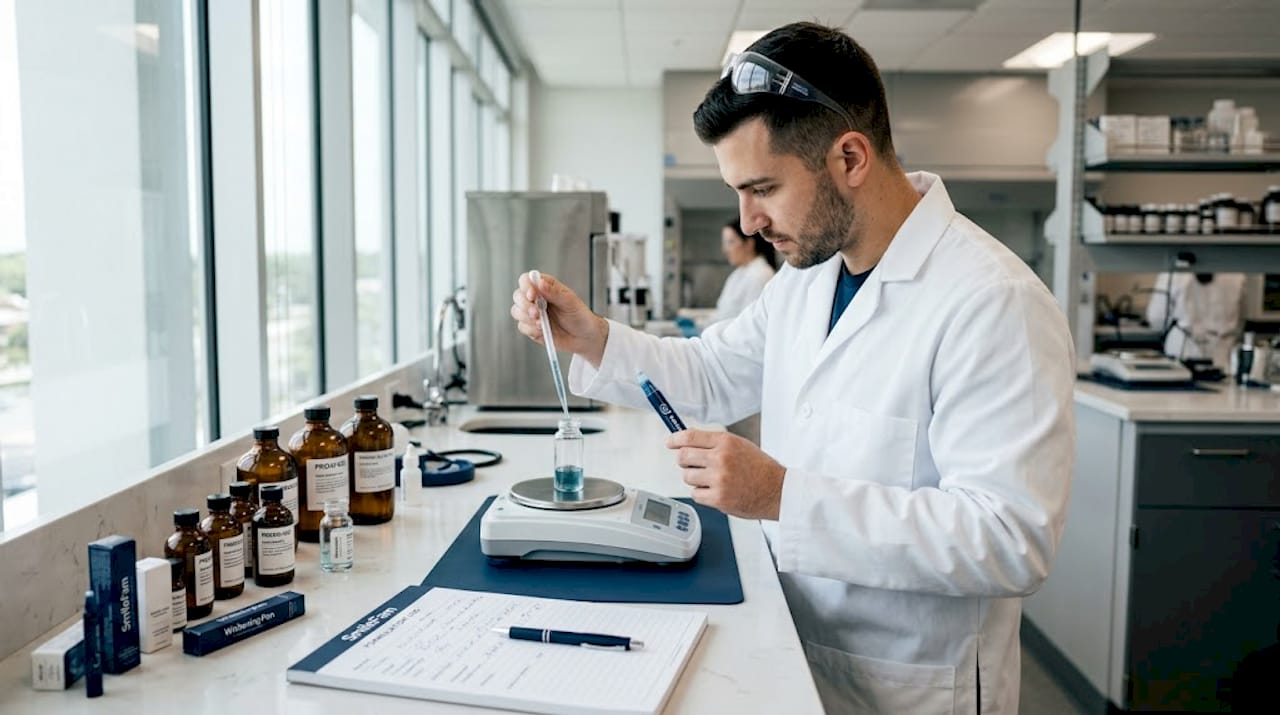
There is a consumer behavior side to this story that doesn’t get discussed enough. Whitening pens are not just cheap to make. They are strategically designed to sell in high volumes, and that volume is one of the biggest drivers of affordability.
Here’s how the market dynamics work in your favor:
- Portable products have mass appeal. Whitening pens target specific surface stains with precise on-the-go application, which makes them attractive for travel, post-coffee touch-ups, and pre-event preparation. Broad appeal equals broad distribution, which equals lower per-unit cost.
- Impulse purchasing is built into the format. Simple packaging and an attractive price encourage quick purchases and repeat sales. A product that sells this consistently allows manufacturers to plan production runs at scale and lock in lower supplier pricing.
- Repeat buyers keep the ecosystem running. Because one pen doesn’t last forever, users come back. That predictable repeat purchase cycle incentivizes manufacturers to keep prices accessible rather than maximizing margin on a one-time sale.
- No dental visit removes friction entirely. OTC availability means no scheduling, no co-pay, no waiting room. That convenience has real dollar value. You’re not just saving on the product price. You’re saving the time and cost of a dental appointment just to maintain your shade.
Pro Tip: Buy your whitening pen before a big event, not the night before. Starting a week out gives you time to build visible results and lets you clean stained teeth safely without rushing the process.
The over-the-counter whitening market overall spans a range of $10 to $300, covering everything from basic pens to at-home LED kits. Pens anchor the low end of that range while still delivering visible results, which is exactly why they dominate entry-level whitening.
Whitening pens vs. other at-home options
Choosing the right at-home whitening method is less about finding the “best” product and more about matching the tool to your goal. Whitening pens are not the strongest option available, but they are the most flexible and the most affordable. Here’s how the main options compare.
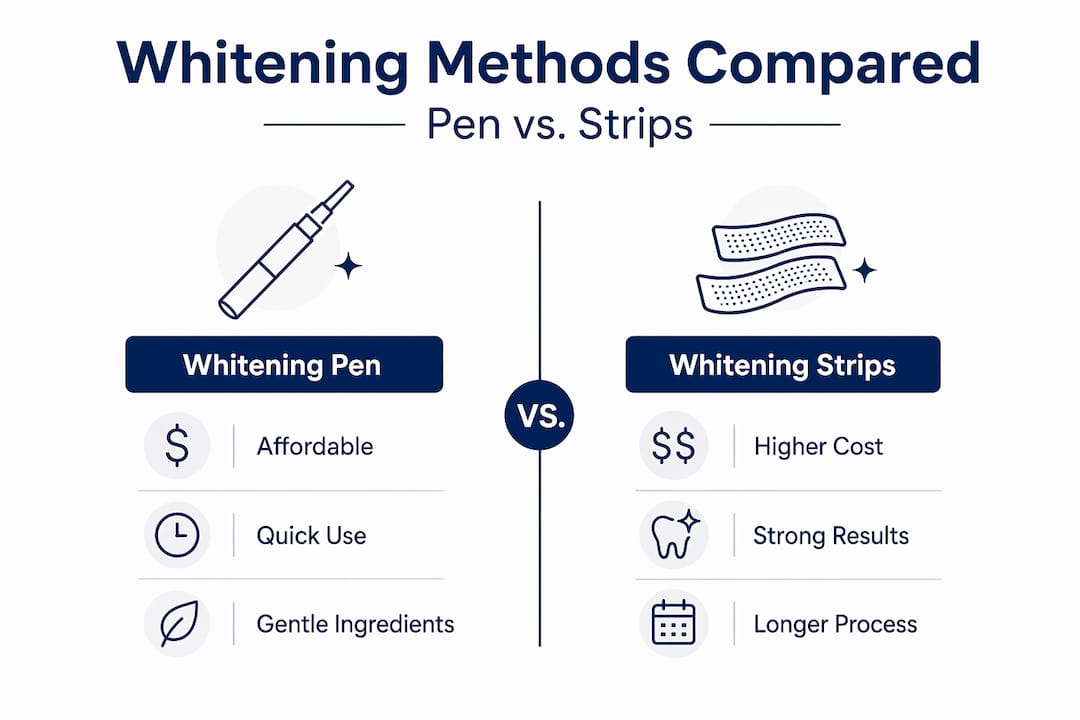
| Method | Average Price | Ease of Use | Speed of Results | Best For |
|---|---|---|---|---|
| Whitening pen | $15 to $25 | Very easy | Gradual (2 to 4 weeks) | Touch-ups, maintenance |
| Whitening strips | $25 to $50 | Moderate | Faster (1 to 2 weeks) | Primary whitening |
| Whitening trays | $50 to $150 | Involved | Moderate | Deeper stain removal |
| Professional treatment | $300 to $1,000+ | N/A | Immediate | Significant discoloration |
Whitening strips outperform pens in speed and whitening strength because they hold the gel against the tooth surface longer and with more even contact. But strips require you to sit still, they can slip, and they don’t work well for targeting individual teeth or back molars. A pen handles those situations with precision.
The scenarios where a pen clearly wins are specific but common. You want to maintain brightness after a professional treatment. You’re traveling and need something that fits in your toiletry bag. You have sensitive teeth that don’t tolerate stronger peroxide formulas. Or you’re new to whitening and want to start with something low-risk before committing to a more intensive method.
For a structured approach to at-home whitening on a budget, pairing a pen with a whitening toothpaste covers both maintenance and ongoing care without the cost of repeated strip purchases. That combination sits well under $50 total and addresses the two main goals most people have.
Consistency matters more than most people realize. Saliva can dilute the gel quickly after application, so following the product instructions closely is what separates people who see results from those who don’t. The pen works. The routine is what makes it work.
My honest take on whitening pens and affordability
I’ve worked around enough whitening products to say this plainly: most people misunderstand what a whitening pen is for, and that’s where their frustration comes from.
I’ve seen the reviews. Someone picks up a pen expecting the same results as a $400 in-office treatment and rates it two stars when their teeth don’t transform in a week. That’s not a product failure. That’s a mismatch between expectation and design. These products are built for a specific, real-world use case. They are cost-effective whitening solutions that work over time with consistent use, not overnight.
What I’ve actually found is that people who use pens correctly get genuinely good results. They apply it after coffee, before bed, after brushing. They use it as part of a broader whitening routine rather than as a standalone fix. Pens function best as a maintenance tool after a stronger initial treatment. When used that way, the affordability is almost unfair. You’re getting professional-level upkeep for roughly $20.
The one thing I’d push back on is the idea that cheap means disposable. If you treat a whitening pen as a daily habit rather than a one-time purchase, the value compounds. Your teeth stay brighter longer, you need fewer intensive treatments, and your total whitening spend over a year stays dramatically lower than someone cycling through strip after strip.
— Lenney
Try a whitening pen that actually delivers
If you’ve been weighing your options and want an affordable whitening pen that skips the harsh chemicals without skipping the results, Getsmilefam’s Snow Serum™ Whitening Pen is worth a close look. It uses BLU Whitening Technology developed in Singapore, with an enamel-safe formula that contains no hydrogen peroxide. It’s designed specifically for sensitive gums and delivers results you can see within a single session.
For anyone building a full budget whitening routine, the Snow Serum™ Whitening Pen pairs naturally with the BLU Whitening Toothpaste for daily upkeep. Or if you want the most value in one purchase, the Ultimate Whitening Bundle combines multiple products at a price that makes professional-level care genuinely accessible at home.
FAQ
Why are whitening pens cheaper than professional treatments?
Whitening pens avoid the overhead costs of dental equipment, trained staff, and individual appointments. Bulk manufacturing keeps unit costs under $5, while professional whitening costs hundreds of dollars per session due to clinic operations.
Are whitening pens worth it for everyday use?
Yes, especially for maintenance. Pens are most effective as a daily touch-up tool after an initial whitening treatment, helping you preserve brightness at a fraction of the cost of repeat professional visits.
Do whitening pens work on sensitive teeth?
Whitening pens use gentler peroxide concentrations compared to strips or trays, making them a popular choice for people with tooth sensitivity. The lower concentration reduces irritation risk while still addressing surface stains over time.
How do whitening pens compare to whitening strips?
Strips deliver faster and stronger results but require more effort and can cause uneven contact. Pens are more convenient, portable, and precise, making them the better choice for touch-ups and on-the-go whitening rather than primary treatment.
What is a realistic price range for whitening pens?
Most whitening pens retail between $15 and $25, placing them at the affordable end of an OTC whitening market that extends up to $300 or more for LED-based kits and trays.