

Affordable teeth whitening is defined as the use of cost-accessible, primarily over-the-counter peroxide-based products and budget-friendly supervised home kits to safely brighten teeth without the expense of professional in-office treatments. OTC products range from $4 to $65, while professional in-office sessions cost $300 to $1,400, making the gap between cheap and clinical enormous. For anyone dealing with stained or yellowish teeth, that price difference matters. The good news is that the most effective budget options, particularly peroxide-based strips and trays, deliver real, measurable results when used correctly.
What is affordable teeth whitening and how does it work?
Affordable teeth whitening covers any method that brightens teeth at a fraction of professional costs, with over-the-counter peroxide products sitting at the center of that category. The active ingredient in most effective products is hydrogen peroxide or carbamide peroxide, which penetrates the enamel and breaks apart the molecular bonds that cause discoloration. This chemical process is what separates true whitening from simple stain removal. Products like Crest 3D Whitestrips, whitening gels, and carbamide peroxide trays all work through this bleaching mechanism.
The industry term for this process is “tooth bleaching,” and it applies specifically to products that change the intrinsic color of the tooth rather than just polishing the surface. Whitening toothpastes, charcoal powders, and most mouthwashes do not bleach. They clean. Understanding that distinction is the single most important thing you can do before spending money on any whitening product.
Cost-effective teeth whitening does not mean cutting corners on chemistry. It means choosing the right delivery system for your budget. A $30 box of peroxide strips can outperform a $15 “whitening” charcoal toothpaste every time, because the strips actually bleach while the toothpaste only scrubs.
What are the most common affordable teeth whitening methods and their costs?
The budget-friendly teeth whitening market breaks into four main product types, each with different mechanisms, price points, and results.
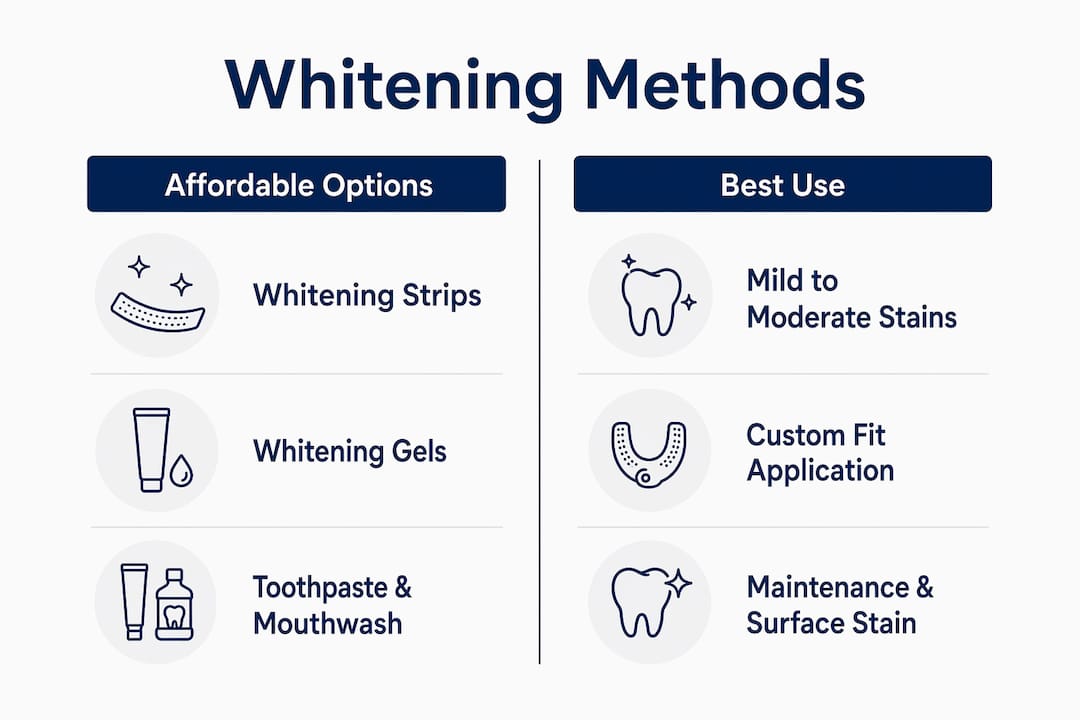
Whitening strips are the most popular OTC option. Brands like Crest 3D Whitestrips use thin, flexible strips coated in hydrogen peroxide gel that adhere to teeth for 30 to 60 minutes per session. Prices range from $20 to $55 per box. 14% peroxide strips produce noticeable shade improvements of 2 to 5 shades over roughly 20 days, which is a meaningful result for most people with surface-level or mild intrinsic staining.
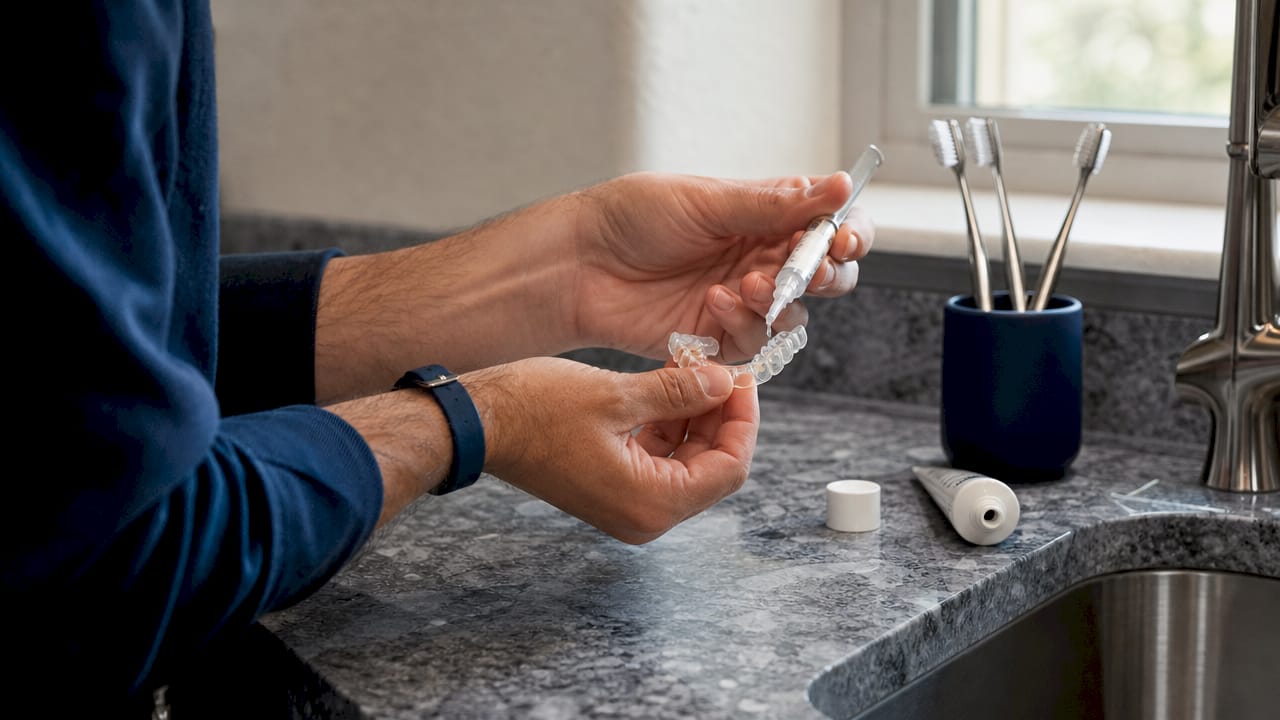
Whitening gels and trays use a similar peroxide formula but delivered through a moldable tray. OTC versions cost $15 to $50. Professional home kits, where a dentist provides custom-fitted trays and prescription-strength gel, cost $375 to $500 with refills running $20 to $25. That supervised approach sits in a middle ground between cheap DIY and full in-office treatment.
Whitening toothpastes and mouthwashes cost $4 to $20 and are best used as maintenance tools after a bleaching cycle, not as primary whitening agents. OTC peroxide-based strips and trays are consistently more effective than toothpastes and mouthwashes, which contain low concentrations of whitening agents and mainly preserve results rather than create them.
Whitening pens are portable and convenient, ranging from $10 to $40, but their thin gel formula and short contact time limit their bleaching power. They work well for touch-ups between strip cycles.
| Product type | Typical cost | Best for | Limitation |
|---|---|---|---|
| Whitening strips | $20–$55 | Mild to moderate staining | Requires consistent daily use |
| Gel trays (OTC) | $15–$50 | Broader coverage | Generic fit may reduce contact |
| Professional home kit | $375–$500 | Supervised, stronger results | Higher upfront cost |
| Whitening toothpaste | $4–$20 | Maintenance after bleaching | Does not bleach intrinsic stains |
| Whitening pen | $10–$40 | Touch-ups and travel | Limited contact time |
Pro Tip: If you are new to whitening, start with a mid-range strip kit like Crest 3D Whitestrips Professional Effects before investing in a professional home kit. You will get a clear read on how your teeth respond to peroxide before spending more.
How effective and safe are affordable teeth whitening options?
Effectiveness in teeth whitening depends on three variables: peroxide concentration, exposure time, and how consistently you follow the regimen. Whitening effectiveness and safety strongly depend on all three factors, making regimen adherence the real driver of results, not just the product you buy.
A counterintuitive finding from a 2025 randomized controlled trial is worth knowing. In-office bleaching with 18%, 25%, and 40% hydrogen peroxide showed no significant difference in final whitening results or tooth sensitivity levels. Higher concentration does not automatically mean better or more painful results. This matters for at-home users because it means a well-formulated lower-concentration product used consistently can match the output of a stronger one used carelessly.
Tooth sensitivity is the most common side effect of peroxide whitening. It occurs when peroxide temporarily increases the permeability of enamel, allowing temperature and pressure to reach the nerve more easily. The sensation is usually short-lived and resolves within 24 to 48 hours after stopping use. Managing it is straightforward.
- Use a sensitivity-formulated toothpaste like Sensodyne in the days before and during a whitening cycle
- Choose a lower peroxide concentration if you have naturally sensitive teeth
- Never exceed the manufacturer’s recommended exposure time, since extending use beyond instructions increases sensitivity without improving whitening
- Skip a day between sessions if sensitivity becomes uncomfortable
“Start with a lower-concentration product if you have sensitive teeth, then use whitening toothpaste or mouthwash to maintain results between cycles.” — Dr. Matt Messina, as cited by NBC News
Pro Tip: Teeth whitening for sensitive teeth works best with carbamide peroxide formulas rather than hydrogen peroxide. Carbamide releases its active ingredient more slowly, reducing the intensity of sensitivity spikes.
You can find a detailed breakdown of safe whitening practices that covers which ingredients to watch for and which to avoid.
What affordable teeth whitening alternatives exist for different stain types?
Not all tooth discoloration responds to the same treatment. Choosing the wrong product for your stain type is the most common reason people feel like whitening “didn’t work.”
Extrinsic stains sit on the surface of the enamel and come from coffee, tea, red wine, and tobacco. These respond well to both abrasive toothpastes and peroxide products. Whitening toothpastes containing hydrated silica or baking soda physically scrub away surface deposits. Whitening toothpastes improve surface discoloration but have limited effect on intrinsic stains, which means they are genuinely useful for extrinsic cases but will disappoint anyone with deeper discoloration.
Intrinsic stains originate inside the tooth structure, caused by aging, certain antibiotics like tetracycline, fluorosis, or trauma. Only peroxide-based bleaching agents reach these pigments. Abrasive products, charcoal powders, and oil pulling do not. If your teeth are uniformly yellow or gray rather than spotted with surface deposits, you need a peroxide product, not a scrubbing agent.
| Stain type | Cause | Recommended affordable option | What to avoid |
|---|---|---|---|
| Extrinsic (surface) | Coffee, tea, tobacco | Whitening toothpaste, strips | Charcoal (too abrasive) |
| Intrinsic (internal) | Aging, antibiotics, fluorosis | Peroxide strips, gel trays | Toothpaste alone |
| Mixed | Both surface and internal | Strips plus maintenance toothpaste | Abrasive-only products |
| Enamel defects | White spot lesions | Professional screening first | Any OTC product without guidance |
Cheap abrasive products often waste money on surface stain removal without addressing deeper pigments. If you have spent money on charcoal toothpaste or activated charcoal powder and seen minimal change, this is why.
One situation where cheap options genuinely fall short is enamel defects. White spot lesions, which appear as chalky white patches on teeth, can worsen with aggressive bleaching. If you notice these on your teeth, a quick dental consultation before starting any whitening regimen is worth the time. The professional cosmetic whitening guide from Laser Skin Solutions Portland covers when professional screening adds real value before starting at-home treatment.
Pro Tip: If you are unsure whether your staining is extrinsic or intrinsic, try a whitening toothpaste for two weeks. If you see improvement, the stains are surface-level. If nothing changes, switch to a peroxide strip kit.
How to use affordable teeth whitening products safely and effectively at home
Getting results from budget-friendly whitening comes down to following a structured regimen, not just buying the right product. Here is a practical sequence that works.
- Assess your stain type before buying anything. Surface stains respond to toothpastes; intrinsic stains need peroxide strips or trays.
- Choose the right concentration. For first-time users or those with sensitive teeth, start with a lower-peroxide product. Dentists recommend low-concentration peroxide for beginners to minimize irritation and build tolerance.
- Follow the instructions exactly. Leaving strips on longer than directed does not accelerate whitening. It increases sensitivity and can irritate gum tissue.
- Use a sensitivity toothpaste for at least three days before starting a whitening cycle. Sensodyne Pronamel or Colgate Sensitive Pro-Relief both work well.
- Complete the full cycle. Most strip kits require 14 to 20 consecutive days for full results. Stopping early means partial results.
- Maintain with toothpaste. Once you reach your target shade, switch to a whitening toothpaste to preserve results between bleaching cycles.
- Repeat as needed. Most people need a full strip cycle once or twice a year, with daily whitening toothpaste in between.
At-home whitening saves money significantly compared to in-office treatments, and supervised at-home whitening produces results comparable to professional procedures when the regimen is followed correctly. The key word is “supervised.” If you have existing dental work like crowns or veneers, check with your dentist before starting, since peroxide does not whiten artificial materials and can create color mismatches.
Pro Tip: Brush your teeth before applying strips, not after. Brushing immediately after whitening removes the fluoride layer your enamel needs for remineralization. Wait at least 30 minutes.
For a full step-by-step plan, the budget whitening home guide from Getsmilefam walks through product selection, timing, and maintenance in detail.
Key takeaways
Affordable teeth whitening works best when you match the right peroxide-based product to your stain type and follow the regimen consistently, not when you simply buy the cheapest option available.
| Point | Details |
|---|---|
| OTC strips outperform toothpastes | Peroxide strips and trays bleach intrinsic stains; toothpastes only clean the surface. |
| Concentration is not everything | Studies show similar results across low and high peroxide concentrations when protocols are followed. |
| Stain type determines product choice | Intrinsic discoloration requires peroxide; extrinsic stains respond to abrasive toothpastes. |
| Sensitivity is manageable | Use lower concentrations, follow timing instructions, and prep with sensitivity toothpaste. |
| Regimen adherence drives results | Completing the full cycle and maintaining with toothpaste produces lasting whitening. |
Why cheap whitening fails more often than people realize
Most people who tell me whitening “doesn’t work” have one thing in common: they bought an abrasive toothpaste or a charcoal product and expected bleaching results. That is not a product failure. It is a category mismatch. Abrasive products do exactly what they are designed to do. They just are not designed to bleach.
What I find more interesting is the concentration myth. People assume the strongest product wins. The 2025 clinical trial data showing no meaningful difference between 18% and 40% hydrogen peroxide in-office treatments should shift how everyone thinks about this. Stronger is not smarter. Consistent is smarter.
The emotional payoff from well-executed affordable whitening is real and often underestimated. A 2 to 5 shade improvement over 20 days is visible in photos, in conversations, and in the mirror. It does not require a $1,000 dental appointment to get there. What it does require is patience, the right product for your specific stain type, and the discipline to complete the regimen without cutting corners.
My honest advice: spend $30 to $50 on a quality peroxide strip kit, use a sensitivity toothpaste alongside it, and maintain with a whitening toothpaste afterward. That combination, done twice a year, will outperform most people’s results from expensive one-off treatments. If you want to explore whitening options for Portland adults or any local market, the same principles apply regardless of geography.
— Lenney
Getsmilefam’s affordable whitening solutions worth trying
If you want a product that skips harsh hydrogen peroxide while still delivering real bleaching results, Getsmilefam has built exactly that.
The BLU Teeth Whitening Kit uses Getsmilefam’s proprietary BLU Whitening Technology, developed in Singapore, with an enamel-safe formula designed for sensitive gums. It is positioned as a professional-grade alternative at a fraction of in-office costs. For daily maintenance after a whitening cycle, the BLU Whitening Toothpaste preserves your results without abrasive compounds that wear enamel over time. Both products come with a satisfaction guarantee and are backed by customer reviews showing visible results within a single session. If you are ready to start, explore the full range at Getsmilefam.
FAQ
What is the cheapest effective teeth whitening option?
OTC peroxide-based whitening strips are the most cost-effective option that produces real bleaching results, with prices starting around $20 and delivering 2 to 5 shade improvements over 20 days.
Are affordable teeth whitening products safe for sensitive teeth?
Yes, when you choose lower-concentration peroxide formulas and follow the manufacturer’s instructions. Dentist Dr. Matt Messina recommends starting with low-concentration products and using sensitivity toothpaste like Sensodyne alongside any whitening cycle.
How long does affordable at-home whitening take to show results?
Most OTC strip kits with 14% peroxide show noticeable results within 14 to 20 days of consistent daily use, making them a practical option for anyone with mild to moderate staining.
Can whitening toothpaste replace peroxide strips?
No. Whitening toothpastes remove surface stains through abrasion but do not bleach intrinsic discoloration. They work best as a maintenance tool after a peroxide bleaching cycle, not as a standalone whitening treatment.
When should I see a dentist before whitening at home?
See a dentist first if you have white spot lesions, significant enamel defects, crowns, veneers, or untreated cavities. OTC whitening products can worsen enamel defects and will not whiten artificial dental materials, creating visible color mismatches.