

Safety in whitening products is defined by strict ingredient limits, regulatory classification, and formulation controls that protect your teeth and gums from chemical harm. The role of safety in whitening products goes far beyond avoiding a bad reaction. It determines which products reach store shelves, what concentrations are legal, and whether a formula can actually damage your enamel over time. Regulatory bodies like the FDA, the ADA, and the HPRA set the rules. Understanding those rules gives you real power when choosing a whitening product that works without putting your dental health at risk.
What regulatory standards govern safety in whitening products?
Whitening product safety is governed by different rules depending on where you live, and those differences matter. In the United States, the FDA classifies whitening products based on their label claims, not just their ingredients. A product marketed for surface stain removal falls under cosmetic rules. A product claiming to bleach deeper discoloration requires drug-level compliance, including a “Drug Facts” panel, establishment registration, and adverse event reporting.
The ADA recommends that over-the-counter products stay at or below carbamide peroxide ≤10% or hydrogen peroxide ≤3.5%. Higher concentrations need dentist supervision to be used safely. The EU applies a strict 0.1% hydrogen peroxide limit for products sold directly to consumers without a dental professional involved. That gap between US and EU thresholds explains why products legal in one market can be seized in another.
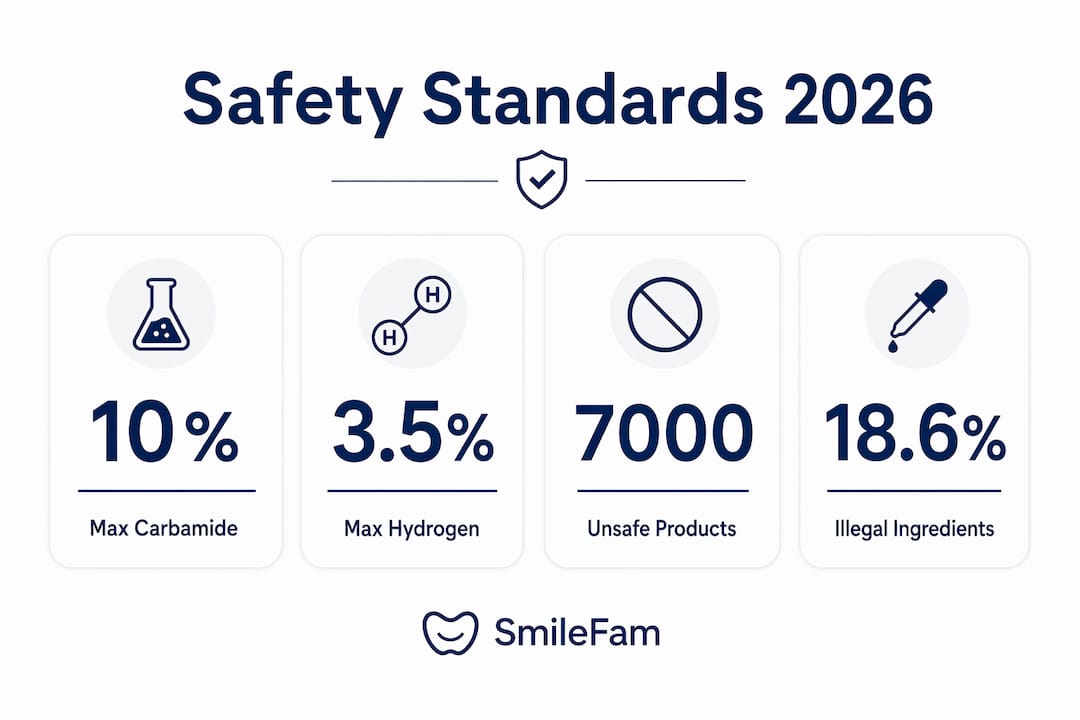
Enforcement is real and active. The HPRA detained nearly 7,000 unsafe items and removed over 100 websites selling non-compliant whitening products in a single year. That scale of enforcement signals how widespread the problem is. Products sold online are the primary offenders, often lacking any “Responsible Person” contact or compliant labeling.
The table below summarizes key regulatory parameters by region:
| Region | OTC Peroxide Limit | Classification Basis | Key Oversight Body |
|---|---|---|---|
| United States | H₂O₂ ≤3.5% / CP ≤10% | Label claims | FDA |
| European Union | H₂O₂ ≤0.1% (consumer) | Ingredient concentration | European Commission |
| Ireland | Aligned with EU limits | Ingredient and labeling | HPRA |
| Singapore | Prohibited toxic ingredients | Ingredient safety | HSA |
Pro Tip: Check whether a whitening product carries a “Drug Facts” panel. Its presence signals that the manufacturer meets Current Good Manufacturing Practice (cGMP) standards and is accountable for adverse events.
How does formulation influence the safety of whitening products?
The role of formulation in whitening safety is not cosmetic. It determines how deeply an active ingredient penetrates your tooth structure and whether it causes lasting damage. Hydrogen peroxide and carbamide peroxide are the two primary whitening agents. Carbamide peroxide breaks down into hydrogen peroxide once applied, releasing it more slowly. That slower release is why carbamide peroxide formulas tend to cause less acute sensitivity than equivalent hydrogen peroxide concentrations.
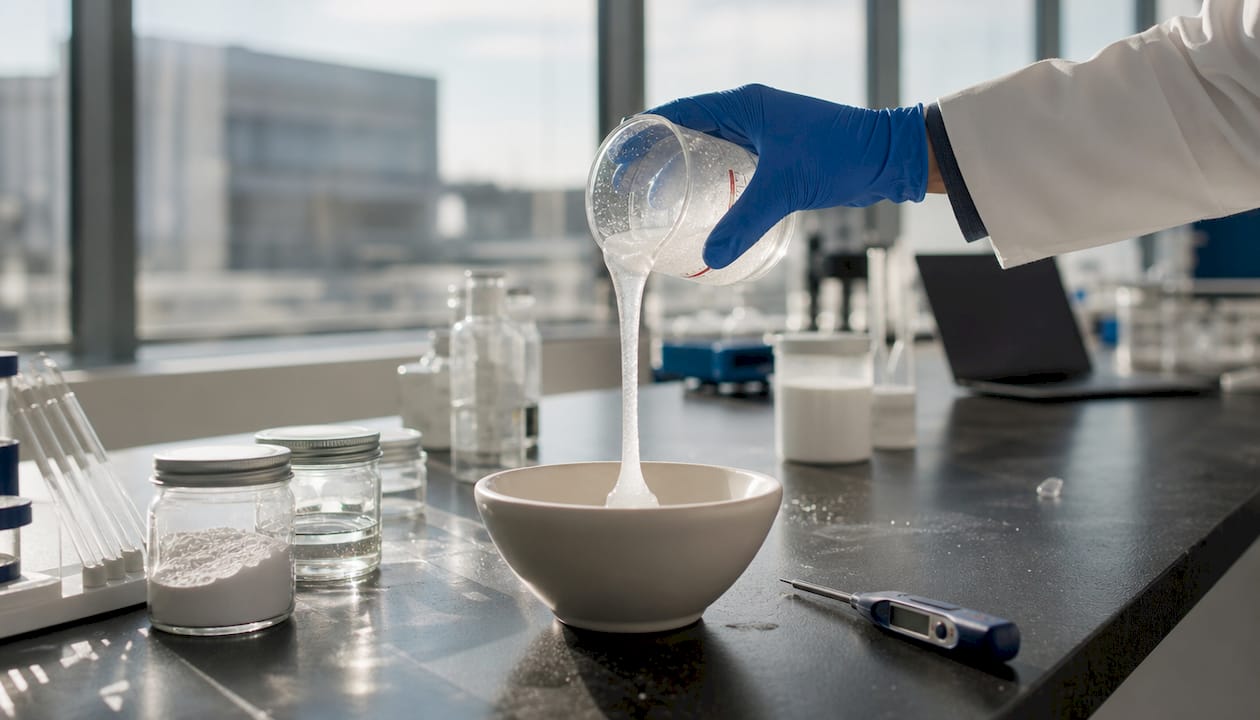
Delivery system design changes the risk profile significantly. Whitening strips reduce peroxide penetration into the pulp chamber compared to gel trays, which means lower sensitivity risk while still achieving visible color change. Gels applied in trays sit against the tooth longer and allow more diffusion. That diffusion is what causes the nerve irritation many people associate with whitening treatments.
Advanced gel formulations now use viscosity agents like carbomer and acrylate polymers to control oxidizing agent diffusion. These polymers stabilize peroxide release and improve gel adhesion to the tooth surface. The result is a more sustained whitening effect with less peroxide reaching sensitive dental tissues. This is the core principle behind safer at-home whitening technology. You can read more about how these mechanisms work in practice in this guide on safe whitening formulas.
Understanding ingredient sourcing matters too. Consumers increasingly look for ethically sourced ingredients in beauty and oral care products, and that scrutiny extends to whitening formulas.
Pro Tip: Look for formulas that include desensitizing agents like potassium nitrate or fluoride alongside the whitening agent. These compounds actively reduce nerve sensitivity during and after treatment, making the process more comfortable without reducing efficacy.
What are the main safety concerns when choosing whitening products?
Chemical burns, gum inflammation, and enamel erosion are the three most common adverse effects from unsafe whitening products. All three result from excessive peroxide concentration or prolonged contact with soft tissue. Gum inflammation appears quickly, often within one or two sessions. Enamel erosion is slower and cumulative, which makes it more dangerous because you may not notice it until real damage has occurred. For a closer look at protecting your gums specifically, this resource on gum-safe whitening explains the key principles.
Illegal ingredients are a separate and more serious category of risk. Research found that 18.60% of commercial whitening samples contained undeclared hydroquinone, a substance prohibited in over-the-counter products due to its systemic exposure risks. That figure means roughly one in five products tested carried an ingredient the label did not disclose. Hydroquinone at unsafe levels produces a Margin of Safety below 100, which regulators treat as a threshold for unacceptable consumer risk.
Mercury is another prohibited ingredient found in whitening and anti-aging products marketed online. Regulatory agencies including Singapore’s HSA have flagged products containing mercury far exceeding legal limits, often paired with exaggerated claims about rapid results. That pattern is a reliable red flag. When a product promises dramatic whitening in hours with no sensitivity, the formula often contains something it should not.
Here are the practical safety guidelines every consumer should follow before and during whitening:
- Read the full ingredient list and cross-reference against your region’s approved ingredient thresholds.
- Verify the product carries a “Drug Facts” panel or equivalent regulatory labeling for your country.
- Check for a manufacturer address and a “Responsible Person” contact on the packaging.
- Follow the recommended application time exactly. Longer is not better with peroxide-based products.
- Stop use immediately if you experience sharp tooth sensitivity, white patches on gums, or burning sensations.
- Consult a dentist before starting any whitening regimen if you have crowns, veneers, or a history of sensitivity.
How can you identify safe whitening products and use them effectively?
Identifying a safe whitening product starts with the packaging. A “Drug Facts” panel on a US product confirms the manufacturer operates under cGMP standards and reports adverse events to the FDA. That accountability does not exist for cosmetic-only products. The ADA Seal of Acceptance is a voluntary third-party validation that a product’s safety and efficacy claims have been independently reviewed. It is one of the clearest signals available to consumers without access to lab testing.
Ingredient concentration is the next checkpoint. Compare the listed hydrogen peroxide or carbamide peroxide percentage against your regional limit. For US consumers buying over-the-counter, hydrogen peroxide above 3.5% warrants caution. For EU consumers, any product above 0.1% sold without a dental professional is non-compliant by definition. Knowing these thresholds takes less than two minutes and eliminates a large category of risk.
Delivery system choice also affects safety outcomes. Strips generally carry a lower diffusion risk than gel trays. Whitening pens offer targeted application and shorter contact time, which reduces the chance of gum contact. Understanding how whitening ingredients work in each delivery format helps you match the product to your sensitivity level.
The checklist below covers the core consumer safety criteria:
- Regulatory labeling: “Drug Facts” panel (US) or CE marking and EU-compliant labeling
- Ingredient transparency: Full ingredient list with concentrations disclosed
- Third-party validation: ADA Seal of Acceptance or equivalent national body endorsement
- Manufacturer accountability: Physical address and contact information on packaging
- Concentration compliance: Peroxide levels within regional OTC thresholds
- Delivery system safety: Strips or pens preferred for sensitive users; gel trays require precise timing
- Professional consultation: Required for anyone with existing dental work or sensitivity history
For a broader look at what lab-approved whitening means in practice, Getsmilefam’s 2026 safety guide breaks down the compliance criteria in plain language.
Key Takeaways
Safe whitening products are defined by regulatory compliance, transparent ingredient disclosure, and formulation controls that limit peroxide penetration and protect enamel integrity.
| Point | Details |
|---|---|
| Regulatory classification matters | FDA drug-level products carry stronger safety accountability than cosmetic-only whitening items. |
| Concentration limits protect you | ADA guidelines cap OTC use at hydrogen peroxide ≤3.5%; anything higher requires professional supervision. |
| Formulation controls diffusion | Polymer-based gels and whitening strips reduce peroxide penetration into the pulp, lowering sensitivity risk. |
| Undeclared ingredients are common | Nearly 1 in 5 commercial whitening samples tested contained undeclared hydroquinone, a prohibited substance. |
| Packaging signals safety | A “Drug Facts” panel and ADA Seal of Acceptance are the two most reliable consumer-facing safety indicators. |
Why I think most consumers underestimate formulation risk
Most people shopping for whitening products focus on price and promised results. I understand that instinct. But after watching the regulatory landscape tighten significantly through 2025 and into 2026, I am convinced that formulation is the variable most consumers ignore and the one that matters most.
The enforcement numbers tell the story clearly. Nearly 7,000 unsafe products detained in one country in a single year is not a fringe problem. It is a systemic failure of the online marketplace to filter out non-compliant products before they reach people’s bathrooms. The products that get seized are not always obviously sketchy. Many have professional-looking packaging and confident marketing language.
What I have learned is that the gap between a product that whitens and a product that whitens safely comes down to two things: what is in it and how it releases. A formula with the right polymer matrix and a compliant peroxide concentration can deliver real results without touching your pulp or burning your gums. A formula without those controls can cause harm even at concentrations that sound moderate on paper.
My honest advice is to treat the “Drug Facts” panel as a non-negotiable. If a product does not have one and is not clearly compliant with your regional standard, the price difference is not worth the risk. Whitening is a long-term practice. Protecting your enamel and gum tissue now means you can keep whitening safely for years.
— Lenney
Getsmilefam’s approach to safe whitening in 2026
Choosing a whitening product that meets 2026 safety standards does not mean settling for weak results. Getsmilefam builds its formulas around lab-approved ingredients and enamel-safe technology designed to whiten without the risks associated with high-concentration peroxide products.
The BLU Teeth Whitening Kit uses BLU Whitening Technology developed in Singapore, formulated for people who want visible results without harsh chemicals. For daily maintenance, the BLU Whitening Toothpaste supports ongoing brightness with a formula suited to sensitive gums. Both products reflect the safety-first formulation principles covered throughout this guide, giving you a practical starting point for whitening that you can trust.
FAQ
Are whitening products safe for everyday use?
Most whitening products are not designed for daily use. OTC products with peroxide should be used according to label instructions, typically in cycles, to avoid enamel erosion and gum sensitivity.
What does the ADA Seal of Acceptance mean on whitening products?
The ADA Seal of Acceptance is a voluntary third-party validation confirming that a product’s safety and efficacy claims have been independently reviewed. It is one of the most reliable consumer-facing safety signals available.
How do I know if a whitening product contains illegal ingredients?
Check the full ingredient list against your regional regulatory thresholds. Research shows that nearly 1 in 5 commercial samples contained undeclared hydroquinone, so ingredient transparency on the label is a critical screening step.
What is the safest delivery system for at-home whitening?
Whitening strips carry lower peroxide diffusion risk than gel trays, making them a safer choice for people with sensitivity concerns. Whitening pens offer targeted application with minimal gum contact.
Should I consult a dentist before using whitening products?
Yes, especially if you have crowns, veneers, existing sensitivity, or gum disease. A dentist can recommend the right concentration and delivery system for your specific dental profile, reducing the risk of adverse effects.