

Short exposure whitening is a teeth whitening technique that applies concentrated peroxide for a brief, controlled period to lighten tooth color effectively and safely. The method works because a high dose of reactive oxygen species floods the tooth structure quickly, oxidizing stained molecules before the treatment reaches a biological ceiling where more time adds no benefit. Recent clinical evidence confirms that shorter sessions match longer ones in measurable color change, while reducing the sensitivity risk that longer exposure creates. Understanding why short exposure whitening works means understanding that chemistry, not clock time, drives results.
Why short exposure whitening works at the chemical level
Hydrogen peroxide is the active agent in virtually every professional whitening treatment. When it contacts the tooth surface, it decomposes rapidly into reactive oxygen species (ROS), primarily hydroxyl radicals. These radicals are small enough to penetrate enamel and dentin and reach the pigmented molecules, called chromogens, that cause staining.
The oxidation reaction breaks chromogens into smaller, colorless fragments. Those fragments scatter light differently than the original pigment, which is what makes the tooth appear whiter. The key insight is that this reaction happens fast. A high concentration of peroxide releases a surge of hydroxyl radicals within the first few minutes of contact, doing the bulk of the chemical work early in the session.
- Rapid decomposition: High-concentration peroxide (25–35%) releases the majority of its hydroxyl radicals within the first 10–20 minutes of application.
- Chromogen fragmentation: ROS break large, colored molecules into smaller, lighter fragments inside the enamel and dentin layers.
- Saturation plateau: Once available chromogens are oxidized, additional exposure produces no further whitening. The reaction simply has nothing left to act on.
- Sensitivity risk window: Prolonged exposure after saturation does not whiten further but does increase the risk of pulpal irritation and transient tooth pain.
Pro Tip: Think of the whitening reaction like filling a glass of water. Once the glass is full, pouring more water just creates a mess. Stopping at the right moment gives you the same result with none of the overflow.
The saturation plateau concept explains why a well-formulated short exposure protocol can match a longer one. The chemistry finishes its work before the clock runs out on a standard 40-minute session.
What does recent research say about exposure time and concentration?
Clinical research published in 2026 provides the clearest evidence yet on exposure duration and whitening outcomes. A controlled study comparing 20-minute and 40-minute applications of 35% hydrogen peroxide found equivalent whitening results. Over 80% of participants showed perceptible color change after a single session in both groups. After two sessions, nearly 100% of participants in both groups showed improvement, particularly in yellowness reduction.
That finding carries a direct implication. Doubling the chair time does not double the result. The whitening reaction reaches its ceiling well before the 40-minute mark, so the extra 20 minutes expose the pulp to unnecessary chemical stress without adding shade improvement.
Concentration matters as much as time. Moderate peroxide concentrations in the 25–35% range deliver whitening outcomes comparable to higher concentrations. Umbrella reviews of clinical bleaching protocols confirm that peroxide levels above approximately 35% do not produce proportionally better whitening but do increase the risk of pulpal inflammation. The practical takeaway is that more aggressive formulas carry more risk for the same payoff.
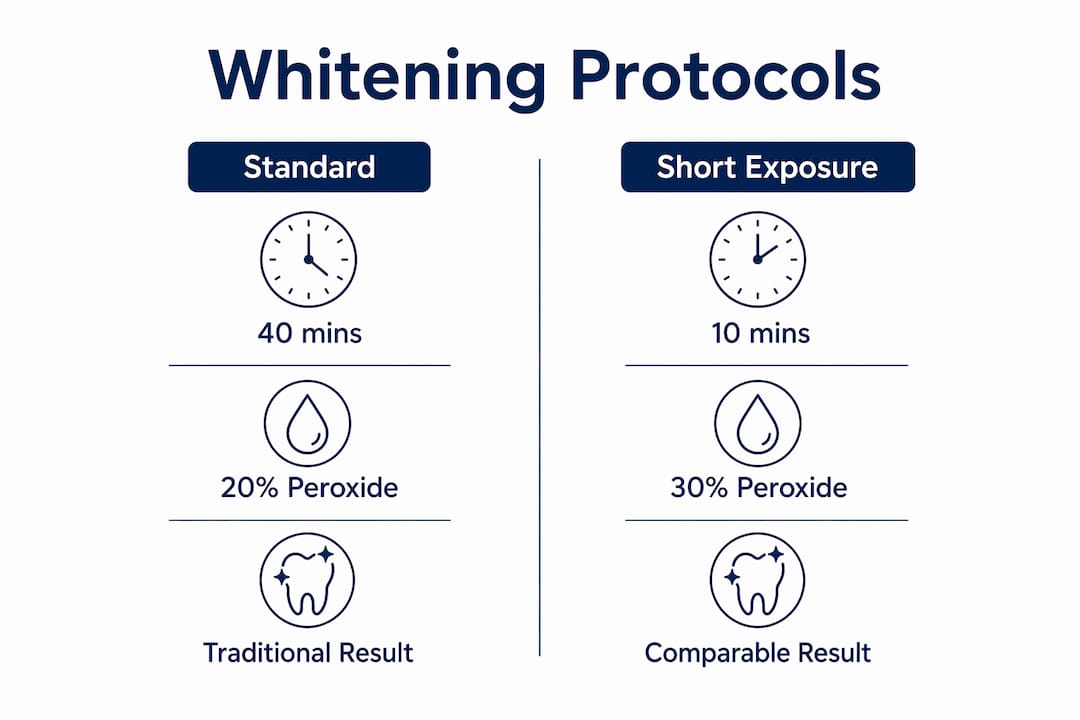
Research also confirms that optimized formulations can reduce effective exposure time to as little as 10 minutes while matching the results of standard 30-minute protocols. The variable that matters most is not raw concentration or raw time. It is the combination of concentration, formulation quality, and application method working together.
| Protocol | Exposure time | Peroxide concentration | Whitening outcome |
|---|---|---|---|
| Standard in-office | 40 minutes | 35% | Perceptible change in 80%+ after one session |
| Short exposure | 20 minutes | 35% | Equivalent outcome to 40-minute protocol |
| Optimized short | 10 minutes | Tailored formulation | Equivalent to standard 30-minute protocol |
| High concentration | 40+ minutes | Above 35% | No added whitening; increased sensitivity risk |
The data table above reflects findings from peer-reviewed clinical studies, not marketing claims.
What are the common misconceptions about short exposure whitening?
The biggest misconception in consumer whitening is that more peroxide and more time always produce better results. Longer exposure does not improve whitening beyond the saturation plateau. It only increases the risk of pulpal stress and post-treatment sensitivity. This misunderstanding drives many people toward aggressive at-home treatments that cause discomfort without delivering faster results.
A second widespread misconception involves light activation. LED and laser devices are marketed as whitening accelerators, but meta-analyses show no significant long-term color improvement from light activation compared to chemical bleaching alone. The immediate shade change people see after a light-assisted session is largely a dehydration effect. The tooth loses surface moisture temporarily, which makes it appear lighter. That effect reverses within hours as the tooth rehydrates.
- Myth: More peroxide equals faster whitening. Reality: Concentrations above 35% increase sensitivity risk without improving color outcomes.
- Myth: Longer sessions whiten more deeply. Reality: The saturation plateau limits whitening regardless of additional exposure time.
- Myth: LED lights accelerate whitening. Reality: Blue light energizes chromophores under specific conditions, but routine whitening lights primarily cause transient dehydration, not lasting color change.
- Myth: Short exposure is a compromise. Reality: Clinical studies confirm short exposure protocols match longer ones in measurable whitening outcomes.
Stain type also matters. Extrinsic stains from coffee, tea, and tobacco respond well to peroxide-based whitening. Intrinsic discoloration from tetracycline antibiotics or fluorosis requires a different approach entirely. No exposure duration fixes the wrong type of stain.
Pro Tip: Before starting any whitening treatment, identify whether your staining is extrinsic or intrinsic. A dentist can confirm this in one appointment, and it will save you from wasting time and money on a protocol that cannot address your specific discoloration.
How to get the best results from a short exposure whitening protocol
Effective short exposure whitening depends on four variables working together: peroxide concentration, exposure time, formulation quality, and application method. Adjusting any one of these without considering the others reduces results or increases risk.
-
Choose the right concentration. The 25–35% range delivers clinical-grade whitening with a lower sensitivity profile than higher concentrations. Anything above 35% requires strict professional supervision and offers no whitening advantage.
-
Respect the exposure window. Stopping at the clinically validated time, whether 10, 20, or 30 minutes depending on the formulation, protects the pulp without sacrificing results. Extending the session past the saturation point adds risk, not whiteness.
-
Use desensitizing agents. Potassium nitrate and sodium fluoride reduce bleaching-related sensitivity without compromising whitening outcomes. Multiple systematic reviews confirm lower sensitivity rates when these agents are incorporated into the protocol, either in the whitening gel itself or as a pre-treatment step.
-
Simplify the application. A single, well-applied gel layer outperforms repeated thin applications. Repeated application increases cumulative exposure and sensitivity without improving color outcomes. For practical guidance on managing sensitivity during treatment, the whitening sensitivity guide from Getsmilefam covers the most effective strategies.
-
Avoid unsupervised high-intensity treatments. DIY kits with very high peroxide concentrations and no professional oversight carry a real risk of chemical burns to soft tissue and pulpal damage. The 2026 whitening best practices from Getsmilefam outline the protocols that balance speed with safety for at-home use.
Short exposure whitening is also well-suited to people with sensitive teeth, provided the formulation includes desensitizing agents and the exposure time is controlled. The brief contact window limits the amount of peroxide that reaches the pulp, which is the primary driver of whitening-related pain. For a broader look at safe whitening approaches in 2026, independent dental resources confirm that protocol optimization, not raw intensity, defines the best outcomes.
Key Takeaways
Short exposure whitening works because the oxidative reaction reaches its saturation point quickly, making additional time unnecessary and potentially harmful.
| Point | Details |
|---|---|
| Chemistry drives results | Hydroxyl radicals oxidize chromogens within the first 10–20 minutes, completing most whitening work early. |
| Saturation plateau limits exposure | Extending treatment past the plateau adds sensitivity risk without improving color outcomes. |
| Concentration sweet spot | The 25–35% peroxide range matches higher concentrations in whitening while reducing pulpal inflammation risk. |
| Light activation is overstated | LED and laser devices do not significantly improve long-term whitening and may increase post-treatment sensitivity. |
| Desensitizers protect without compromise | Potassium nitrate and sodium fluoride lower sensitivity rates without reducing whitening effectiveness. |
The shift I’ve watched happen in professional whitening
I’ve followed the whitening space for years, and the clearest trend is the move away from “more is more” thinking. A decade ago, the default assumption was that higher peroxide and longer chair time meant better results. Clinicians and consumers both believed it. The research has steadily dismantled that assumption, and the 2026 clinical data makes the case definitively.
What strikes me most is how counterintuitive the saturation plateau concept is for most people. We are conditioned to believe that effort scales with outcome. In whitening, it does not. The chemistry finishes its job and then stops. Keeping the gel on longer does not push the reaction further. It just stresses the pulp.
The practical implication for anyone researching whitening options is this: a shorter, well-formulated treatment is not a budget compromise. It is the scientifically supported choice. The people who get the best results are not the ones who use the strongest formula for the longest time. They are the ones who match the right concentration to the right exposure window and use desensitizing agents to protect their comfort throughout.
The future of whitening is not more aggressive. It is more precise. Formulations that deliver the right radical surge at the right moment, combined with agents that protect the pulp, will continue to outperform blunt-force approaches. That is good news for anyone who wants a brighter smile without the sensitivity that used to come with it. For a deeper look at how hydrogen peroxide whitening works in practice, the evidence consistently points toward protocol quality over raw intensity.
— Lenney
Getsmilefam’s approach to short exposure whitening
Getsmilefam builds its whitening products around the same principles that clinical research validates: optimized concentration, controlled exposure, and formulas that protect sensitive gums.
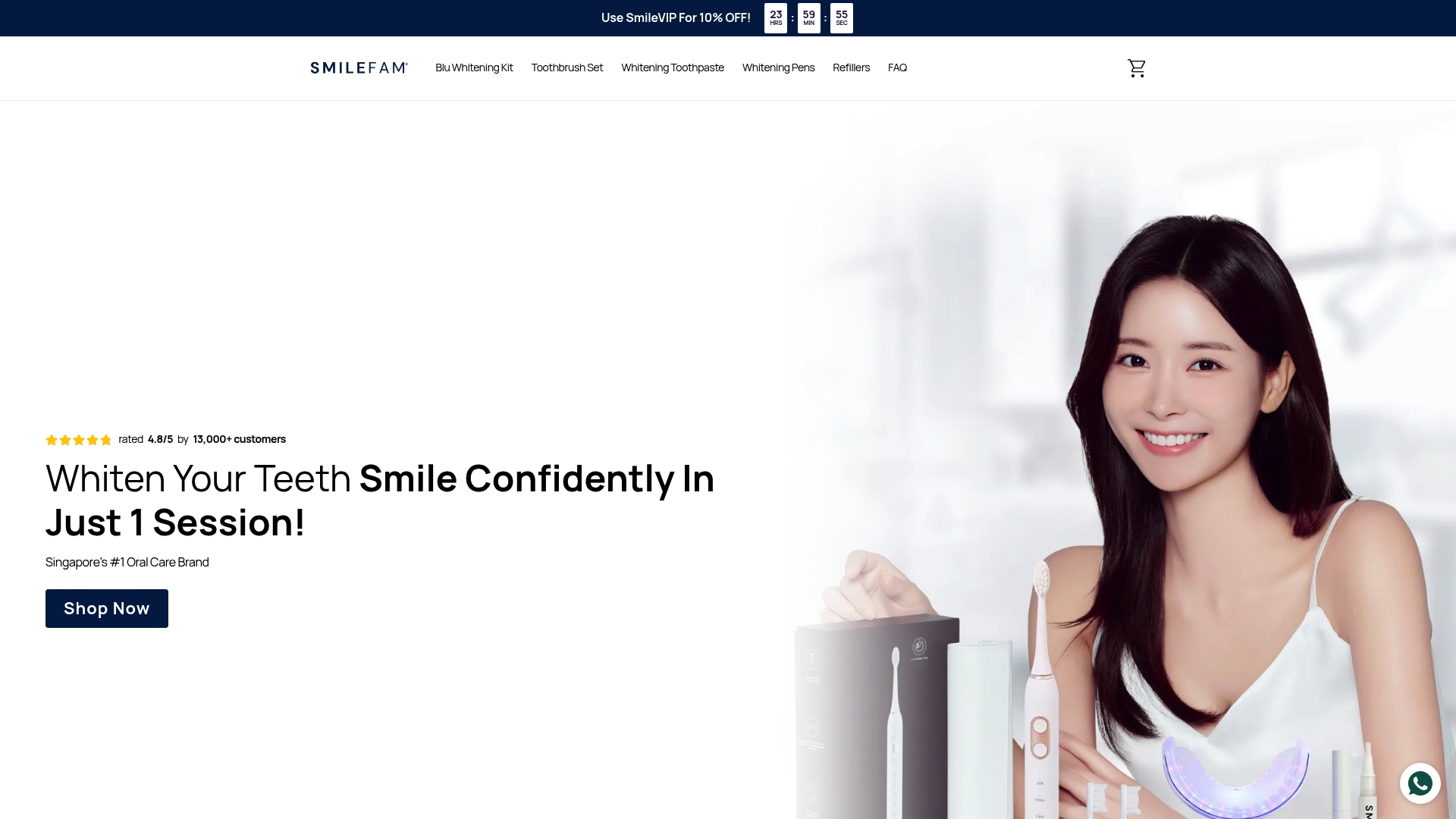
The BLU Teeth Whitening Kit uses BLU Whitening Technology, developed in Singapore, to deliver perceptible results in a single session without hydrogen peroxide. The formula is enamel-safe and designed for people who want professional-grade outcomes at home without the sensitivity that aggressive treatments cause. For daily maintenance between sessions, the BLU Whitening Toothpaste supports brightness without disrupting enamel. Both products reflect the core finding from 2026 research: smart formulation beats brute force every time.
FAQ
What makes short exposure whitening as effective as longer treatments?
Short exposure whitening reaches the oxidative saturation plateau within 10–20 minutes, completing most of the chromogen-breaking work early. Clinical studies confirm that 20-minute and 40-minute applications of 35% peroxide produce equivalent color change outcomes.
Is short exposure whitening safe for sensitive teeth?
Short exposure whitening is generally safer for sensitive teeth than longer protocols because less peroxide reaches the pulp during the brief contact window. Adding desensitizing agents like potassium nitrate or sodium fluoride further reduces sensitivity without affecting whitening results.
Does a higher peroxide concentration whiten teeth faster?
Concentrations above 35% do not produce proportionally better whitening but do increase the risk of pulpal inflammation and sensitivity. The 25–35% range delivers comparable outcomes with a lower risk profile, making it the clinically preferred choice.
Do LED lights improve short exposure whitening results?
Meta-analyses show that routine LED and laser activation does not significantly improve long-term whitening outcomes compared to chemical bleaching alone. The immediate shade change seen after light-assisted sessions is primarily a temporary dehydration effect that reverses within hours.
How many short exposure sessions are needed to see results?
Over 80% of people see perceptible color change after a single short exposure session using 35% peroxide. Nearly 100% show measurable improvement after two sessions, particularly in yellowness reduction, based on controlled clinical study data.