

Unsafe whitening products cause chemical burns, severe tooth sensitivity, and irreversible dental tissue damage. These are not rare edge cases. They are the documented, predictable results of using bleaching agents that exceed safe concentration limits or lack proper application controls. The clinical term for the category of harm is “adverse effects of bleaching agents,” and the research is clear: products with hydrogen peroxide above regulated thresholds put your enamel, gums, and dental pulp at serious risk. Knowing exactly what can go wrong is the first step toward protecting your teeth.
1. Side effects of unsafe whitening products: what the science shows
The core mechanism behind whitening product damage is oxidative stress. Hydrogen peroxide releases free radicals that break down stain molecules inside enamel. At low, regulated concentrations, this process is largely safe. At high concentrations, those same free radicals attack healthy dental tissue.
- Enamel microhardness loss: Morphological alterations from unsafe whitening include enamel microhardness reduction and increased surface roughness. Softer, rougher enamel picks up stains faster and is more vulnerable to decay.
- Pulp penetration: Hydrogen peroxide has a low molecular weight, which means it penetrates dental structures quickly and reaches the pulp. High concentrations provoke oxidative stress and inflammatory reactions deep inside the tooth.
- Gum burns: Even legally permitted concentrations can cause chemical burns when gum tissue is not properly isolated during application.
- Cytotoxic effects: At doses beyond legal limits, hydrogen peroxide becomes cytotoxic. It kills cells rather than just bleaching pigment.
Pro Tip: Check any whitening product label for its hydrogen peroxide percentage before use. If the percentage is not listed, treat the product as non-compliant and avoid it.
The biological damage from high-concentration agents does not always appear immediately. Pulp inflammation can develop over days, and enamel changes accumulate with repeated exposure. That delayed timeline is exactly why many people underestimate the risk.
2. Which specific side effects do people experience?
The most commonly reported and clinically observed adverse effects fall into four categories: soft tissue injury, tooth sensitivity, restoration damage, and pulp complications.
Soft tissue injury is the most visible. Chemical burns on gums and oral mucosa result from direct contact with high-peroxide gels. The tissue turns white, blisters, and peels. Pain is immediate and can last several days.
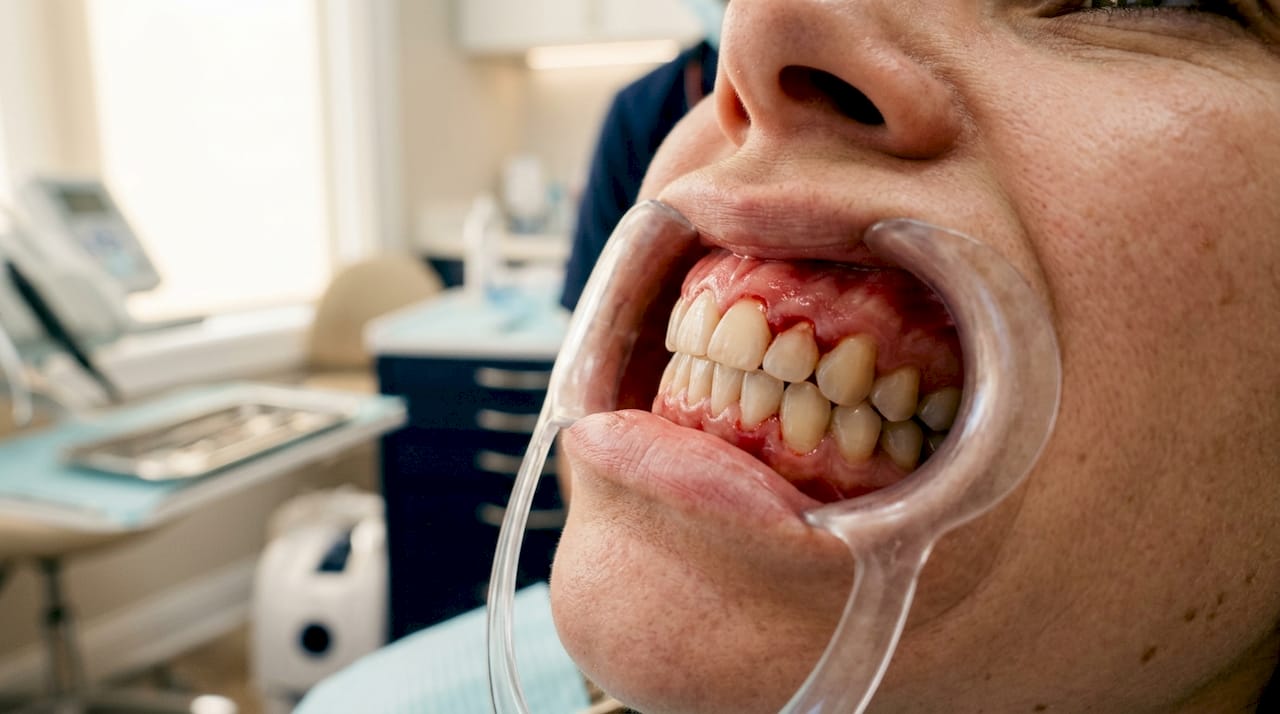
Tooth sensitivity is the most common complaint. Peroxide opens dentinal tubules, the microscopic channels that connect the tooth surface to the nerve. Exposed tubules make teeth acutely sensitive to heat, cold, and pressure. Clinical trials using low-concentration whitening products report only transient sensitivity with no serious adverse events. High-concentration products produce a far more severe and prolonged version of the same reaction.
Restoration damage is less discussed but clinically significant. Peroxide degrades the bond between composite fillings and tooth structure. Crowns, veneers, and bonded restorations can lose their seal, leading to leakage and secondary decay underneath.
Pulp complications represent the most serious end of the spectrum. Unsafe products with high bleach concentrations carry a documented risk of pulpitis, which is inflammation of the pulp, and in severe cases, pulp necrosis, which is the death of the pulp tissue. Pulp necrosis requires root canal treatment or extraction. These are not reversible outcomes.
Whitening is a medical procedure, not just cosmetic, requiring proper clinical scrutiny to avoid enamel and pulp damage from cytotoxic agents.
The risks of over-the-counter whitening products are not theoretical. They are well-documented in clinical literature and increasingly visible in regulatory enforcement data.
3. How regulatory standards protect consumers from dangerous products
Regulatory bodies set hydrogen peroxide limits specifically because the concentration determines the risk level. The European Union framework is the clearest example of how these limits work in practice.
| Category | Hydrogen peroxide limit | Who can supply it |
|---|---|---|
| Over-the-counter products | Up to 0.1% | Anyone |
| Professional use products | 0.1%–6% | Dentists only |
| Prohibited products | Above 6% | No one |
EU limits restrict over-the-counter whitening products to 0.1% hydrogen peroxide. Dentist-supplied products may contain up to 6%. Anything above 6% is prohibited entirely. Many products detained by health authorities in 2025 contained concentrations between 15% and 40%, far beyond any legal threshold.
Labeling requirements add another layer of accountability. Compliant products must display a designated “Responsible Person” with a name and EU or EEA address. Non-compliant products frequently omit this information entirely. Without it, there is no legal accountability if the product causes harm.
Enforcement is active but limited. The Health Products Regulatory Authority and similar bodies removed over 100 websites in 2025 for selling non-compliant whitening products. That scale of enforcement shows how widespread the problem is, not how contained it is.
Pro Tip: Buy whitening products only from licensed dental practices or verified retailers. If a product is sold through social media with no ingredient list, it almost certainly does not meet regulatory standards.
Social media distribution creates a false perception of safety. A product with thousands of positive comments and a polished brand aesthetic can still contain 30% hydrogen peroxide with no safety labeling. Popularity is not a proxy for compliance.
4. Why professional supervision changes the outcome
Professional supervision does not just reduce risk. It changes the entire risk profile of the whitening procedure. A dentist does things before, during, and after treatment that no at-home kit can replicate.
Before treatment, a dentist conducts a full anamnesis, which is a structured medical and dental history review. This identifies contraindications like existing restorations, gum disease, exposed root surfaces, or a history of sensitivity. Professional supervision significantly lowers adverse outcomes precisely because it screens out the people most likely to be harmed.
During treatment, proper gum isolation is applied. This is the step that most at-home users skip entirely. Improper gum isolation causes chemical burns even when the peroxide concentration is within legal limits. A trained professional uses barriers and retractors to keep the gel on the tooth surface and away from soft tissue.
After treatment, a dentist monitors for signs of pulp stress, sensitivity changes, and restoration integrity. This follow-up catches complications early, before they become irreversible.
The contrast with self-administered, unregulated products is stark. Those products skip every one of these steps. The person applying a high-peroxide gel at home has no way to assess their own pulp health, isolate their gum tissue correctly, or recognize early signs of pulpitis. Understanding safe versus harsh whitening approaches is not just academic. It determines whether whitening improves your smile or damages it.
“The clinical safety of bleaching depends on individual anamnesis and tissue health assessments conducted before any whitening procedure begins.”
For people with sensitive teeth, the stakes are even higher. Reviewing teeth whitening best practices before starting any treatment gives you a clear framework for what safe whitening actually looks like in 2026.
5. How to identify a dangerous whitening product before you use it
Recognizing a non-compliant product before it causes harm is a practical skill. Several clear warning signs appear on packaging and in how products are sold.
The first check is the ingredient list. Any product listing hydrogen peroxide above 0.1% for consumer use is non-compliant in regulated markets. Products that list “carbamide peroxide” without specifying the percentage are also a red flag. Carbamide peroxide breaks down into hydrogen peroxide, so the same concentration rules apply.
The second check is labeling completeness. A compliant product lists a Responsible Person with a full name and address, a batch number, an expiry date, and a full ingredient list in the correct language for the market. Missing any of these elements means the product has not passed the required safety review.
The third check is the sales channel. Products sold exclusively through social media accounts, unverified online marketplaces, or pop-up beauty stalls carry the highest risk. These channels have the least regulatory oversight and the highest concentration of non-compliant products. Understanding how to protect enamel while whitening starts with choosing products that have been through proper safety evaluation.
The fourth check is price. Professional-grade whitening treatments cost more because they include clinical oversight, compliant formulations, and follow-up care. A product that promises professional results at a fraction of the cost is almost certainly cutting corners on safety, concentration control, or both. Understanding clinical evaluation standards for beauty and whitening devices helps you ask the right questions before purchasing.
Key Takeaways
Unsafe whitening products cause chemical burns, enamel damage, and irreversible pulp injury because they exceed regulated hydrogen peroxide limits and bypass the professional oversight that prevents these outcomes.
| Point | Details |
|---|---|
| Peroxide concentration is the core risk | Products above 0.1% for OTC use or 6% for professional use are non-compliant and dangerous. |
| Enamel and pulp damage are documented | High-concentration agents reduce enamel microhardness and can cause pulpitis or pulp necrosis. |
| Regulatory enforcement is active but limited | Nearly 7,000 illegal products were detained in 2025, with over 100 websites removed. |
| Labeling gaps signal non-compliance | Missing Responsible Person details or ingredient percentages indicate a product has not passed safety review. |
| Professional supervision prevents the worst outcomes | Gum isolation, pre-treatment screening, and follow-up care eliminate the most serious risks. |
What I’ve learned from watching people whiten their teeth the wrong way
The most common mistake I see is treating whitening as a cosmetic shortcut rather than a clinical procedure. People spend weeks researching the right shade of lipstick and then buy a 35% peroxide gel from an Instagram ad without reading a single ingredient label. The asymmetry is striking.
What concerns me most is the delayed harm. Chemical burns are obvious immediately. But enamel microhardness loss and early pulp inflammation are invisible. People finish a two-week course of an illegal product, see whiter teeth, and conclude the product was safe. They do not see the structural changes happening underneath. By the time sensitivity becomes severe or a filling fails, the connection to the whitening product is long forgotten.
The regulatory picture is also more fragile than most people realize. Nearly 7,000 illegal products detained in a single year tells you that enforcement is reactive, not preventive. The products reach consumers first. Authorities catch them later. That gap is where the harm happens.
My honest position is this: whitening works, and it can be done safely. But the safety comes from the formulation and the process, not from the marketing. A product that skips clinical testing, ignores concentration limits, and sells through unverified channels is not a bargain. It is a liability. Seek out products with transparent ingredient lists, verified safety testing, and formulations designed to protect enamel rather than strip it.
— Lenney
Getsmilefam’s approach to whitening without the risks
Whitening your teeth should not mean choosing between results and safety. Getsmilefam builds its products around that exact principle.
The BLU Teeth Whitening Kit uses BLU Whitening Technology developed in Singapore, with lab-approved, enamel-safe ingredients and no harsh hydrogen peroxide. The formulation is designed for people who want visible results without the chemical burns, sensitivity spikes, or enamel damage that come with non-compliant products. For older adults with more sensitive teeth and existing restorations, the SmileFam for Seniors range offers a gentler approach built around the same safety standards. Every product Getsmilefam offers is formulated to protect the teeth you have while improving how they look.
FAQ
What are the most serious side effects of unsafe whitening products?
The most serious side effects are pulpitis and pulp necrosis, which is irreversible death of the tooth’s inner tissue. These result from high-concentration peroxide penetrating deeply into the tooth and triggering severe inflammatory reactions.
How much hydrogen peroxide is safe in a whitening product?
Over-the-counter whitening products are limited to 0.1% hydrogen peroxide under EU regulations. Products containing 0.1%–6% are restricted to professional dental use only, and anything above 6% is prohibited.
Can at-home whitening products cause permanent damage?
Yes. Morphological enamel changes from high-concentration products, including microhardness loss and surface roughness, are not reversible. Pulp necrosis from excessive peroxide exposure requires root canal treatment or extraction.
How do I know if a whitening product is safe to use?
Check that the product lists a hydrogen peroxide concentration at or below 0.1% for consumer use, includes a Responsible Person name and address, and provides a full ingredient list. Products sold through social media without these details are high-risk.
Does professional whitening eliminate all side effects?
Professional whitening significantly reduces adverse effects by screening for contraindications and using proper gum isolation techniques. Clinical trials using regulated concentrations report only transient sensitivity with no serious adverse events.