

If you’ve been staring at whitening pen options wondering whether they can actually match what a dental clinic delivers, you’re not alone. Understanding how whitening pens compare to clinics is one of the most searched questions in cosmetic dental care, and the answer depends on more than just ingredient strength. This article breaks down efficacy, cost, safety, and practical fit so you can make a decision based on real information rather than marketing claims. Whether you’re after a quick touch-up solution or a dramatic shade change, the right choice comes down to your specific goals and budget.
Table of Contents
- Key Takeaways
- What whitening pens actually do and how they work
- How professional clinic whitening actually works
- Cost comparison: pens vs clinic treatments
- Convenience, safety, and what fits your lifestyle
- When to choose a pen vs when to choose a clinic
- My honest take after years of covering this topic
- Why Getsmilefam is worth considering before you book a clinic
- FAQ
Key Takeaways
| Point | Details |
|---|---|
| Pens work best for maintenance | Whitening pens are ideal for mild surface stains and keeping results fresh between deeper treatments. |
| Clinics deliver faster, stronger results | Professional whitening can lighten teeth up to 8 shades in a single session, far outpacing at-home pens. |
| Cost gap is significant | Pens cost $15 to $50; professional in-office whitening runs $300 to $1,000 or more per session. |
| Technique determines pen performance | Inconsistent contact time and saliva dilution are the top reasons whitening pens underperform. |
| Both can coexist in your routine | Using pens for maintenance after a clinic treatment is one of the smartest approaches to long-term brightness. |
What whitening pens actually do and how they work
Whitening pens fall under the broader category of over-the-counter (OTC) tooth bleaching products, a category that also includes strips and trays. The core active ingredient in most pens is either hydrogen peroxide or carbamide peroxide. OTC pens typically contain 3 to 10% hydrogen peroxide or 10 to 35% carbamide peroxide, which is considerably lower than what a dentist uses in a clinic setting.
Here’s the chemistry in plain terms. Hydrogen peroxide pens act faster but can increase sensitivity for some users. Carbamide peroxide releases hydrogen peroxide more slowly, making it a gentler option if your teeth are already reactive. These two chemistries offer real trade-offs between speed and comfort, which is why reading the label before buying matters.
The typical treatment schedule with a pen runs two to four weeks of daily applications. Most pens target surface-level staining caused by coffee, tea, wine, or food coloring. They are not designed to address deeper intrinsic discoloration from medications, aging, or dental trauma.
- Pens are best for surface touch-ups rather than dramatic shade changes
- Results are temporary and fade faster than professional treatments without consistent reapplication
- Effectiveness is heavily influenced by user technique, specifically contact time and how well the gel stays on the tooth
One thing most users don’t realize: pen gels can be diluted or washed away by saliva if you apply them incorrectly or talk and drink too soon after application. This is the single biggest reason pens underperform for many people.
Pro Tip: Apply the pen gel after brushing and drying your teeth with a tissue. Keep your mouth slightly open for 30 to 60 seconds after application to maximize contact time before closing.
How professional clinic whitening actually works
Professional teeth whitening, technically called in-office bleaching, is a different category of treatment entirely. Clinics use peroxide concentrations far above what OTC products offer, applied under controlled conditions with protective measures that simply aren’t possible at home.
The three main types of professional whitening are:
- In-office whitening: A dentist applies a high-concentration peroxide gel directly to your teeth, sometimes activated with light or laser technology, in a single session of 60 to 90 minutes.
- Light-assisted whitening: Uses LED or laser energy to accelerate the breakdown of the peroxide gel, which can speed up the whitening reaction.
- Custom take-home trays: Your dentist takes impressions of your teeth and creates fitted trays you use with prescription-strength gel over two to four weeks. This sits between pens and in-office treatments in both cost and strength.
In-office whitening uses peroxide gels with light activation alongside safety steps like gum isolation barriers to protect soft tissue during treatment. That level of control is what separates clinic results from anything you can replicate at home.
“Professional whitening results are generally faster, stronger, and longer lasting than OTC products due to higher-strength gels, professional monitoring, and custom trays.” — Chapel Hill Advanced Dentistry
Clinics can deliver up to 8 shades lighter in a single session, while pens lighten gradually by fewer shades over weeks. Sensitivity management is also built into most professional protocols, with dentists able to adjust gel strength mid-treatment based on how your teeth respond. That kind of real-time adjustment is something no pen can offer.
After your session, your dentist will usually recommend specific aftercare, including dietary restrictions for 24 to 48 hours and sensitivity relief products like potassium nitrate toothpaste if needed.
Cost comparison: pens vs clinic treatments
This is where the comparison between whitening pens and professional treatment cost becomes very clear, and for many people, very decisive.
| Treatment Type | Cost Range | Sessions Needed | Results Duration |
|---|---|---|---|
| Whitening pen | $15 to $50 | Daily for 2 to 4 weeks | 2 to 6 months |
| Custom take-home trays | $200 to $600 | 2 to 4 weeks | 6 to 12 months |
| In-office professional | $300 to $1,000+ | 1 to 3 sessions | 1 to 3 years |
Professional in-office whitening costs roughly $300 to $1,000 per session in the United States. That number reflects the dentist’s time, specialized equipment, prescription-strength materials, and professional liability. When people ask why clinic whitening is expensive, the answer is straightforward. You’re paying for controlled outcomes, speed, and safety supervision.
Pens, on the other hand, represent a low-cost entry point. If you’re maintaining existing results or dealing with mild yellowing, buying a $30 pen every few months is a fraction of the cost. But if you expect a pen to deliver the same shade change as a professional treatment, you’ll be disappointed repeatedly.
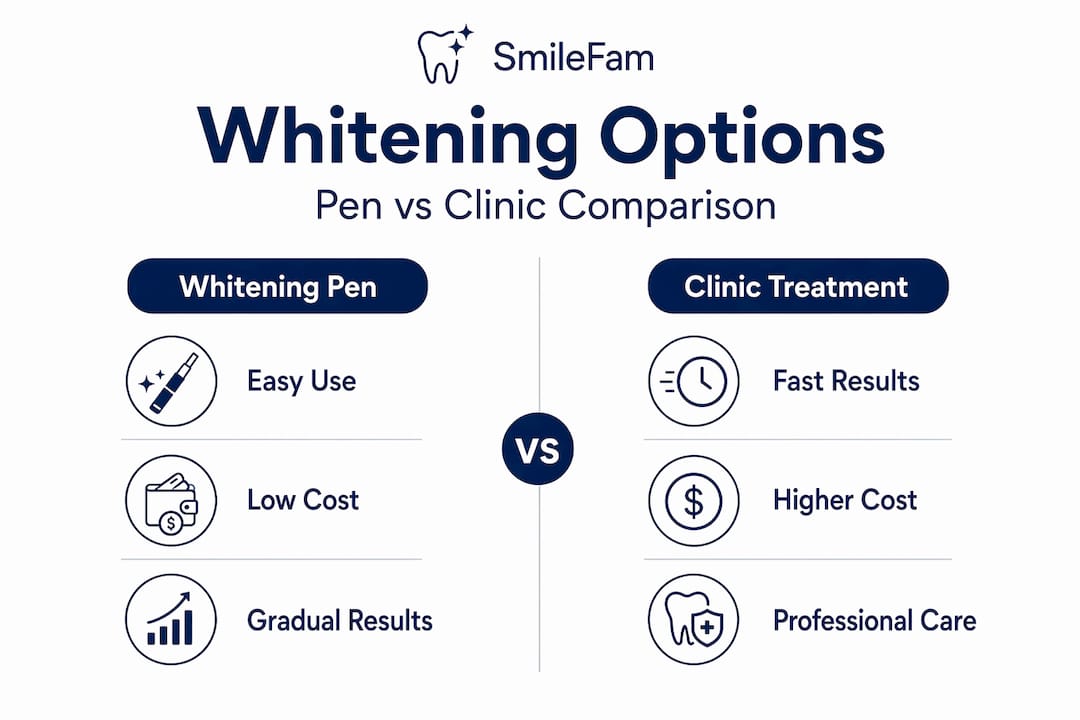
The most cost-efficient strategy for many people is a clinic session once or twice a year with pen maintenance in between. This approach gives you professional-grade results without recurring clinic bills, and it keeps your investment working longer.
Pro Tip: If you’re considering at-home whitening to save money, factor in how often you’ll repurchase pens or strips. A quality whitening pen used consistently can maintain brightness between professional visits without significant expense.
Convenience, safety, and what fits your lifestyle
The convenience gap between pens and clinics is real. Pens fit in a pocket. You can use one in a car, at your desk, or after lunch. There’s no appointment, no waiting room, and no rearranging your schedule. For people who travel frequently or have unpredictable hours, that flexibility carries genuine value.

Clinics require appointments, typically 60 to 90 minutes in the chair, and sometimes multiple sessions for severe staining. Dental anxiety, transportation, and scheduling barriers are real obstacles for a portion of the population. Custom dentist-supervised take-home trays offer a middle ground: professional gel strength with at-home application flexibility.
Safety considerations are different for each option:
- Pens carry a low risk of serious side effects but can cause uneven whitening due to patchy application or inconsistent contact time
- Clinical treatments carry a monitored sensitivity risk, with protocols adjusted in real-time by the dentist
- Anyone with crowns, veneers, or bonding should consult a dentist before using any whitening product, since bleaching agents only affect natural tooth enamel
Studies and dental professionals agree that managing sensitivity as a separate phase before aggressive whitening dramatically improves user tolerance and outcomes. If your teeth are reactive, start with a lower concentration pen and space out applications before moving to stronger options.
About 38% of adults report tooth sensitivity during or after whitening treatments, according to dental research, which means sensitivity planning isn’t optional for nearly four in ten users. If you fall into that group, the right whitening option for sensitive smiles matters more than the price tag.
When to choose a pen vs when to choose a clinic
Knowing how whitening pens and clinic treatments compare only helps if you can translate that knowledge into a decision. Here’s a practical breakdown.
Choose a whitening pen when:
- You’re maintaining brightness after a professional treatment
- Your staining is mild and surface-level, caused by food or drink
- Your budget is under $50 and you want gradual improvement
- You travel often and need a portable, no-prep option
Choose a professional clinic treatment when:
- You have deep or intrinsic staining from aging, medication, or genetics
- You want noticeable results quickly, such as before a wedding or event
- You’ve tried OTC products consistently without satisfying results
- You have dental restorations and need a professional to assess compatibility
The combination approach: One of the most effective strategies is to start with a professional whitening overview to understand your baseline, do a clinic treatment for the initial shade lift, then use a quality pen for monthly touch-ups. This gives you the dramatic result of a clinic visit with the long-term maintenance of an at-home routine without paying for repeated professional sessions.
If you have significant sensitivity concerns or complex dental history, consult your dentist before starting any whitening program. Knowing the condition of your enamel before bleaching is always worthwhile.
My honest take after years of covering this topic
I’ll be direct about something most whitening articles skip over. The biggest mistake I see people make isn’t buying the wrong product. It’s skipping the baseline assessment entirely.
In my experience, most people reach for a whitening pen or book a clinic appointment without knowing what’s actually causing their discoloration. Surface stains from coffee respond beautifully to a good pen. But if your yellowing is from thinning enamel, no amount of bleaching will reverse that, and aggressive whitening can make it worse.
What I’ve learned from following this space closely is that commitment beats product strength every time. A $20 pen used correctly, every day, for three weeks will outperform a $500 clinic treatment you follow up on poorly. Results don’t live in the product. They live in the habit.
My advice for anyone on the fence: start with a quality pen, learn your teeth’s tolerance, and use that experience to decide whether a clinic visit is worth the investment for you. Don’t let the price difference alone drive the decision. Let your actual goals and stain type drive it instead.
— Lenney
Why Getsmilefam is worth considering before you book a clinic
If the cost of professional whitening is giving you pause, you’re not stuck choosing between an underperforming drugstore pen and a $600 dental appointment.
Getsmilefam’s Snow Serum™ Whitening Pen is built on proprietary BLU Whitening Technology developed in Singapore, using enamel-safe, lab-approved ingredients without harsh hydrogen peroxide. It’s designed for people who want real results quickly without the clinic price tag or the sensitivity risk that comes with high-peroxide formulas. For readers wanting a more complete solution, the Ultimate Whitening Bundle combines multiple treatments for a full at-home whitening routine. Both options come with customer reviews, a satisfaction guarantee, and the kind of transparent ingredient disclosure you should expect from any whitening product before you commit.
FAQ
How effective are whitening pens compared to professional treatment?
Whitening pens are effective for mild, surface-level staining and touch-up maintenance. Professional clinic treatments deliver stronger, faster, and longer-lasting results, with clinics capable of achieving up to 8 shades lighter in a single visit.
Why is professional clinic whitening so expensive?
Clinic whitening costs reflect prescription-strength materials, dentist oversight, specialized equipment like light activation systems, and gum protection protocols. Safety and even results come from that level of controlled, supervised application.
Can I use a whitening pen after a professional clinic treatment?
Yes, and many dental professionals recommend it. A whitening pen used for monthly touch-ups after a clinic session extends your results significantly and reduces how often you need to return for professional treatments.
Are whitening pens safe for sensitive teeth?
Most pens are safe at recommended use, but carbamide peroxide formulas tend to be gentler than hydrogen peroxide options. Spacing out applications and starting with lower concentrations helps sensitive users tolerate whitening better.
How long do whitening pen results last?
Results from whitening pens typically last two to six months depending on diet, oral hygiene habits, and how consistently you apply the product. Professional treatments last one to three years with proper maintenance.