

Walk into any pharmacy and you’ll find an entire aisle dedicated to teeth whitening. Open your browser and the options multiply fast. With so many types of teeth whitening treatments available, ranging from a $30 strip kit to an $800 laser session, the real challenge is not finding options. It’s knowing which one actually fits your stains, your sensitivity, and your life. This guide cuts through the noise and gives you a clear picture of every major category, what results to realistically expect, and how to pick the right treatment for your smile.
Table of Contents
- Key takeaways
- The types of teeth whitening treatments worth knowing
- 1. Professional in-office whitening
- 2. Dentist-supervised take-home whitening kits
- 3. Over-the-counter whitening strips
- 4. Whitening toothpastes and rinses
- 5. Whitening pens and spot treatments
- 6. Generic OTC trays and whitening gels
- 7. DIY and natural home remedies
- 8. Teeth whitening comparison at a glance
- 9. How to choose the best whitening treatment for you
- My honest take on navigating whitening choices
- Ready to brighten your smile the smart way?
- FAQ
Key takeaways
| Point | Details |
|---|---|
| In-office whitening is fastest | Professional sessions can lighten teeth 6-10 shades in under 90 minutes. |
| Take-home kits offer balance | Dentist-supervised home kits cost less than in-office and reduce sensitivity risks. |
| OTC products suit mild staining | Whitening strips and pens work well for surface stains but struggle with deep discoloration. |
| Dental restorations complicate results | Whitening gels do not change the color of crowns or veneers, so consult your dentist first. |
| Maintenance is non-negotiable | Most dentists recommend waiting six months between professional sessions to protect enamel and manage sensitivity. |
The types of teeth whitening treatments worth knowing
Before committing to any whitening method, you need a clear framework for comparing them. Not every treatment works on every type of stain, and the wrong choice can mean wasted money or unnecessary discomfort.
Here are the core criteria that separate a smart pick from a frustrating one:
- Effectiveness. Measured in shades of improvement. A treatment that moves you two shades is very different from one that moves you eight.
- Type of staining. Extrinsic stains from coffee, wine, or tobacco sit on the enamel surface and respond well to most treatments. Intrinsic stains, those deeper inside the tooth structure, require higher-concentration formulas and professional supervision.
- Cost and long-term value. Cheap upfront does not always mean cheaper over time if you need repeat purchases.
- Time commitment. Some treatments require two weeks of daily wear. Others take a single 90-minute appointment.
- Sensitivity and safety. Higher peroxide concentrations whiten faster but can trigger gum irritation and sensitivity.
- Professional supervision. Dentist-led treatments offer customization and safety monitoring that over-the-counter products simply cannot replicate.
Pro Tip: Before spending anything on whitening, identify whether your stains are extrinsic or intrinsic. A quick check with your dentist can save you from buying a product that was never designed for your type of discoloration.
1. Professional in-office whitening
This is the gold standard. Period. A trained dentist applies a high-concentration peroxide gel (typically 25 to 40%) directly to your teeth, protecting your gums with a specialized barrier. Many offices also use a light or laser to activate the gel and accelerate the chemical reaction.
The results are striking. Professional whitening achieves 6 to 10 shades of improvement in a single session lasting 60 to 90 minutes. For anyone with a wedding, reunion, or job interview on the calendar, nothing comes close to this speed.
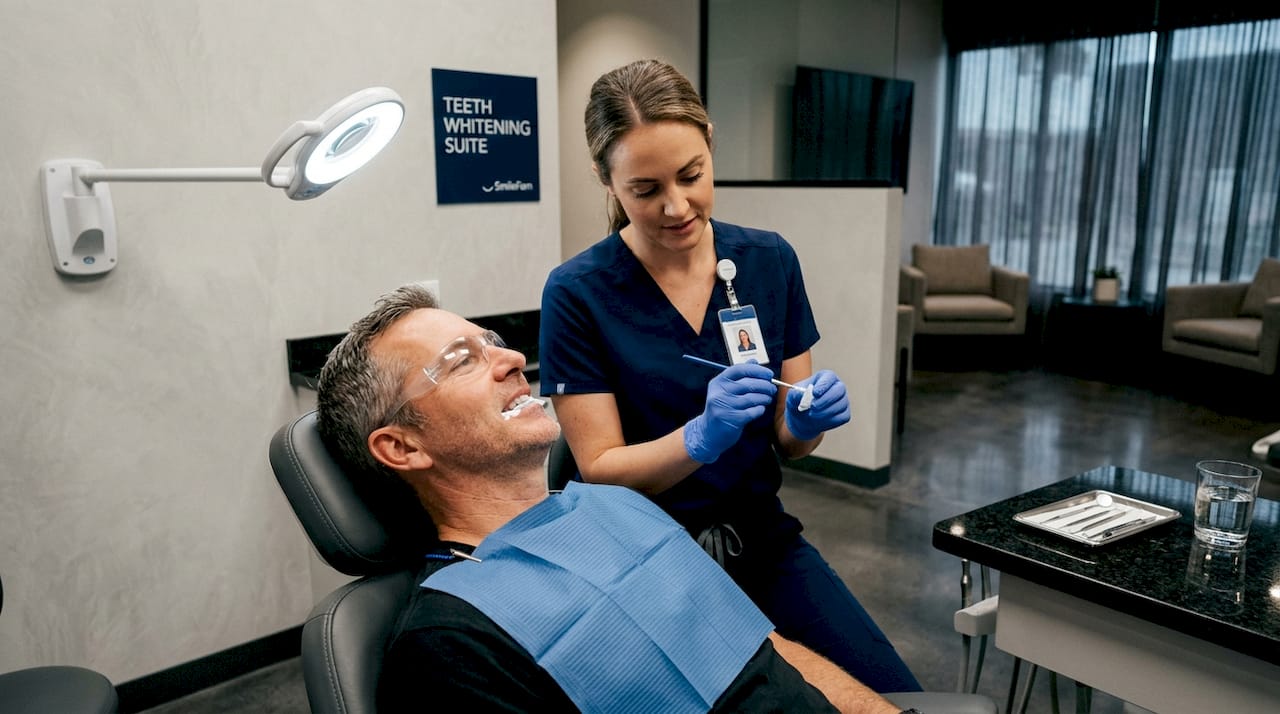
Cost runs between $300 and $800 per session depending on your location and the technology used. Laser whitening, in particular, sits at the higher end of that range but consistently delivers the quickest and most long-lasting outcomes. The price is steep compared to OTC options, yet the precision and predictability of the results often justify the investment for patients who want dramatic, same-day change.
Key facts about in-office whitening:
- Single session: 60 to 90 minutes
- Shade improvement: 6 to 10 shades
- Cost range: $300 to $800
- Best for: Severe or intrinsic staining, time-sensitive results
- Sensitivity risk: Moderate to high immediately post-treatment
2. Dentist-supervised take-home whitening kits
Think of this as the middle path between professional power and at-home convenience. Your dentist creates custom-fitted trays molded to the exact shape of your teeth. You take those trays home with a professional-strength gel and wear them daily for one to two weeks.
The gels used in these kits contain 10 to 35% carbamide or hydrogen peroxide, which is significantly stronger than anything you can buy at a pharmacy. Take-home kits typically deliver 4 to 8 shades of improvement with costs ranging from $200 to $500. That price includes the custom trays, which you keep for future touch-ups using refill gel only.
The custom-fit design is a major safety advantage. Professional formulation and custom trays reduce the risk of uneven whitening and gum contact compared to generic one-size-fits-all trays. You get more control over pacing, which means you can slow down or skip a day if sensitivity builds up. For details on at-home whitening benefits, this approach is hard to beat in terms of cost-to-result ratio.
Pro Tip: Use a small amount of gel per tooth and apply a thin layer of petroleum jelly along your gumline before inserting the tray. This one habit dramatically reduces gum irritation over the course of your treatment.
3. Over-the-counter whitening strips
Whitening strips are the most widely used home teeth whitening method, and for good reason. They are accessible, easy to use, and genuinely effective for mild to moderate extrinsic staining.
Most strips contain 3 to 14% hydrogen peroxide. OTC strips typically yield 1 to 5 shades of improvement over 2 to 3 weeks of twice-daily application, with kit costs averaging $25 to $45. That is real improvement for the price, as long as you go in with realistic expectations.
The downside is in the design. Because strips are cut to a standard shape, they often miss the curves and gaps between teeth, leaving uneven patches. People with more complex tooth alignment tend to see the most uneven results. Strips also sit on the gum tissue, which can cause irritation if used too frequently or left on too long. If you’re prone to sensitivity, read about safe whitening for sensitive teeth before committing to a full strip regimen.
4. Whitening toothpastes and rinses
Whitening toothpaste effectiveness gets talked about a lot. Here is an honest take. These products remove surface stains through mild abrasives or low levels of peroxide. They will not change the underlying color of your enamel in any significant way.
They shine as a maintenance tool after a more intensive whitening treatment, not as a standalone solution. Used daily, a good whitening toothpaste keeps new coffee or tea stains from building up and extends the life of your professional results. The cost is minimal, typically $10 to $20 per tube, and there is no additional time commitment beyond your regular brushing routine.
Rinses follow the same logic. Useful for control and upkeep, but not powerful enough to act as a primary whitening strategy on their own.
5. Whitening pens and spot treatments
Whitening pens are a newer category that sits between strips and professional treatments in terms of precision. You paint a thin layer of gel directly onto specific teeth, which makes them excellent for targeting individual spots or freshening your smile between full treatment cycles.
The gel concentrations are typically low (around 3 to 8% hydrogen peroxide), so the whitening effect is subtle rather than dramatic. The real value is in portability and touch-up convenience. A good pen fits in a pocket or purse and delivers a quick refresh before an event or meeting. For guidance on using these safely, check out how to clean stained teeth with a whitening pen.
6. Generic OTC trays and whitening gels
These products copy the concept of dentist-provided tray systems without the custom fit. You fill a generic tray with gel and wear it for a set period each day. Results vary widely based on how well the tray actually covers your teeth.
The core problem is fit. A tray that does not seal properly allows the gel to pool against your gums rather than concentrating on enamel. This raises the risk of irritation without improving effectiveness. Brushing and flossing before each use is critical with these products since gel applied over plaque or food residue produces patchy, uneven results. For the modest price difference between generic trays and dentist-supervised kits, the custom option is usually worth the upgrade.
7. DIY and natural home remedies
Baking soda, activated charcoal, oil pulling, lemon juice. These get shared constantly on social media as easy fixes. The reality is not so flattering.
Warning: DIY remedies like lemon juice and baking soda are flagged by dental experts as unsafe for regular use. The acidity of lemon juice erodes enamel permanently, and aggressive abrasives damage enamel over time. These are not cosmetic annoyances. Enamel does not grow back.
Baking soda in small doses as an occasional additive to toothpaste has some mild plaque-reducing benefit, but it is not a whitening treatment. The risk-to-reward ratio on DIY remedies is simply too poor to recommend them when safer, more effective alternatives exist at every price point.
8. Teeth whitening comparison at a glance
A direct teeth whitening comparison helps put all of these options side by side where the differences become obvious fast.
| Treatment type | Shades improved | Session time | Cost range | Supervision needed |
|---|---|---|---|---|
| In-office professional | 6 to 10 | 60 to 90 min | $300 to $800 | Yes |
| Dentist take-home kit | 4 to 8 | 1 to 2 weeks daily | $200 to $500 | Yes (initial) |
| OTC whitening strips | 1 to 5 | 2 to 3 weeks daily | $25 to $45 | No |
| Whitening toothpaste | Minimal | Daily use | $10 to $20 | No |
| Whitening pen | Subtle | Minutes per use | $15 to $40 | No |
| Generic OTC trays | 1 to 4 | 1 to 2 weeks daily | $30 to $70 | No |
| DIY/natural remedies | Negligible to harmful | Varies | Low | No |
The cost of teeth whitening spans a wide range, but the data tells a consistent story: higher professional supervision correlates with better and faster results.
9. How to choose the best whitening treatment for you
Finding the best whitening treatments for your specific situation requires honest self-assessment before you spend a dollar.
- Start with the stain type. Surface stains from food and drinks respond well to strips, pens, and take-home kits. Stains from medications, aging, or trauma are intrinsic and typically need in-office treatment.
- Account for dental restorations. Whitening treatments do not change the color of veneers, crowns, or bonding. If you have visible restorations on front teeth, whitening your natural teeth without addressing them creates a noticeable mismatch.
- Manage sensitivity proactively. If you already experience sensitivity to hot and cold foods, high-concentration peroxide treatments may worsen it. Start lower and slow down. Tips for avoiding whitening sensitivity can prevent a lot of unnecessary discomfort.
- Be realistic about maintenance. Whitening results are temporary, and staining from diet gradually returns. Budget for touch-ups and plan your treatment around lifestyle, not just cost.
- Consult before committing. If you have not had a dental checkup recently, do that first. Whitening over untreated cavities or gum disease makes things worse, not better.
Pro Tip: After any whitening treatment, use a whitening toothpaste daily to slow stain reaccumulation. Pair it with avoiding dark-pigmented drinks for the first 48 hours post-treatment, when enamel pores are most open to re-staining.
My honest take on navigating whitening choices
I have spent years watching people make the same avoidable mistake with teeth whitening. They see the dramatic before-and-after photos in an ad, grab whatever is cheapest or most convenient, and then feel let down when results are underwhelming or the sensitivity becomes unbearable.
What I have learned is that the biggest variable is not the product. It is the match between the product and the person. I have seen people with mild coffee staining get extraordinary results from a simple take-home kit because they used it correctly and consistently. I have also seen people blow $700 on in-office whitening and walk away disappointed because they had intrinsic discoloration that no peroxide treatment was ever going to fully address.
The marketing around whitening is aggressive and often misleading. Words like “immediate” and “dramatic” get applied to products that realistically deliver one or two shades of change over three weeks. My genuine advice is to slow down before buying. Know your stain type. Know your sensitivity baseline. Know whether you have restorations that will create a mismatch. And accept that whitening is maintenance, not a one-time fix.
Professional oversight is not always necessary, but when you are dealing with significant discoloration, it saves you from spending months chasing results that only an hour in the dentist’s chair could have delivered on day one.
— Lenney
Ready to brighten your smile the smart way?
If you want effective whitening without peroxide, without harsh chemicals, and without a high price tag, Getsmilefam has built their product line around exactly that. Their Snow Serum™ Whitening Pen uses proprietary BLU Whitening Technology developed in Singapore, delivering visible results in a single session without irritating sensitive gums.
For daily maintenance and surface stain control, the BLU Whitening Toothpaste works without the enamel-damaging chemicals found in many drugstore alternatives. And if you want the full at-home whitening experience, the complete BLU Whitening Kit gives you everything you need in one package. All Getsmilefam products are lab-approved, enamel-safe, and built for people who want real results on their own schedule.
FAQ
What are the main types of teeth whitening treatments?
The main types include professional in-office whitening, dentist-supervised take-home kits, OTC whitening strips, whitening toothpastes, whitening pens, and generic tray systems. Each varies by strength, cost, and speed of results.
Which whitening treatment works fastest?
In-office professional whitening achieves 6 to 10 shades of improvement in a single 60 to 90 minute session, making it the fastest available option for dramatic results.
Is whitening toothpaste actually effective?
Whitening toothpaste removes surface stains and helps maintain results after treatment, but it does not significantly change the underlying color of your enamel on its own.
How often can you whiten your teeth safely?
Most dentists recommend waiting at least six months between professional whitening sessions to avoid overuse and protect enamel from sensitivity and erosion.
Do whitening treatments work on crowns or veneers?
No. Whitening treatments do not alter the color of dental restorations like crowns, veneers, or bonding. If you have visible restorations, consult your dentist before whitening to avoid color mismatches.