

Whitening consistency is defined as the process of maintaining stable gel chemistry, controlled application conditions, and daily treatment adherence to produce uniform tooth stain oxidation. Without it, peroxide breaks down unevenly, contact time varies, and results come out patchy. Three formulation factors govern how uniform whitening works: peroxide concentration, pH balance, and gel viscosity. Each one directly controls how much active whitening agent reaches your enamel and stays there long enough to do its job. Understanding how whitening consistency works gives you a real advantage when choosing products and building a routine that actually delivers.
How whitening consistency works at the formulation level
Whitening gel chemistry is more precise than most people realize. Whitening efficacy depends on delivery system design, including viscosity, pH, and stable peroxide release, not just on peroxide concentration alone. A gel with a high peroxide percentage but poor pH control will lose potency before it even touches your teeth.
The pH of a whitening gel determines how long peroxide stays active. Neutral pH (6.0–7.0) is optimal for balancing whitening efficacy, shelf life, and minimizing tooth sensitivity by stabilizing peroxide availability. Gels that drift outside this range either break down too fast or irritate dentinal tubules, which are the tiny channels that lead to your tooth’s nerve.
Viscosity controls where the gel stays and how evenly it releases peroxide. Poor viscosity causes runny gels to migrate onto gum tissue, creating chemical burns and uneven whitening. The right gel thickness keeps the whitening agent anchored precisely on enamel, not sliding off onto soft tissue.
Professional whitening gels are manufactured to tight tolerances. Potency variance of ±10–15% is the accepted standard for professional-grade formulations. Anything beyond that range signals instability, which means the gel you apply on day one may perform very differently from the gel you apply on day ten.
- pH stability: Keeps peroxide active and reduces sensitivity by preventing over-acidic or over-alkaline conditions.
- Viscosity control: Holds the gel on enamel surfaces, prevents gum migration, and ensures even peroxide release.
- Buffering systems: Resist pH drift over time, protecting potency through the product’s full shelf life.
- Thickening polymers: Maintain gel body so the product performs consistently from the first application to the last.
Pro Tip: Store your whitening gel away from heat and direct sunlight. Heat accelerates pH drift and peroxide breakdown, cutting your product’s effective life short before you finish the treatment.
How does treatment adherence affect whitening uniformity?
Skipping sessions is the most common reason whitening results look uneven. Whitening targets organic pigments through oxidation, and inconsistent application interrupts stain molecule breakdown, leading to patchy outcomes. Think of it like painting a wall. One coat applied unevenly leaves streaks. Multiple consistent coats build a uniform finish.
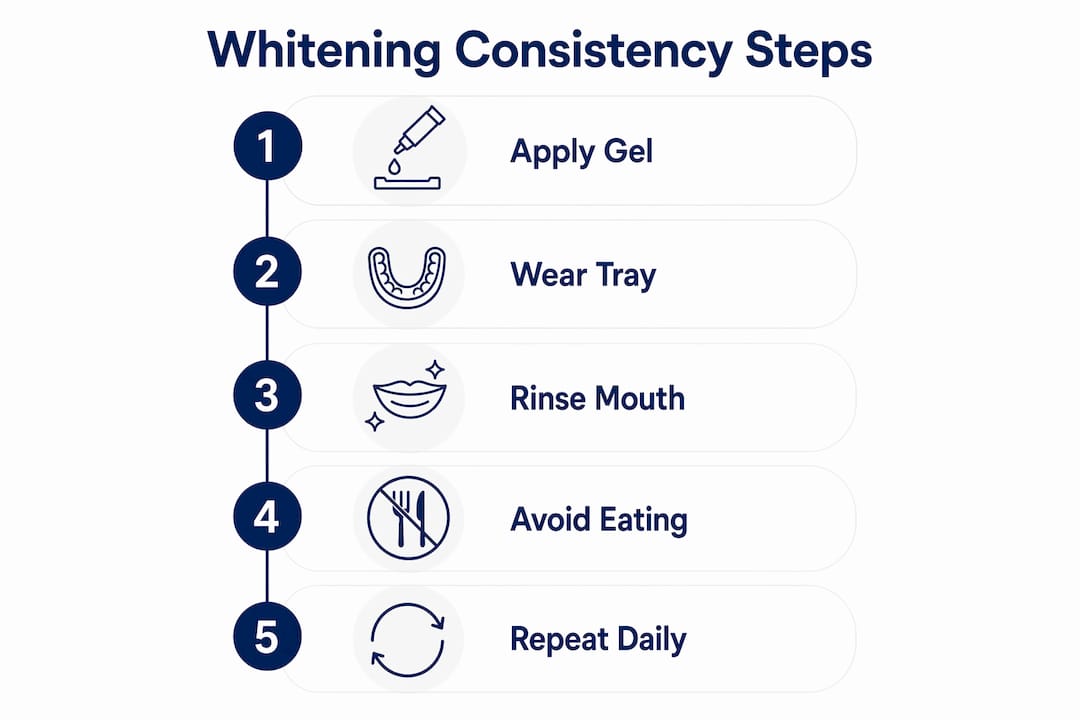
The dose-time relationship in whitening is straightforward. Tray systems require 30–60 minutes of daily application for 7–14 days to deliver expected results. That window is not arbitrary. It reflects the time peroxide needs to fully oxidize chromogen molecules embedded in enamel.
Whitening toothpastes work on a different timeline. They lighten teeth gradually through mild abrasives and low-level peroxide, requiring weeks of daily use to show noticeable change. Tray-based kits concentrate the exposure time, which is why they produce faster and more dramatic results. Neither approach works without daily commitment.
Here is a practical routine that protects whitening uniformity:
- Set a fixed daily window. Apply your whitening product at the same time each day, such as after dinner, so it becomes automatic.
- Dry your teeth before application. Saliva dilutes gel and reduces contact time. Pat teeth dry with a clean cloth or gauze first.
- Use the recommended amount. A thin, even layer across all tooth surfaces beats a thick glob concentrated in one spot.
- Track your sessions. Mark each completed session on your phone or calendar. Missing two consecutive days breaks the oxidation cycle.
- Avoid staining foods during treatment. Coffee, red wine, and dark sauces re-stain enamel while pores are open from peroxide exposure.
Pro Tip: If you miss a session, do not double up the next day. Extra gel does not compensate for lost time. Just resume your normal schedule and complete the full treatment course.
Consistent whitening best practices also include rinsing after treatment and waiting 30 minutes before eating or drinking anything colored.
Whitening delivery systems compared: which holds consistency best?
Not all delivery systems protect whitening consistency equally. The method you choose determines how well the gel stays in contact with your enamel, how stable the peroxide remains, and how predictable your results will be.
| Treatment | Application time | Viscosity impact | Consistency factors |
|---|---|---|---|
| Whitening toothpaste | 2 min, twice daily | Low viscosity, brief contact | Gradual; requires weeks of daily use |
| Tray-based gel kit | 30–60 min daily, 1–2 weeks | High viscosity, sustained contact | Most consistent; controlled exposure time |
| Whitening strips | 30 min daily, 1–2 weeks | Medium viscosity, fixed coverage | Good uniformity; limited to strip shape |
| Light-activated gel | 10–20 min per session | Must match lamp specifications | Effective only with correct gel formulation |
Tray-based systems lead in consistency because the custom or semi-custom tray holds gel against every tooth surface for a controlled duration. Strips perform well but cover only the front teeth, leaving molars untreated. Toothpastes offer the lowest consistency because contact time is too short for deep stain oxidation.
Light-activated whitening adds a layer of complexity. Whitening lights require gels with specific viscosity and composition to activate whitening compounds efficiently. Thin or uneven gels waste the light exposure entirely and yield no extra whitening benefit. This means the gel and the lamp must be matched. Using a generic gel with a light device is a common and expensive mistake.
Gel formulation stability also matters across all delivery systems when products are tested for clinical safety and efficacy. Products that pass rigorous stability testing maintain their pH and viscosity from the first use to the last, which is the foundation of reliable results.
What are the most common whitening consistency mistakes?
Most whitening failures trace back to a handful of predictable errors. Knowing them in advance saves you time, money, and sensitivity.
- Using too much gel. Applying excessive gel does not improve results. Efficacy depends on peroxide release kinetics and stable formulation, not volume. Overfilling a tray pushes gel onto gums and increases irritation risk.
- Ignoring product storage. Heat and humidity accelerate peroxide breakdown. A gel stored in a hot bathroom cabinet may lose significant potency before you open it.
- Choosing products with unstable pH. Poor pH control causes peroxide to break down before application, meaning you apply a gel that has already lost its active ingredient. Check for whitening misconceptions debunked before buying based on marketing claims alone.
- Expecting uniform results over dental work. Crowns, veneers, and bonding do not respond to peroxide. Whitening only affects natural enamel, so existing dental work will remain its original shade while surrounding teeth lighten.
- Stopping treatment early. Partial treatment cycles leave stain oxidation incomplete. The final days of a treatment course often produce the most visible change as cumulative peroxide exposure reaches deeper chromogens.
Professional-grade formulations maintain pH and viscosity stability for a 24-month shelf life, passing microbial and potency tests for reliable consumer results. Choosing a product built to that standard eliminates most of the formulation-related failures listed above.
People with sensitive teeth face an additional challenge. Unstable pH irritates dentinal tubules, making sensitivity worse. A neutral-pH, properly buffered gel reduces this risk significantly.
Key Takeaways
Whitening consistency works because stable gel chemistry, controlled pH and viscosity, and daily treatment adherence together ensure complete, uniform oxidation of tooth stains.
| Point | Details |
|---|---|
| pH stability is non-negotiable | Gels at neutral pH (6.0–7.0) keep peroxide active and reduce tooth sensitivity throughout treatment. |
| Viscosity determines contact quality | Thick, well-engineered gels stay on enamel and prevent gum migration that causes burns and uneven results. |
| Daily adherence drives uniformity | Tray systems need 30–60 minutes daily for 1–2 weeks; skipping sessions breaks the oxidation cycle and causes patchiness. |
| Delivery system choice matters | Tray-based kits offer the most consistent results; light devices only work with matched, properly viscous gels. |
| More gel does not mean faster results | Efficacy depends on peroxide release kinetics, not volume. Overfilling trays increases irritation without improving whitening. |
Why I think most people are solving the wrong whitening problem
After reviewing the chemistry behind whitening gel formulations and watching how people approach at-home whitening, one pattern stands out. Most people focus on finding a stronger product when the real problem is formulation instability in what they already have.
A gel with a higher peroxide percentage stored poorly, applied inconsistently, or built without proper buffering will underperform a lower-concentration gel that is well-formulated and used correctly every day. The concentration number on the box is the least reliable predictor of results. pH stability and viscosity control are the real variables.
The other thing I have come to believe strongly: sensitivity is almost always a sign of formulation failure, not a sign that whitening is working. When a gel irritates your gums or causes sharp tooth pain, it usually means the pH is off or the gel migrated where it should not. That is a product quality issue, not an inevitable side effect. Choosing a product with a stable, neutral-pH formulation and using it as directed should produce noticeable whitening with minimal discomfort.
My honest recommendation is to treat your whitening routine the way you treat any other health habit. Consistency over time, with a quality product, beats intensity applied sporadically. Two weeks of daily, properly timed sessions with a well-formulated gel will outperform a month of irregular use with any product on the market.
— Lenney
Getsmilefam products built for consistent whitening results
Getsmilefam designs its whitening products around the formulation principles that make consistency possible.
The BLU Teeth Whitening Kit features a gel optimized for controlled viscosity and stable potency across the full treatment course. The BLU Whitening Toothpaste uses a stable, enamel-safe formula suited for daily maintenance after a whitening cycle. Both products are built without harsh peroxide formulations, making them a practical option for people with sensitive gums. Getsmilefam’s BLU Whitening Technology, developed in Singapore, focuses on delivering results within a single session while keeping the formulation safe for regular use. If you want whitening results you can count on, the science behind the product matters as much as the routine you build around it.
FAQ
What does whitening consistency mean?
Whitening consistency means maintaining stable gel chemistry, proper daily application time, and uninterrupted treatment adherence so that peroxide oxidizes tooth stains evenly across all sessions.
How long does it take to see consistent whitening results?
Tray-based whitening systems typically require 30–60 minutes of daily use for 7–14 days. Whitening toothpastes need several weeks of consistent daily use to show visible change.
Why does my whitening result look uneven?
Uneven whitening usually results from inconsistent application, gel migration due to poor viscosity, or incomplete treatment cycles that leave stain oxidation unfinished in certain areas.
Does more whitening gel produce faster results?
No. Applying more gel than recommended does not speed up whitening. Efficacy depends on peroxide release kinetics and formulation stability, and excess gel increases gum irritation risk.
What pH should a whitening gel have?
A whitening gel should maintain a neutral pH between 6.0 and 7.0. This range keeps peroxide active, extends shelf life, and minimizes tooth sensitivity during treatment.